Bottom line up front
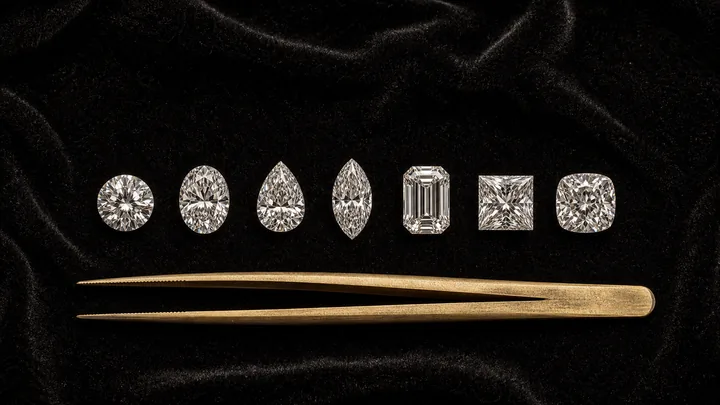
There are ten diamond shapes that account for almost everything sold. The round brilliant is one of them. The other nine are called fancy shapes, which simply means not round: oval, princess, cushion, emerald, pear, marquise, radiant, asscher and heart. Below those sit shapes you will mostly meet as side stones or in antique jewellery, chiefly the baguette, the trillion and old cuts such as the old European and the old mine.
Now the part that decides whether you buy well, and that most shape guides skip entirely.
Shape and cut are not the same thing. Shape is the outline. Cut is how well the stone was made: the angles, the proportions, the polish, the symmetry, everything that decides whether light comes back out of the top or leaks away through the bottom. The trade uses the word cut for both, which is where the confusion starts. Shape is a taste decision with no right answer. Cut is a quality decision with a very clear one, and it is worth more to how a diamond looks than colour and clarity put together.
Here is the consequence. GIA issues an overall cut grade for one shape only: the round brilliant. Ask for a report on an oval, a pear, an emerald cut or a princess and you get colour, clarity, carat, measurements, polish and symmetry, and no cut grade at all. On every fancy shape, the single most important quality of the stone is the one line the certificate does not print. You either learn to read the proportions yourself, or you are trusting a stranger about the thing that matters most.
That gap is the honest reason people overpay for fancy shapes, and this page is built around closing it.
Which also answers where to buy a fancy shape, a question that missing line of paper makes sharper than usual.
- Go to a manufacturer, cutting house or dealer. On a shape the laboratory declines to grade, you want somebody who will lay three candidates on a tray under one lamp and let you compare them, not sell you the one already in the window.
- It costs less there. A retailer buys its stones at that same level and then applies keystone, roughly doubling the price, about three times at a branded name, while the steps inside the trade run 3 to 5 percent a hop.
- They make it, and they keep it going. The mount is built around the stone you actually chose, and the resizing, re-tipping, repairs and insurance valuations afterwards are bench work. Most cutting houses, manufacturers and dealers run a bench or work with one, and that is where a retail counter sends the same jobs.
Go to a showroom instead if the ring has a date on it, if seeing a dozen finished shapes on a real hand and walking out with one is how the outline gets chosen, or if the name on the box is part of what is wanted.
The three faceting families, which matter more than the outline
Before the individual shapes, learn the grouping. It explains more about how a diamond behaves than its silhouette does.
Brilliant cuts are faceted with dozens of small triangular and kite-shaped facets arranged to bounce light back at you. Round, oval, pear, marquise, radiant, cushion and heart are all brilliant cuts. They sparkle, they scatter, and that busy light hides small inclusions and slight tints well.
Step cuts are faceted in long parallel rows running down to the culet, like steps. Emerald, asscher and baguette are step cuts. They do not scatter light, they flash it in broad planes and give you a clear view straight into the stone. That is the architectural, glassy, Art Deco look, and it comes with a cost: an open table hides nothing, so inclusions and body colour that would vanish in a brilliant cut are plainly visible.
Mixed cuts borrow from both, most commonly a brilliant-faceted crown over a step-cut pavilion. The princess is the best known.
Once you know the family, a lot of buying advice writes itself. A step cut needs cleaner clarity to look right. A brilliant cut is more forgiving on clarity and colour but far more variable in how well it is made.
Shape is not cut, and only one shape gets graded
The round brilliant is not the most popular shape because it is prettiest. It is the most popular shape because it is the only one where a laboratory will tell you whether the stone was made properly.
A round brilliant is cut to a well-understood set of proportions, so GIA can grade it against a standard and print Excellent, Very Good, Good, Fair or Poor on the report. That grade does an enormous amount of work for a buyer. It means two round brilliant certificates are genuinely comparable. Our round brilliant guide covers what to demand once you have that grade to lean on.
For fancy shapes there is no single agreed formula for a good stone, and so no grade. There is no ideal oval, only ovals people like. That is a defensible position for a laboratory and a difficult one for a buyer, because the variation between a superb fancy shape and a lifeless one is far wider than the variation between an Excellent and a Very Good round. The report goes silent exactly where the spread is widest.
GIA has said it will begin issuing cut grades for fancy shapes from 2027, starting with the marquise, oval and pear. Treat that as a future improvement rather than a solution. It will not retrospectively grade the stones already sitting in South African safes and display cases, and the step cuts sit further back in the queue. Anyone buying a fancy shape now is still doing the grading themselves.
What to read when there is no cut grade
This is the practical payoff. A fancy-shape report is not blank. It carries several lines that tell you a great deal if you know what to do with them. Use them to compare candidate stones against each other, not against an absolute pass mark, because no published pass mark exists.
- The measurements line. Length, width and depth in millimetres. Divide length by width and you have the length-to-width ratio, which decides the entire character of the stone. Each of the shape guides on this site gives the ratio range most buyers prefer for that shape, and they differ sharply.
- Depth percentage. This is where hidden weight shows up. A stone carrying a lot of its weight below the girdle hits the carat figure on the scale while facing up small. On most fancy shapes a depth much above about 70 percent is worth questioning, because you are paying for a belly nobody will ever see. The size guide sets out how weight and face-up spread come apart.
- Table percentage. Read it alongside depth rather than on its own. A very large table on a brilliant cut tends towards a flat, glassy look; a very small one towards darkness at the centre.
- Girdle thickness. This is the line almost nobody reads and the one that predicts breakage. An extremely thin girdle on a shape with a point or a corner, which means pear, marquise, princess, heart, emerald or asscher, is a chip risk sitting in plain sight on a document that supposedly says nothing about cut. It says plenty.
- Polish and symmetry. Graded on every shape, fancy included. They are not a substitute for a cut grade, but poor symmetry on a shape that has to mirror itself down an axis, such as a pear or a heart, is visible to the naked eye and is a reason to move on.
- The clarity plot. Where the inclusions sit matters more than the grade letter, and on step cuts it matters most of all.
Then do the thing no report can do. Tilt the stone in ordinary daylight, not under a display case spotlight, and look for two faults: a bow-tie, meaning a dark band fixed across the centre that does not move as the stone moves, and a window, meaning a patch you can see straight through to whatever is behind it. Both are cutting faults. Neither appears anywhere on a certificate. Both are obvious once you know to look, and both are why a fancy shape should be seen before it is paid for. The GIA report guide walks through verifying the document itself, and the glossary defines the terms above.
Diamond shapes compared
Prices in the second column are the discount ranges commonly quoted in the trade against a round brilliant at matched colour, clarity and carat weight. They are a market convention that moves with demand, not a figure measured in our own data, so treat them as orientation for negotiation rather than a quote.
| Shape | Price vs a round at matched spec | Everyday wear | What specifically goes wrong | Check this first |
|---|---|---|---|---|
| Round brilliant | The reference. Dearest per carat | Excellent. No point or corner | Very little, but Excellent covers everything from superb to ordinary | The cut grade, then whether it beats another Excellent in daylight |
| Oval | Roughly 10 to 25 percent less. The narrowest discount of the fancy shapes because demand is high | Excellent. No weak point | A bow-tie across the waist, and shallow stones cut wide to look big and read flat | The bow-tie on a moving stone, then the length-to-width ratio |
| Princess | Roughly 10 to 40 percent less. Often the lowest of the common shapes | Poor without protection. Four sharp ninety-degree corners | Corners chip or cleave on a knock, and a chip usually means a recut and lost weight | The girdle thickness at the corners, and that the setting has V-tips or a bezel |
| Cushion | Roughly 20 to 35 percent less | Excellent. Soft rounded corners take knocks well | The crushed-ice look: a mass of tiny facets that glitters but goes watery, and conveniently masks tint and inclusions | Whether it is chunky or crushed-ice, decided before you shop |
| Emerald | Roughly 20 to 35 percent less | Good. Corners are cropped but still the weak point | The open step-cut table shows every inclusion and any body colour, and a badly proportioned one windows straight through | The clarity plot for anything under the centre of the table |
| Pear | Roughly 15 to 30 percent less | Fair. One exposed point | A bow-tie, plus asymmetry down the long axis. A shoulder bulging on one side is common and obvious once seen | That the point is covered by the setting, and that both sides mirror |
| Marquise | Roughly 20 to 35 percent less | Fair. Two exposed points | The heaviest bow-tie risk of any shape, because the long thin body leaks light at the centre | The bow-tie under a moving light. Reject a fixed black band |
| Radiant | Roughly 20 to 35 percent less | Good. Cropped corners | Cut deep to hold weight, so it faces up smaller than its carat suggests | The depth percentage against the millimetre spread |
| Asscher | Roughly 20 to 35 percent less | Good. Cropped corners | Same as the emerald cut, worse. A square step cut with a small table shows inclusions and darkens easily | Clarity, then whether the concentric squares stay crisp as it tilts |
| Heart | Roughly 15 to 30 percent less | Poor. A point plus a cleft | Asymmetry between the two lobes, and the shape becomes hard to read below about 0.75 carat | Symmetry between the lobes, and that the cleft is well defined |
Baguettes and trillions belong in a separate category. They are accent stones, cut to flank a centre diamond rather than to be one, and they are priced and judged as a matched set rather than individually.
Why fancy shapes cost less, and why that is a real saving
The discount is not a marketing device and it is not a quality signal. It is physics at the cutting wheel.
Rough diamond crystals commonly form as octahedra, two square pyramids joined base to base. Turning that crystal into a round brilliant means grinding away the corners and cutting a circle out of a square, and the cutter loses roughly 60 percent of the weight to dust. You pay for every one of those lost carats, because the polished stone has to carry the cost of the rough it came from.
A shape that follows the crystal more closely wastes less. A princess cut is close to the natural outline of the rough, and trade figures commonly put its yield at around twice that of a round. Emerald cuts, radiants and the elongated brilliants sit in between. Less waste per finished carat means a lower price per finished carat, and that is passed on.
So the saving is genuine. It comes from the cutting floor, not from a lower-quality stone, and at matched colour, clarity and weight you really are paying less for the same goods in a different outline. On top of that, the elongated shapes hand you a second saving: they face up larger than a round of the same weight, so you can drop a little carat weight, hold your colour and clarity, and still read as a bigger stone.
Two honest qualifications. First, the discount narrows when a shape is fashionable. Oval demand has been strong for years and the oval discount is now the thinnest of the fancy shapes. Second, and more important, cheaper per carat is not the same as cheaper for what you see. A round at Excellent cut has a floor under its light performance. A fancy shape has none, so part of that discount is compensation for risk you now carry yourself. Spend some of the saving on a better make rather than on more weight, and you come out ahead.
Where the discount stops being a bargain
The trap is comparing a low headline against a high one and calling the difference a saving. It usually is not the same stone.
The relevant number is what is actually in the case. In June 2026 I listed 230 GIA-certified natural diamonds offered by six South African sellers and split them by where the stone was physically held. Of the stones reachable through trade access, 52 percent were D to G in colour with VS2 clarity or better. Of the stock held in South African retail, 9 percent were. That is a comparison of inventory composition and not of price, and it says nothing about what either route charges. What it does say is that the pool most buyers shop in is overwhelmingly lower specification, by a factor of about five, so a cheap ticket is far more often a downgraded stone than a discounted one.
That lands harder on some shapes than others. A step cut needs cleaner clarity to look right at all, and it is being asked to shop in the part of the market where roughly one stone in eleven meets premium specification. A crushed-ice cushion has the opposite problem: it hides a tint and a feather so well that a downgraded stone still photographs beautifully.
The gap between a trade-level price and a counter price is published convention rather than anything I uncovered. Retail runs on keystone, meaning the counter price is roughly double what the stone cost the counter, and a branded showroom goes to about three times, while margins between one trade level and the next are commonly 3 to 5 percent. The doubling pays for rent, stock, staff and insurance, not for anything that happened to the diamond.
Making the decision
Work in this order and the choice gets much smaller.
- Pick the family first. Do you want sparkle or clarity of form? Brilliant cut or step cut. This single question eliminates most of the list and it is pure taste.
- Rule out on wear. If the ring will be on a hand that works, cooks and gardens every day, a point or a sharp corner is a standing liability. Round, oval and cushion have none. Everything else needs a setting decision made before the ring is built, not after.
- Decide how much certainty you want on paper. If you want a laboratory to tell you the stone was made properly, there is exactly one answer and it is the round brilliant. If you are willing to do that work yourself, the fancy shapes are where the value is.
- Set the length-to-width ratio before you shop. For elongated shapes this decides which stones are even worth viewing, and it halves the search.
- Then price it, on one fixed specification across every seller you approach.
Do not skip step five, and do not let anyone hold the specification loose while quoting. Fix the shape, the carat, the colour, the clarity and the report, and only then compare rands.
The price question, which is the one worth searching
Once the shape is chosen, everything else is a price conversation, and this is where most buyers ask the wrong question of a search engine.
Searching for a diamond dealer, or a diamond wholesaler in Johannesburg, is close to useless here. Those terms carry almost no South African search volume and the results do not contain the kind of seller who will put a fancy shape on a tray and let you read its bow-tie. Ask the question you actually want answered instead. Search 1 carat diamond price, or diamond price per carat South Africa, and see who answers with a figure in rands. A seller who publishes a per-carat number has agreed to be measured on it, and on a shape where the report withholds the cut grade you want everything else about the transaction to be measurable.
For the numbers themselves, the South African diamond price index sets out the studies and the method, and what a diamond costs in South Africa breaks down where the money goes between the stone and the counter. In short: a loose one carat at G colour and VS1 clarity works out at roughly R72,000 to R92,000 including VAT, taking 10 to 30 percent off the Rapaport round list of 20 March 2026, which puts that grade at $5,400 per carat, converting at 16.50 rand to the dollar and adding 15 percent VAT. A one carat ring in a premium South African showroom ran R105,000 to R428,000 in a July 2026 study of 73 rows, 71 of them priced, across 18 sellers, 17 of whom are South African. Do not read those two figures as the same object. The showroom number is a finished ring with a setting inside it, the loose number is a bare stone, and the showroom band rests on three listings of three different specifications, so it says what a counter charges for “a one carat ring” rather than what one specification costs three times over. What the width of each band is really showing you is specification doing the work, and the distance between them is mostly the retail step rather than the diamond.
What this page does not know
It does not know what any specific stone in front of you is worth, and no page can. The discount figures in the table are trade convention rather than measurement, and they move with fashion. The one carat rand band above is an estimate built on a published list plus an assumed 10 to 30 percent discount off it, and it covers round brilliants only, because that is the list on file. Do not carry it across to a fancy shape without the corresponding list. The 52 percent against 9 percent split describes what six sellers listed on one day in June 2026 and is a statement about inventory, not about price. Nothing here tells you whether a particular oval has a bow-tie, because that fact exists only in the stone. Get the report, read the six lines above, then look at the diamond in daylight.
See also
- Round brilliant engagement rings. The only shape with a cut grade, and what to demand once you have one
- Oval engagement rings. Bow-tie, ratio, and the thinnest discount of the fancy shapes
- Princess cut engagement rings. The corner problem and the setting that solves it
- Cushion cut engagement rings. Chunky against crushed-ice, decided before you shop
- Emerald cut engagement rings. Why the clarity floor is higher on a step cut
- Pear shaped diamond rings. Symmetry, the point, and the order to judge them in
- Marquise diamond rings. The largest face-up spread, and the heaviest bow-tie risk
- Diamond size guide. Why carat weight is not size, in millimetres