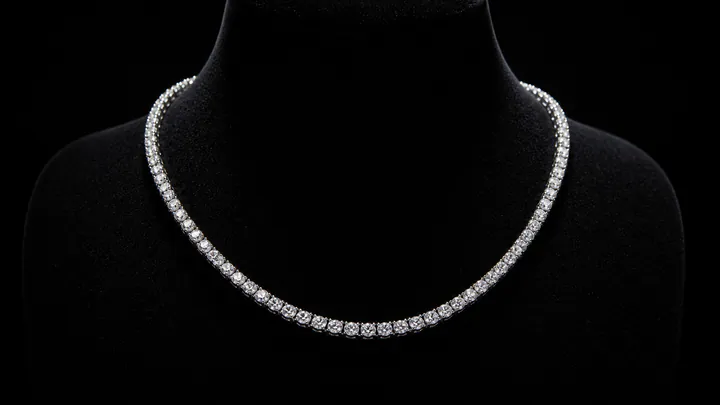
Short answer: write the spec down, then have the line built by a manufacturer, cutting house or dealer who will show you the finished necklace in daylight.
- A hundred stones that agree is bench work. None of them will ever carry a certificate, so the only test worth anything is the assembled line in front of your own eyes.
- Cheaper. A retail counter buys its stones at exactly that level and then roughly doubles the price, about three times in a branded showroom, on what is usually the largest single piece of jewellery anybody buys.
- Better. The specification most buyers want is about five times more common at that level: 52 percent of trade-access stock against 9 percent of retail-held stock, counted on certified stones rather than on melee.
- They do the rest too. Setting, the clasp and safety latch, a graduated centre stone, shortening the line, repairs, insurance valuations and buy-back, usually on their own bench. A retail counter mostly sends that work out to a bench like theirs.
Go to a showroom instead only if the necklace has to be in a box by a fixed date, if you want 16 inch and 18 inch held against your own neck first, or if you want the brand and the box.
On price, a reference point rather than a made-up band. The published round list on file prices single round brilliants, and its lowest bracket is 0.30 carat, where one G/VS1 stone comes to roughly R5,000 to R6,500 including VAT and an H/VS2 to R4,500 to R5,500: the list for that bracket less 10 to 30 percent, converted at R16.50 to the dollar, plus 15 percent VAT. Per carat that is about R17,000 to R22,000, against R71,500 to R92,000 a carat for the same G/VS1 grade at a full carat. Melee in a tennis line sits below even the 0.30 carat rung, so use that rate as a ceiling on what the diamonds in your line should cost per carat, not as the rate itself, and remember it buys a bare stone with no gold, no bench labour and no clasp attached to it.
Best diamond tennis necklaces South Africa: matching is the whole game
How do you tell a genuinely good diamond tennis necklace from one that just photographs well? On a tennis necklace you are not buying diamonds, you are buying the agreement between them, and that is where most of the necklaces shoppers chase quietly fall apart. A tennis line lays flat against the throat in one continuous row, and your eye reads the whole strand as a single object. One stone half a colour grade warmer, or one with an inclusion you can see, and that spot reads as a shadow sitting right under the chin where every photograph and every dinner guest looks. I have watched buyers fall in love with a necklace from across a room and then go cold the moment they spot the one stone that does not belong. That is the real test when you shop for the best diamond tennis necklaces South Africa has, and it is the part that is almost impossible to verify from a listing.
So before you compare a single price, understand what you are actually paying for: 60 to 100 small stones colour-matched and clarity-matched into one line, set so each one is secure, on a clasp that will not let the whole thing go. Get the matching right and the rest is arithmetic. Get it wrong and no carat weight saves it.
What a tennis necklace costs, and what I can honestly tell you
Tennis necklaces are priced on total carat weight, the sum of every stone in the line, not on any single stone. The measured work behind this site sits somewhere else entirely, and you should know that before weighing anything I say about price here.
In July 2026 I recorded what 73 listed rows were priced at, 71 of them carrying a figure, spread across 18 sellers of which 17 are South African. At one carat, finished rings in premium showrooms ran R105,000 to R428,000, a band resting on three listings of three different specifications with the setting included in every one. Set against that, the published Rapaport round list of 20 March 2026 puts a loose one carat G/VS1 at about R82,000 including VAT once you take 20 percent off list, convert at R16.50 and add 15 percent VAT, inside a range of roughly R72,000 to R92,000. Those two are not like for like, since one is a bare stone and the other is a ring, and I am not going to present them as though they were. The method behind the July work, and behind the June inventory study, is set out in the South African diamond price index. Every row in it was a single certified diamond or a finished ring. A tennis necklace is 60 to 100 pieces of melee, most far too small ever to have been graded alone, plus a considerable amount of gold and a great deal of bench labour.
So there is no 5 carat necklace band on this page, because the list stops before melee does. What the list does give you is the bottom rung and the shape of the curve, and both are useful. At 0.30 carat, the smallest bracket on file, a single round brilliant works out to roughly R5,000 to R6,500 including VAT in G/VS1, R5,000 to R6,000 in H/VS1 and R4,000 to R5,000 in I/SI1, on the same arithmetic used everywhere on this site: list for that bracket, less 10 to 30 percent, at R16.50 to the dollar, plus 15 percent VAT. Read those per carat and the rate has already fallen to about a quarter of what the same grade fetches at one carat. Your melee sits below that again, so 0.30 carat is the ceiling on the diamond line in your quote rather than the answer to it, and the answer itself has to come out of the quote by method.
The method is straightforward. Ask for the total carat weight, the stone count, the colour and clarity band, and the per-carat rate at the actual stone size used. Multiply the rate by the total carat weight and you have the diamond line on its own. Whatever is left in the total is gold and bench labour, and both should be itemised rather than folded in. A quote that will not separate those three is not a price, it is a number.
What does transfer is the mechanism, because it applies to any finished piece however many stones are in it. The convention is called keystone: a counter price at roughly double the trade cost, a branded showroom at roughly three times it. Move from one trade level to the next and the margin is slight, usually 3 to 5 percent. On a necklace, where the total is large and the components are many, that last doubling is the biggest single line in the quote and by far the easiest to lose sight of.
Which is why you demand the price broken into three parts, the diamonds, the metal and the setting labour, with the per-carat rate stated at the actual stone size in the line. Then check that VAT is in the number. A sticker that quietly leaves out VAT, or leaves out import cost on stones shipped in from abroad, is not cheaper. It is incompletely priced.
The thing a certificate cannot cover on a necklace
Here is the most useful way I know to think about this piece, and it is specific to a tennis line.
On a solitaire, one GIA report describes essentially all of the diamond value you are buying. Coverage is total. You verify the number at the laboratory’s own site and you know the graded stone is the stone. On a graduated tennis necklace built around a certified half-carat centre, that one report might describe a tenth of the diamond in the piece. On an ungraduated hundred-stone line, it describes none of it at all. Documentation covers less of a tennis necklace than of almost anything else in a jeweller’s window, and the price does not drop to match.
That leaves you with exactly two things. The seller’s written description of the band, and your own eyes on the finished line.
On the first, the nearest thing to a signal I have is inventory quality. In June 2026 I worked through 230 GIA-certified natural diamonds, all listed with full specification, at six South African sellers. Where sellers had trade access, 52 percent of the stones hit a premium specification, defined as D to G colour with VS2 clarity or better. Where the stock sat physically in South African retail, 9 percent did. Those were certified stones, not melee, and I am not going to stretch the figure over melee it never measured. What it does show is what a seller buys to when the grades are printed and anyone can check them, which is a fair thing to weigh when judging what they will accept in a parcel where nobody can.
On the second there is no substitute at all. Much of the online market pulls the line from a far larger external catalogue once you order, which on a hundred stones is close to unavoidable and is not the flaw. The flaw is that the line is then matched by grade on a screen rather than by eye on a bench, so you commit before anyone has established whether these particular stones agree with each other. On a single solitaire that is a manageable risk. On a hundred-stone necklace, where the entire value rests on agreement, it is a gamble with the one thing you are actually paying for.
Spec drives price far more than carat alone
This is the lesson buyers most often miss, and it shows plainly even with the carat number held completely still. In the July sample, one carat finished rings in premium showrooms ran from R105,000 to R428,000, across three listings of three different specifications, each with its setting included. Not one rand of that spread is carat weight. Colour, clarity, quality of make and margin account for all of it.
On a tennis necklace that maths compounds across every stone. A line matched tightly in a G to H, VS band costs meaningfully more than a line scattered across F to J at the same total weight, and it should, because the tight band is what makes the necklace read as one clean line of light. When you compare two quotes at “5 carats total”, you are not comparing like for like unless the colour band, the clarity band and the stone count all match. Get those three on paper before you let anyone tell you their necklace is the better deal.
Length, chain and clasp: the practical decisions
Decide length before you price the diamonds. A 16 inch line sits at the base of the throat and is the South African daily default. An 18 inch line drops about 2cm lower and reads more formal. Length changes the bill because a longer line at the same total weight needs more, smaller stones, or the same count at a higher total weight. Either way you are buying more diamond, so settle length first, then price the carat total weight.
The clasp is where I get firm. A necklace carries more leverage than a bracelet and a drop loses far more stones, so insist on a box clasp with a figure-of-8 safety latch, and a secondary catch on any high-value line. Some cheaper pieces skip the safety latch to shave a little off the hardware cost. On a necklace this is the one corner you never let anyone cut. Ask to open and close the clasp yourself in the showroom; it should click positively and the safety should be fiddly enough that it will not release on its own.
If the necklace is graduated around a larger centre stone, treat that centre stone like a solitaire in its own right. At roughly half a carat or more it should carry its own GIA report you can verify by number, and the surrounding stones should be matched in colour and clarity to it.
How I would actually shop for one
Write your spec first: length, total carat weight, the colour and clarity band you want matched, the metal and the clasp type. Take that exact spec to two or three sellers so you are comparing the same necklace, not three different ones dressed up to look comparable. For honest market context, branded showrooms will quote you the finished-piece premium end; use those quotes to calibrate what polished retail asks, then push the harder questions about matching and provenance those displays rarely answer.
For every quote, ask three things. Were these stones matched as one line, or assembled from whatever was loose in the tray. Can I see the actual necklace before I pay, or is it sourced and shipped in. Does the price include VAT and the setting labour, broken out. If a seller is vague on any of those, the quote is not really comparable, and on a piece costing this much, vague is expensive.
The honest summary: the best diamond tennis necklaces South Africa has to offer are not the ones with the lowest sticker, they are the ones where a hundred stones genuinely agree and you got to watch them do it. So whether anyone will show you the finished line before you pay is the single most important question on a piece this size, and it outranks every other question on this page.
Finding sellers who will is where most buyers stall, and the obvious searches are the wrong ones. Diamond dealer and diamond wholesalers Johannesburg are near-dead terms in this country, thin on results and barely used by anybody. Price searches are what turn up sellers operating at trade level, because a per-carat number on a public page is something only a seller willing to be measured will publish. Begin with diamond price per carat South Africa or 1 carat diamond price, then take your written spec, length, total carat weight, colour and clarity band, metal and clasp, to whoever answers you with figures rather than a form.