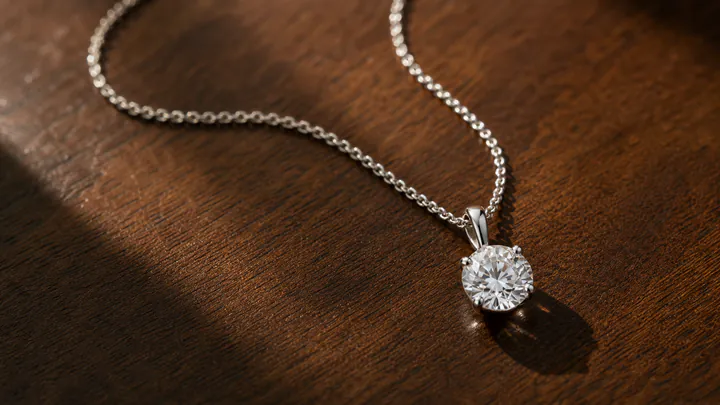
Short answer: choose the stone on its GIA report, then have a manufacturer, cutting house or dealer hang it for you.
- Cheaper. A retail counter buys its stones at exactly that level and then roughly doubles the price, about three times in a branded showroom. Same stone, one step earlier.
- Better. A pendant hangs alone at throat height in daylight, the least forgiving position in jewellery, and the specification that survives it is about five times more common at that level: 52 percent of trade-access stock against 9 percent of retail-held stock.
- They do the rest too. The bail, the chain, the setting, bespoke work, re-tipping, insurance valuations, repairs and buy-back, usually on their own bench. A retail counter mostly sends that work out to a bench like theirs.
Go to a showroom instead only if the pendant is a gift for a date that will not move, if you want three chain lengths held against the wearer’s own collarbone first, or if you want the brand and the box.
Best diamond pendants South Africa: the centre stone decides everything
The honest answer about the best diamond pendants in South Africa is that quality starts with the stone, not the design. A pendant is the simplest diamond purchase there is and the easiest to get quietly wrong. It is one visible stone on a chain, so almost the entire value sits in that single centre stone, and there is nothing else on the piece to distract the eye from a soft one.
Which makes the more useful question not what a pendant costs, but what is likely to be in the case at all. In June 2026 I worked through 230 GIA-certified natural diamonds listed with full specification by six South African sellers, sorted by where the stone was physically held. Sellers working with trade access cleared a premium specification, D to G colour with VS2 clarity or better, on 52 percent of their stones. Stock held in South African retail cleared it on 9 percent. Same country, same laboratory’s grades, roughly a five-fold difference in the odds.
For a pendant that gap bites harder than it sounds. A middling stone in a ring is surrounded by metal, a hand and eventually a wedding band. A middling stone on a chain hangs alone at throat height in daylight, which is the least forgiving position in all of jewellery. My diamond buying checklist sets out how to work out which of those two piles a given stone came from before you pay for it.
Read the centre stone first. The chain comes second.
What you actually pay in 2026
There are two figures on this page worth anchoring to, both at one carat, and they are different kinds of number.
| One carat, including VAT | Figure | What it actually is |
|---|---|---|
| Loose G/VS1 round, list less 20 percent | about R82,000, and R72,000 to R92,000 across a 10 to 30 percent discount | arithmetic on the published Rapaport round list of 20 March 2026 at $5,400 a carat, converted at R16.50 with 15 percent VAT. A bare stone |
| Finished ring, premium South African showroom, July 2026 | R105,000 to R428,000 | three listings of three different specifications, from a 1.0ct I/VS2 oval to a 1.04ct G/VVS2. Rings with their settings included |
The showroom figures are published as a band across sellers rather than as individual stones with individual prices, and that is deliberate. A band describes a market. One stone with one price describes one business, and that is not something this site publishes.
Two things follow for a pendant buyer. The first is that the spread inside a single carat weight is enormous, which means a pendant marketed as a 1ct diamond tells you almost nothing until you have read the colour, clarity and cut grade off a GIA report. Spec drives the price far harder than carat does. Note also that the showroom band is a ring including its setting and the loose figure is not, so do not subtract one from the other and call the difference margin.
The second is that most pendants are not one carat. The common tier is 0.25ct to 0.50ct, and the rate per carat falls steeply as stones get smaller, so a half-carat pendant costs a fraction of the one carat figure rather than half of it.
What I do not have is anything at half a carat. The list bracket I hold starts at 1.00 carat, and halving a one carat number would produce a figure that looks researched and is not. So use the one carat figure as a ceiling and a sanity check, then get the per-carat rate at your actual stone size from the seller in writing, with the setting and chain quoted as separate lines. If a natural half-carat pendant comes in far under whatever that arithmetic implies, something has been given up: lower colour, lower clarity, a weaker cut, or a chain that will not last.
Why the chain and the bail are where shortcuts hide
The sparkle lives in the stone, but the failures live in the metal, and neither failure shows up in a product photo.
The bail is the small loop the chain runs through. On a cheap pendant it is thin, soft and open, and over a couple of years of being pulled over a jersey it wears through and the stone is lost. A properly made bail is closed, thick enough to resist wear, and soldered, not just bent shut. Ask to see it from the side.
The chain is the other quiet downgrade. A beautiful half-carat stone on a hollow economy chain is a bad purchase, because the chain snaps long before the stone has earned its keep. For a solitaire in the common 0.25ct to 0.50ct range, an 18ct white gold cable or box chain with a real lobster or spring-ring clasp is the floor; above about 1.50ct, a platinum bail and chain carry the weight more safely. Length is taste: 18 inches sits at collarbone level, 16 higher, 20 to mid-chest for layering.
Solitaire, halo, or a matched pair
Most SA pendant buying is one of three shapes, and each changes what you scrutinise.
A solitaire is the cleanest: one centre stone doing all the work, so the band above applies to it more directly than to anything else on this page, and the GIA report is the whole story.
A halo rings the centre with small melee and makes it look bigger, so a 1.00ct centre can read like 1.30ct to 1.50ct, often cheaper than buying up to a true 1.50ct stone. The catch is that the halo stones must match the centre in colour, or the surround looks grey against a white centre and cheapens the piece.
A matched pair, or a pendant cut to sit alongside studs, is its own discipline. If you are building a set with diamond stud earrings or a wider diamond earrings purchase, the pendant centre should match the studs in colour and cut so the set reads as one, not as three diamonds that happened to meet. That same parcel-matching logic is why a diamond tennis bracelet is graded as a group, not a single stone.
How to read an online pendant price before you pay
Here is the part the polished product grids do not tell you. With most online pendants the seller is listing from a catalogue rather than a safe, and the stone is ordered in once you have paid. Listing from a catalogue is ordinary and it is how a good centre stone gets found. The catch is that you never see the actual diamond before committing, nobody here checks it against its report, and the sticker frequently leaves out VAT and import cost. On specification those catalogue sellers read well, and honestly so, because trade-access supply is exactly where the 52 percent premium-spec figure in my June sample came from, against 9 percent for stock held in local retail. But specification is not the same thing as make. My premium definition covers colour and clarity and says nothing whatever about how the stone was cut, and on a pendant the diamond hangs alone at eye level in daylight, which is where a soft make announces itself first.
That is not automatically wrong, but it changes how you read the price. Before you pay for any online pendant, ask three things. Is the price ex-VAT or including VAT? Is there a GIA report number you can verify yourself before paying? And do you see the actual centre stone, or a stand-in photograph of a similar one? If it is a stand-in, you are buying sight-unseen.
A pendant is less forgiving on that last point than a ring is. The stone hangs clear of the hand and the metal at throat height, with daylight reaching it from behind as often as from the front, and that back-lit angle is exactly the one a product photograph is composed to avoid. So judge pendant sellers on what they will let you look at rather than on the name above the door, and let the diamond buying checklist carry the rest of the conversation. The two additions worth making for a pendant are these. Ask for video of this specific stone turning in ordinary light rather than a library image of the model. Then ask to see it hanging, on the chain, at the length you intend to wear, before anything is soldered. A seller who has the diamond can do both without much fuss, and will usually quote the stone, the setting and the chain on separate lines while they are at it. A seller who has only a listing will want to talk about the design instead.
Finding sellers worth putting on that list is a problem in itself, and the usual advice fails at it. Searching for a diamond dealer, or for diamond wholesalers in Johannesburg, turns up almost nothing you can act on here. The searches that surface sellers working at trade level are the price ones, because anyone comfortable at that level publishes a per-carat number rather than an enquiry form. Start at diamond price per carat South Africa or 1 carat diamond price, then ask whoever puts real figures on a page what their rate is at 0.50ct, which is the size most pendants are actually built around.
A word on lab-grown pendants
A factory-grown pendant at the same visual specification is far cheaper, and if that is what you want, buy it knowing what it is. Lab-grown prices have fallen very steeply and are still falling, with published estimates of the decline running from about 70 to 96 percent depending on the base year and the size measured. The secondhand side is thin rather than non-existent: published estimates put resale at somewhere between 10 and 40 percent, on estimates that disagree sharply with each other, of purchase price, and some jewellers will not buy one back at all. For a piece meant to be worn for years or handed on, that is the part to weigh rather than the sticker. A pendant is usually bought to mark something, and I would rather the stone kept an upgrade path, which is why buyers asking me about pendants get steered towards natural stone. Bought for what it is on the day, a lab-grown pendant is a reasonable purchase. Bought as something to hold, it is not.
Sources and references
This article cites the following authoritative sources. Each was verified at the publication date shown.
- GIA (Gemological Institute of America) for diamond grading standards and Report Check verification: gia.edu and gia.edu/report-check
- De Beers Group for the Sightholder programme and DBCM Beneficiation Customer transparency disclosures: debeersgroup.com
- Diamond Dealers Club of South Africa for trade member listings and member-good-standing: diamonds.org.za
- Jewellery Council of South Africa for jeweller member directory: jewellery.org.za
- South African Diamonds and Precious Metals Regulator (SADPMR) for SA regulatory framework and supplier registration: sadpmr.co.za
- Kimberley Process Certification Scheme for international rough-diamond compliance: kimberleyprocess.com
- Responsible Jewellery Council (RJC) for chain-of-custody standards: responsiblejewellery.com
- Rapaport and Rapaport Store for industry pricing benchmarks: rapaport.com, store.rapaport.com
- South African Diamonds Act 56 of 1986, as amended by the Diamonds Amendment Act 29 of 2005 and the Diamonds Second Amendment Act 30 of 2005 (in force 1 July 2007) for SA cutting-industry regulatory framework: gov.za
- South African Advertising Regulatory Board (ARB) code of conduct: arb.org.za
Pricing bands were built from published listings across multiple sellers and trade-press references current as of the publication date, and are reported as bands rather than as individual stones. Specific quotes for specific stones must come from the supplier directly. Editorial opinion described in this article reflects the research conducted at the publication date and may be updated as new information becomes available.
For our complete editorial methodology, conflict-of-interest disclosure, and corrections process, see the editorial policy.