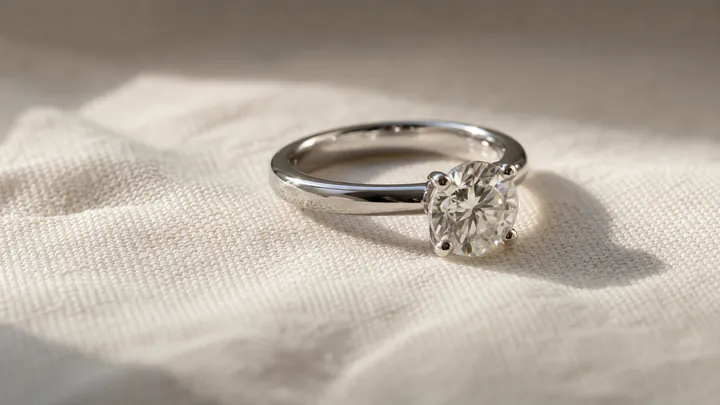
The cushion answer, before anything else
Short answer: decide chunky or crushed-ice first, then buy the stone from a manufacturer, cutting house or dealer who will tilt it under a light while you watch.
- One step earlier costs less. A retailer buys its cushions at exactly that level and then applies keystone, roughly doubling the price, with branded showrooms at about three times. Inside the trade the steps are 3 to 5 percent a hop.
- Somebody there has actually looked at it. GIA awards no cut grade to fancy shapes, so on a cushion the certificate ranks nothing and a trained eye is the only protection you have. The stock is stronger too: premium specification ran 52 percent at trade access against 9 percent of retail-held stock.
- The mount and the years afterwards sit at that level too. The setting gets made around the cushion you picked rather than the stone being dropped into a mount that already existed, and the resizing, re-tipping, repairs and insurance valuations that follow are bench jobs. Most dealers and manufacturers run a bench or work with one, and it is where a counter sends the same work.
The showroom wins if the ring is needed by a date that cannot move, if seeing ten finished cushion rings on a hand in one afternoon and leaving with one is how you want to buy, or if the brand matters to whoever will wear it.
On price, the anchor to work from is the round list, because fancy shapes price off their own. At one carat the published list less 10 to 30 percent, at R16.50 to the dollar with 15 percent VAT, gives a loose round of roughly R71,500 to R92,000 in G/VS1, R60,000 to R77,000 in H/VS1 and R41,000 to R53,000 in I/SI1. A cushion at matched grades normally sits a little under a round, so use those as orientation, hold a cushion quote against them, and price the stone apart from the setting.
Cushion cut engagement rings in South Africa start with one question: chunky or crushed-ice
Two cushion cuts can share the same carat weight, colour and clarity on paper and look like different stones in your hand. The reason is the faceting style, and it is the first thing I check before anything else. A chunky cushion has a small number of large facets and throws broad, lazy flashes of light. A crushed-ice cushion has dozens of tiny facets that scatter light into a glittery, almost watery shimmer. Neither is wrong. But crushed-ice is where buyers in South Africa get caught, because that busy sparkle can mask a stone that is slightly tinted or carrying inclusions you would otherwise see. So when you search for cushion cut engagement rings South Africa, your real job is not to compare certificates. It is to decide which look you love, then judge the actual stone against it.
Why the certificate will not rank your cushion for you
Here is the thing most retail counters will not volunteer. GIA does not give fancy shapes an overall cut grade. A round brilliant gets a clean Excellent-to-Poor cut grade that does a lot of the thinking for you. A cushion gets polish, symmetry and measurements, and that is all. There is no grade on the report that says this cushion sparkles well and that one is dull. That gap is precisely why cushion cut engagement rings reward inspection more than almost any other shape. You cannot outsource the judgement to a piece of paper. You have to see the stone move.
Two practical tests. First, ask for a daylight video, taken near a window, not under the warm halogen spotlights that make every stone in a shop look alive. Second, watch for the bow-tie effect: a faint dark band across the centre of the stone, most common in longer cushions, caused by the diamond shadowing your own line of sight. A slight bow-tie is normal. A heavy dark zone that does not move as the stone tilts is a stone to walk away from. None of that survives a stone you have only seen in a render, so my advice on a cushion is to confirm the GIA report number and then handle that exact stone rather than trust a promise made at a distance. The diamond buying checklist sets out how to insist on it: the report number first, then the stone itself, moving, in front of you, before any money changes hands.
Ratio decides whether it reads square or elongated
Length-to-width ratio is the lever that changes the entire character of the ring. A ratio around 1.00 to 1.05 reads as a classic, cushiony square. Push toward 1.10 to 1.20 and it elongates, which can flatter a slender finger and make the stone look a touch larger for its weight. If you like the more rectangular look, you are partway between this shape and an oval, and it is worth viewing both before you commit. Cushions sit softer and rounder at the corners than a princess cut, which is the other square contender, and those rounded corners are also more forgiving to wear: princess corners are sharp and can chip, while a cushion’s gentle corners take daily knocks far better.
What a cushion actually costs here, with real numbers
Pricing for cushion cut engagement rings in South Africa is wide, and on this shape it is wider than the certificate can account for. In July 2026 I recorded 73 listed rows, 71 of them carrying a price, across 18 sellers of which 17 are South African, from premium showrooms through mall chains to online sellers. At one carat, finished rings in premium showrooms ran from R105,000 as far as R428,000, and that band rests on three listings of three different specifications, each of them a ring including its setting rather than a bare stone. For the loose side the benchmark is the round list, and you can redo the working: the published Rapaport round list of 20 March 2026, taken at 10 to 30 percent off, converted at R16.50 to the dollar with 15 percent VAT added, puts a one carat round at roughly R71,500 to R92,000 in G/VS1, R60,000 to R77,000 in H/VS1 and R41,000 to R53,000 in I/SI1. Note what that implies here: GIA awards a cut grade only to rounds, fancy shapes price off a separate list, and a cushion is neither a round nor a graded make. A cushion at matched colour, clarity and weight usually sits a little below a round, so read that figure as orientation and not as a cushion price, and do not subtract it from the showroom band, because one is a stone and the other is a ring. Our South African diamond price index sets out how those listings were collected.
Most of that gap is the counter rather than the stone. Retail convention is keystone, meaning roughly double the trade cost, and a branded showroom goes to roughly three times, while the steps between one trade level and the next are commonly 3 to 5 percent. On a cushion there is then a second spread stacked on top of that one, because with no cut grade on the report, two stones matching on colour, clarity and weight can be priced well apart on make alone, and neither price is necessarily wrong.
A blunt warning on cheap headlines. Listing 230 GIA-certified natural stones offered by six South African sellers in June 2026, only 9 percent of the 137 stones held in South African retail stock were D to G in colour and VS2 or better in clarity, against 52 percent of the 93 stones reachable through trade access. That is a measure of what is in the case, not of what it costs, and it is why a low sticker so often turns out to be a lower colour and clarity dressed up as a bargain. On a cushion that matters twice over, because a crushed-ice faceting pattern is unusually good at hiding the exact things a downgraded stone carries: a faint tint, and inclusions you would spot immediately in a chunky cushion.
One practical note on finding sellers who will talk in numbers at all. Searching for a diamond dealer or a diamond wholesaler barely returns anything useful in South Africa. Search the price question instead, 1 carat diamond price or diamond price per carat South Africa, and see who answers with a per-carat figure. On a shape where the report deliberately ranks nothing, a seller willing to publish a number is a seller you can hold to a like-for-like comparison.
Ordering it in is fine. Nobody looking at it is not
When a cushion is ordered in on demand it is pulled from a far larger catalogue, and that part is not the problem. On this shape it is arguably a help, because crushed-ice and chunky cushions vary so widely that a broad search finds the look you actually want far better than a tray of four ever will. The risk sits one step later. A cushion’s sparkle is not on the report, the faceting style is the entire decision, and if the stone travels from a listing to a courier without anyone tilting it under a light, the only thing that matters on this shape is the one thing nobody checked. So ask who is going to look at it, and whether you can look at it yourself before you pay.
Because the report deliberately declines to rank this shape, the usual paper comparison between two sellers collapses, and the diamond buying checklist is what you use in its place. Run it on process. Who has looked at this cushion, and when. Will you be shown it tilting under daylight before the money leaves your account. Does the loose stone carry its own price, apart from the setting, so you can hold it against another cushion rather than against another ring. Is VAT already inside that figure. And what is written down if the bow-tie nobody showed you turns out to sit right across the middle. Two sellers answering that honestly separate themselves within a few minutes, and you never once need to know what either of them is called.
A short pre-buy checklist
- Decide chunky or crushed-ice before you shop, and judge stones against that choice.
- Get the GIA report number and confirm natural origin in writing.
- Ask for a daylight video and watch for a fixed bow-tie.
- Confirm the length-to-width ratio matches the look you want.
- Get the loose-stone price and the setting price separately, and confirm VAT is included.
- See the stone in person before paying, especially with crushed-ice.
None of this requires you to buy from any particular place. It does require you to treat the stone, not the certificate, as the thing being judged. If you are still weighing shapes, our guides to oval and princess cut engagement rings sit alongside this one, and the best engagement rings in South Africa overview ties the shapes together.