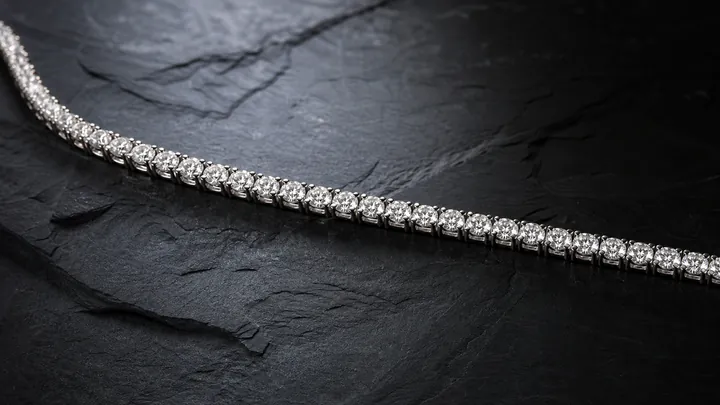
Short answer: have the line built by a manufacturer, cutting house or dealer, and look at the finished bracelet in daylight before you pay.
- Evenness is the entire product, and only a bench delivers it. Thirty to sixty stones that no laboratory ever graded one by one, so your own eye down the line is the only instrument that can test them.
- Cheaper. A retail counter buys its stones at exactly that level and then roughly doubles the price, about three times in a branded showroom, and forty stones give that one step a great deal of room to hide in.
- Better. The specification most buyers want is about five times more common at that level: 52 percent of trade-access stock against 9 percent of retail-held stock, counted on certified stones rather than on melee.
- They do the rest too. Setting, the clasp and its safety catch, shortening the line, repairs, insurance valuations and buy-back, usually on their own bench. A retail counter mostly sends that work out to a bench like theirs.
Go to a showroom instead only if the bracelet is for a fixed date, if you want several finished widths and lengths on your own wrist first, or if you want the brand and the box.
On price, a ceiling and a method rather than a made-up band. The published round list prices single stones, and its lowest bracket is 0.30 carat, where one round brilliant comes to roughly R5,000 to R6,500 including VAT in G/VS1 and R4,000 to R5,000 in I/SI1: the list for that bracket less 10 to 30 percent, at R16.50 to the dollar, plus 15 percent VAT. That is about R17,000 to R22,000 a carat, against R71,500 to R92,000 a carat for the same grade at a full carat. Bracelet melee is smaller again and therefore cheaper per carat again, so treat the 0.30 carat rate as the ceiling on the diamond line in your quote, then get the actual figure out by method: rate at the true stone size, times the total carat weight, with metal and bench labour itemised separately.
Why the line, not the carat weight, is the product
A tennis bracelet lives or dies on one thing, and it is not the carat figure on the receipt. It is whether thirty or more small stones, set in one continuous line and worn flat on the wrist, actually match each other. I have watched a customer turn a line under a shop window and pick out, in a second, the single stone that sat a touch warmer than the rest. Every stone graded the same band on paper. Worn together, that one stone broke the whole bracelet. That is the real craft in a good diamond tennis bracelet, and it is a completely different problem from buying one stone for a ring.
What separates the best diamond tennis bracelets South Africa offers
When people ask me for the best diamond tennis bracelets South Africa sells in 2026, I steer the conversation onto three things: how evenly the line is matched, what the actual stone count and grade band are, and how secure the clasp is. Get those right and the bracelet looks superb for decades. Get them wrong and a big total carat weight still reads as cheap on the wrist. Since the evenness of the line is the whole game, the question that matters most is whether you get to see the finished bracelet, in daylight, before you pay for it. My diamond buying checklist sets out how to establish that in advance, so you are confirming the match with your own eyes rather than trusting a grade band typed against stones that are still somewhere else.
Matching a line is harder than matching a pair
Diamond studs ask you to match two stones. A tennis bracelet asks you to match the whole row, often thirty to sixty of them, and the line sits in one plane under one light, so any odd stone is obvious. Two studs sit on opposite ears and the eye forgives small differences. A line does not. A single stone a shade warmer, or with an inclusion in a visible position, or cut a touch shallow so it throws a duller flash, interrupts the run of light right where you look.
This is why where the stones come from matters more than the brochure suggests. A matched line is only as even as the parcel it was assembled from, and much of the online market ships that parcel in from a far larger external catalogue only after you commit. That is fine for a single certified stone you pick off a list, but it is the wrong model for a matched line, because you are trusting that someone, somewhere, sorted it well. When a line is cut and matched in one workshop, stone by stone before setting, the evenness is built in instead. Ordered-in versus matched-on-the-bench is the distinction to keep in mind.
What you actually pay, and why
This is the page on the site with the least direct evidence behind it, and glossing over that would be the easiest way to mislead you.
My June 2026 work went through 230 GIA-certified natural diamonds listed with full specification by six South African sellers. My July 2026 work covered 73 listed rows, 71 of them priced, across 18 sellers of which 17 are South African. Both looked at single, certified, individually listed stones and finished rings. A tennis bracelet is not that. It is thirty to sixty pieces of melee that no laboratory ever graded one by one, sold as a parcel on the maker’s description of the band.
So neither piece of work prices your bracelet, and dividing a solitaire figure by forty would not be research, it would be a solitaire figure with a decimal point moved.
What the published list does give you is the bottom rung of the curve, and that is worth having. At 0.30 carat, the smallest bracket on file, one loose round brilliant works out to roughly R5,000 to R6,500 including VAT in G/VS1, R4,500 to R5,500 in H/VS2 and R4,000 to R5,000 in I/SI1, on the same arithmetic used everywhere on this site: the list for that bracket, less 10 to 30 percent, at R16.50 to the dollar, plus 15 percent VAT. Convert those to a per-carat rate and it is about R17,000 to R22,000 a carat, roughly a quarter of what the same grade fetches per carat at one carat. Your line sits below that rung, so the number is a ceiling on the diamonds in your quote, not the price of them.
That ceiling is genuinely useful. If a quote implies a per-carat rate on the melee that sits at or above the 0.30 carat rate, either the stones are much larger than you were told or something other than diamond is being charged for inside the diamond line.
Beyond that, the two studies give you two useful things at one remove.
The first is about the seller rather than the stone. Among sellers working with trade access, 52 percent of their certified stock met a premium specification, which I defined as D to G colour together with VS2 clarity or better. The same count against stock physically held in South African retail came to 9 percent. That is a measurement of certified goods, not of melee, and that distinction is exactly why I will not stretch the figure over a parcel it never measured. What it does tell you is the standard a seller buys to when the grades are printed and checkable, and it is fair to draw an inference from that about what they accept in a parcel when nobody can check.
The second is about the counter. Keystone is the trade’s own rule of thumb: roughly double the trade cost at a counter, roughly triple at a branded showroom. Each step inside the trade itself adds little, typically 3 to 5 percent. That applies to a bracelet exactly as it applies to a ring, and a piece carrying forty stones offers a great deal of room for the difference to hide.
So the honest guidance on price is a ceiling plus four numbers to demand before you compare anything: total carat weight, stone count, the colour and clarity band, and the per-carat rate at the actual stone size in the line. A 3 carat line of thirty larger stones is a different and dearer product from a 3 carat line of sixty small ones, because larger matched stones are harder to source and harder to set. Two quotes that agree on total carat weight and diverge on everything else are not comparable and should not be compared. If you want the method behind both studies, our South African diamond price index sets out how each was built and, just as importantly, what each one does not cover.
The clasp is the part nobody photographs
A tennis bracelet hangs loose and takes knocks all day, on desks, car doors, handbag straps. The clasp is the single point of failure, and it is the part the marketing never shows. I want a box clasp with a figure-of-eight safety catch, a secondary latch that holds the bracelet on the wrist even if the main clasp springs open. Without that catch, one knock can put the whole line on the floor, or lose it entirely. On a piece this valuable, confirm the clasp type and safety catch in writing before you pay, and be wary of any line where the hardware was clearly where the maker saved money. After that, a well-made line is serviced like a ring: a yearly check of the clasp, the safety catch, and the prongs keeps stones from working loose, and that path is far easier when one workshop made the bracelet and stands behind it.
Where the budget options quietly cut corners
This is the piece where a downgrade hides best, because there is no report to catch it.
On a single ring, a soft colour or a weak clarity is written on a certificate you can verify at the laboratory’s own website in about a minute. On a tennis line, most of the stones are far too small ever to have been graded individually. You are buying a band, described by the seller, across dozens of stones. A whole line of slightly warm, slightly included, loosely matched melee is precisely what makes a bracelet look flat across a room, and nothing in the paperwork will warn you about it.
The June inventory work is the nearest thing to a warning signal that exists. A seller whose certified, checkable stock runs at 9 percent premium specification is showing you what they buy when the grades are visible. It is reasonable to wonder what they accept in a parcel when the grades are not.
Ordering the line in is not the problem, incidentally. On forty matched stones it is close to unavoidable, and a wide catalogue is genuinely the better place to find stones that agree with each other. The problem is that nobody lays the line out afterwards, and you never see it before paying. And at the far end of the market a branded showroom is applying roughly two to three times the trade cost to that same line, which pays for real things, rent, stock, staff, insurance and a brand, but does not buy you a better match.
My honest steer for South African buyers
For a piece whose entire quality lives in the evenness of the line, the thing worth more than any sticker saving is seeing the actual stones together, in daylight, before they are set or before the money moves. Everything else on this page is secondary to that. Ask for it directly, and treat a refusal as the answer to your question.
Finding sellers who will say yes is the practical obstacle, and the standard search advice sends people nowhere. In South Africa the trade terms, diamond dealer and diamond wholesalers Johannesburg, return almost nothing and are barely used by anybody. What surfaces sellers working at trade level is the price question, because publishing a per-carat rate is something only a seller willing to be compared will do. Try 1 carat diamond price or diamond price per carat South Africa, then ask the ones publishing real figures for their rate at the melee size in your line. Most will not have that on the page. The ones who can produce it on request are the ones worth an appointment.
Then run the diamond buying checklist over the line itself: ask whether the stones are physically held, get the colour and clarity band in writing, get the stones and the setting priced as separate lines, confirm VAT and return terms, and get at least two like-for-like quotes before paying.
Lab-grown lines, and where the value breaks
A lab-grown tennis line looks identical across a room and costs a fraction of the natural equivalent, which for a bracelet is a genuinely tempting trade. On a piece carrying forty or more stones, the saving is the largest of any category on this site. No rand figure for lab-grown appears here, and the reason is specific to a line. There is no published lab-grown list to work from as there is for natural, and a per-carat rate multiplies by forty on a bracelet, so a stale number on this page would not be slightly wrong at the bottom of a quote. It would be badly wrong. What you can price is the natural side, using the 0.30 carat ceiling above, and then ask the seller to quote the same line in both materials on the same day.
The break is on the other side of the transaction. A wholesale index published in the trade press is down as much as 96 percent, and by roughly 70 percent on measures that start from a later year, and while the rate of decline has slowed it has not turned, so a line bought today competes against a cheaper identical line every year it exists. Published resale estimates for lab-grown run from 20 percent of the original invoice up to about 40 percent, a poor recovery rather than a nil one.
What is genuinely worse on a bracelet is the route rather than the percentage. A natural melee line has a floor under it because forty small stones are ordinary trade goods that can be broken out and moved on as a parcel. Lab-grown melee has no equivalent parcel market to fall back into, the resale market is thin, and some jewellers will not handle the stones at all. So the realistic position on a lab-grown line is not a low offer. It is often no offer at all, and selling it as a piece of jewellery to a private buyer instead.
That is not an argument against buying it. It is an argument for knowing which purchase you are making. If the bracelet is being worn and never sold, lab-grown buys you far more sparkle per rand and the resale point is irrelevant. If you are thinking of it as something that keeps a value, it is the wrong category and no amount of matching or finish changes that.