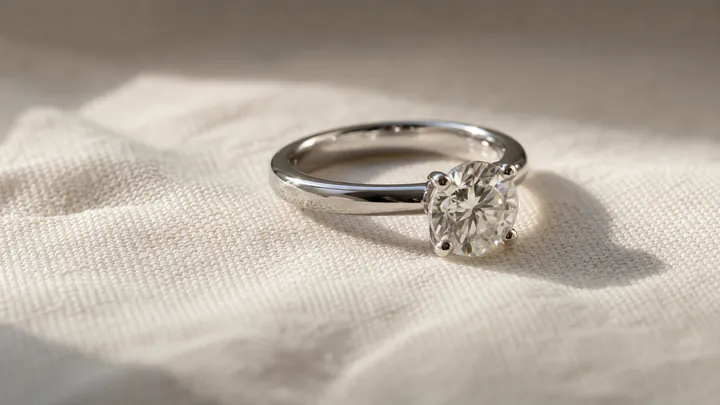
Bottom line up front
Short answer: buy the princess from a manufacturer, a cutting house or a dealer, and buy one you have turned in daylight yourself.
- There is no cut grade to hide behind. GIA gives a princess no overall cut grade, and it is not in the first wave of fancy shapes due to get one in 2027. The judgement that decides whether it flashes or sits dark has to come from your own eyes and from whoever ground it, which is an argument for standing closer to the person who ground it.
- Cheaper. A retail counter buys from that same trade level and then roughly doubles the price, about three times at a branded showroom, so you pay more for a stone one fewer person has judged.
- Better. Premium specification is about five times more common one step up the chain, 52 percent of trade-access stock against 9 percent of retail-held stock.
- They set it too, and that matters on this shape. Four sharp corners are the most fragile feature you can put on a diamond, so the mount has to protect them. A bench that has the stone in front of it can build the corner protection around that particular stone instead of dropping it into a mount that already existed, and the same bench does the corner repairs, resizing and insurance valuations later. A counter without a workshop sends that work out to a bench like theirs.
A counter is the right call when the date is a few weeks away and fixed, when you want a dozen finished rings on a real hand, or when the brand matters to you. Go in asking for the daylight video and the millimetre measurements anyway.
Most people assume those crisp square corners mean a princess cut is graded just as tightly as a round, and that the GIA report will tell them whether the cut is any good. It will not, and that single assumption is the trap most princess cut engagement rings South Africa buyers walk into: as of 2026 GIA does not give a princess cut an overall cut grade. On a round brilliant report you get an Excellent-to-Poor cut score that does most of the quality work for you. On a princess, that line simply is not there. The lab grades the colour, the clarity and the polish and symmetry, but the thing that decides whether the stone is lively or lifeless, the cut, is left for you to judge with your own eyes. That changes how you have to buy. You cannot shop a princess off a spec sheet the way you can a round.
Why the cut grade is missing, and what to do about it
A princess cut, properly called a square modified brilliant, is one of the most popular diamond shapes after the round, though the oval has overtaken it in recent years, and for good reason. It keeps the sparkle of a brilliant cut but in a clean, modern square. The catch is that there is no single agreed formula for a perfect princess the way there is for a round, so GIA declines to grade the overall cut. Two princess cuts with identical carat, colour and clarity on paper can look completely different in the hand. One throws light, the other looks glassy and dark in the centre.
So you replace the missing grade with your own inspection. Ask for a video shot in daylight or under a normal bulb, not under the blue-white lights of a display case which flatter every stone. Watch for even sparkle across the whole face, not a dead patch in the middle. Check the exact millimetre measurements and the depth percentage, a princess that is too deep hides weight underneath where you cannot see it, so you pay for carats that do not show. With the cut grade absent from the report, the safest substitute is buying from someone who grinds the cut themselves and will answer for how it performs, rather than a seller passing along a stone they have never handled. That is why I push princess buyers towards sellers who keep stock in the building, where you can turn the actual stone in daylight and watch its centre come alive before paying. The diamond buying checklist covers how to establish that on the phone before you drive anywhere. This is the same discipline I cover for fancy shapes on the marquise diamond ring and pear shaped diamond ring pages, because none of those shapes gets a GIA cut grade today either, though marquise and pear are both due one in 2027.
The corner problem nobody mentions in the showroom
A princess gets its fire from four crisp 90-degree corners, and those corners are the most fragile feature you can put on a diamond. Diamond is the hardest natural material, but hardness is not toughness. A sharp corner caught on a door frame, a car door or a kitchen counter can chip, and a bad knock can cleave the corner clean off. I have seen it on real rings brought in for repair, and a chipped corner is not a polish job, it usually means recutting and weight loss.
The fix is the setting, and on a princess it is not negotiable. You want V-tip prongs, little metal claws shaped like a V that wrap and cover each of the four corners. A bezel or a half-bezel works too. What you do not want is a setting that leaves the corners exposed to look daintier. If a jeweller offers you a princess with bare corners, that is a maker prioritising the photo over the marriage. A protective setting is also why so many princess buyers choose a halo, which tucks the corners inside a ring of small diamonds. There is more on that on the halo engagement rings page.
What a princess cut really costs in South Africa
Price tracks the four Cs far more than it tracks the shape, so anchor yourself on the one carat market and adjust from there. Start with arithmetic rather than a claim. Rapaport’s round list of 20 March 2026 prices G colour, VS1 clarity in the 1.00 to 1.49 carat bracket at $5,400 per carat, that list is an asking price the trade sells beneath, and taking 10 to 30 percent off it, converting at R16.50 to the dollar and adding 15 percent VAT, a loose one carat round G VS1 works out at roughly R72,000 to R92,000, with about R82,000 in the middle at 20 percent off list. Every input there is public, so redo it when the list or the rate moves.
Then the shop end, which is a different object. In July 2026 I priced 73 one carat listings across 18 sellers, 17 of them South African, from premium showrooms through mall chains to online sellers, and 71 of those rows carried a price. Finished one carat rings at premium showrooms ran R105,000 to R428,000. That band includes the setting, and it rests on three listings of three different specifications rather than one stone priced three ways, so treat it as the span of what a showroom charges for “a one carat ring” and not as a like-for-like gap against a loose stone. The lesson underneath both is blunt: spec drives price far more than carat alone, and a princess is no exception.
A princess does carry one quiet advantage. Because the square shape follows the natural octahedral rough more closely, less of the crystal is lost in cutting than for a round, so princess cuts often come in a little cheaper per carat. You get a touch more diamond for your rand, with the corner fragility as the trade-off.
The harder thing to navigate is who is actually selling you the stone, and on a princess it decides more than it would on a round. In June 2026 we listed 230 GIA-certified natural diamonds across six South African sellers and sorted them by where the stone was physically held. Trade access met a premium standard, D to G colour with VS2 clarity or better, on 52 percent of its stones. The stock sitting in South African retail met the same standard 9 percent of the time. That is a comparison of what is stocked and not a price comparison, but it tells you what you are walking into: the cheap square in a display case is usually a lower colour and a lower clarity stone rather than a bargain version of the one you had in mind.
Why the counter costs what it does is published trade convention, not something we uncovered. Keystone is the retail rule, meaning the counter price is roughly double what the stone cost the counter, and a branded showroom runs to about three times. Between one level of the trade and the next, margins are thin, commonly 3 to 5 percent. The doubling lands at the point the stone crosses from the trade onto a retail floor, and it pays for rent, stock, staff and insurance rather than for anything that happened to the diamond.
Then there is the question of whether the stone even exists yet. A seller who sources on demand pulls the princess out of a far larger external feed only once you have committed, so you pay before it is in front of you. On a shape GIA does not currently give a cut grade, that is the one thing I would not accept, because your own eye is the only substitute for the missing grade and you cannot use it on a stone that has not arrived. You can see the full method on the diamond price index for South Africa.
For context on what is sitting next to it in the same cabinet, a lab-grown princess costs a small fraction of a natural one. Published wholesale tracking puts the lab-grown price fall at somewhere between 70 and 96 percent depending on the base year chosen and the size measured, and it has kept drifting down even as the pace of the fall slowed. Resale is thin rather than absent: published estimates put it at somewhere between 10 and 40 percent, on estimates that disagree sharply with each other, of what was paid, and some large retail groups will not take a lab-grown stone in on trade at all. Treat it as a different product bought for what it is on the day, not as a cheaper version of the natural stone.
Where I would buy a princess cut
Start with the price question rather than with a search for a dealer or a wholesaler. Those searches barely happen in South Africa and the results do not contain the kind of seller a princess buyer needs. Search what you actually want to know instead: 1 carat diamond price, or diamond price per carat South Africa. A seller who publishes a per-carat figure in rands is a seller who has agreed to be measured, and on a shape where the report withholds the cut grade you want everything else about the transaction to be measurable.
Then judge them on what they will put in writing rather than on the shopfront. The diamond buying checklist runs the full sequence, and the princess version of it is short enough to hold in your head. Ask for the daylight video and a close-up of all four corners before you ask the price, because on a shape with no cut grade a seller who cannot produce those has nothing to show you. Ask whether the V-tips are quoted inside the setting or added on afterwards. Ask for the report number in advance so you verify it yourself instead of reading it off somebody’s screen. Ask for the stone and the mount as two figures on the same VAT basis. Two sellers put through that and you have compared them properly, without once having had to decide which of them sounds more reputable.
None of that leads you to the cheapest number, and it should not. The cheaper princess is usually either a lower colour and clarity stone or a stone you never see before paying, often on a sticker that quietly leaves out VAT and import. What you are buying is a stone you can put your own eye on, not the lowest figure on a page. If a princess is not quite your shape, the cushion cut gives you a softer square with rounded, far less fragile corners, and the round brilliant gives you back the GIA cut grade if certainty on paper matters most to you.
A short checklist before you pay
Ask for the GIA report number and verify it yourself on GIA Report Check. Get the exact millimetre measurements and the length-to-width ratio, aim for 1.00 to 1.05 for a true square. Insist on a daylight video and a clear close-up of all four corners. Confirm the setting protects every corner with V-tips, a bezel or a halo. Get the loose stone price and the setting price separately so you can see what you are actually paying for. And see the real stone, or at minimum a real video of the real stone, never a stock image. On a princess, the page you cannot read is the cut, so the eye has to do that work.