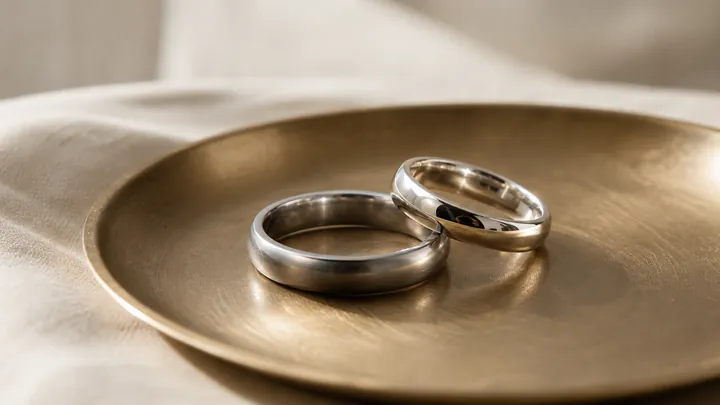
Short answer: settle fit and metal first, then have a manufacturer, cutting house or dealer supply the stones and cut the band to your engagement ring’s contour.
- Fit beats sparkle on a ring you never take off. A comfort-fit profile, a metal hard enough for fifty years of knocks, and a shape that sits flush against the engagement ring.
- Cheaper. A retail counter buys its melee at exactly that level and then roughly doubles the price, about three times in a branded showroom. Same stones, one step earlier.
- Better. The specification most buyers want is about five times more common at that level, 52 percent of trade-access stock against 9 percent of retail-held stock, and a row of small stones that genuinely agree is far easier to assemble from the richer pool.
- They do the rest too. Fabricating the band to your contour, setting, resizing, re-plating, re-tipping, tightening a bead that lets go, insurance valuations, repairs and buy-back, usually on their own bench. A retail counter mostly sends that work out to a bench like theirs.
Go to a showroom instead only if the wedding is in three weeks, if you want twenty finished bands tried against the engagement ring in one afternoon, or if you want the brand and the box.
One ordering note that most showrooms will not lead with. An engagement ring is bought to be looked at; a wedding band is bought to be lived in, and those are different design problems. So settle fit, width and metal before colour and clarity, then ask whoever is supplying the stones the short version of the test: can you put the actual melee in front of me, and will you put a per-carat number in writing. The diamond buying checklist turns that into questions you can ask at the counter.
Get the fit, the metal and the profile right and the ring disappears onto the hand the way it should. Get them wrong and you spend the next decade catching it on jersey sleeves, re-plating it twice a year, or watching it tilt sideways every time you wash your hands.
Comfort fit and width: the decisions nobody mentions
Run your finger along the inside of a band. If it is flat, that is a standard fit. If it is gently domed, that is a comfort fit, and on a ring you never take off it is the single best upgrade you can make. The domed inner edge slides over the knuckle more easily, sits with less of a hard line against the skin, and stops the ring from feeling like a washer by the end of a long day. It uses slightly more metal, so it costs a little more, and on a daily-wear band it is worth every rand.
Width is the next call, and it is personal. For men, 4mm to 6mm covers most hands; go wider for a bold look, but be honest about whether a heavy band suits a slim finger or a job that has your hands in and out of gloves all day. For women, 2mm to 3mm is the usual range, narrow enough to tuck against the engagement ring without crowding it. Try the actual width on before you commit, because a 5mm band feels very different on the hand than it looks in a tray.
Metal: what survives fifty years of daily wear
This is where durability is won or lost, and South African showroom defaults do not always match what wears best.
18ct white gold is the local standard and the most common recommendation you will hear. It is genuinely good metal, but it is rhodium-plated to get that bright white colour, and on a band worn every day the plating wears through at the contact points and needs re-dipping roughly every 12 to 24 months. That is an ongoing cost nobody mentions at the till.
Platinum costs more and for a daily band it earns it. It is denser, it wears by displacing metal rather than shedding it, it holds prongs tighter on a diamond band, and it never needs plating because its white colour is its own. If your budget reaches platinum and the ring will be worn hard, that is my quiet preference for the band that has to last.
18ct yellow and rose gold are excellent for plain bands and need no plating, so the colour is permanent. 9ct is cheaper and harder, which sounds ideal, but the harder alloy is also more brittle and, in my view, a rougher long-term host for small diamonds. For a plain men’s band on a tight budget, 9ct is defensible. For anything holding stones you intend to keep, step up to 18ct or platinum. Whatever you choose, match the colour of the two rings even if you do not match the jeweller.
Matching the band to the engagement ring
The most expensive wedding-ring mistake in South Africa is buying a beautiful band that will not sit flush against the engagement ring. A band can be perfect on its own and still gap, tilt or spin once it is next to the ring it is meant to partner.
The profile of the engagement ring decides everything. A plain solitaire with a low setting takes a simple straight band and the two sit together happily. A halo, a three-stone, or any low-set centre stone usually needs a shaped or notched band that curves around the setting, or the two rings will fight for the same space on your finger. This is why I tell every reader the same thing: take the engagement ring to every single wedding-band appointment. Trying bands against it in person is the only way to see how they actually pair, and ordering a band blind is gambling on geometry.
You do not need to buy both rings from the same place, but there is a real convenience if you do: one jeweller who already holds the engagement ring’s specs can fabricate the band to its contour and keep both on the same record for future resizing.
Men’s bands and women’s bands are different problems
A man’s wedding band is usually a metal decision more than a diamond one: width, finish (polished, brushed or matte), comfort fit and alloy. Most men want something that takes a knock and looks unfussy, which is why plain 4mm to 6mm bands dominate; if a man does want diamonds, keep them flush- or channel-set rather than raised so nothing catches. There is more on profiles and finishes on our men’s wedding rings in South Africa page. A woman’s band more often has to live next to an engagement ring, so fit, profile and diamond-matching dominate, which our wedding rings for women in South Africa and wedding bands in South Africa guides cover in more depth.
Channel, pave or plain
Three settings cover almost every diamond band sold here, and the choice is as much about daily wear as looks.
Plain is exactly that, no stones, just metal. It is the most durable, the easiest to resize, and the easiest to upgrade later: a wider plain band can have diamonds added at a milestone anniversary, while a band under about 4mm rarely has the metal to take secure settings without weakening.
Channel-set sinks a row of small diamonds between two protective metal walls. The stones sit below the surface, nothing snags, and it is the toughest of the diamond options for hands-on daily life, so it is my default for anyone who works with their hands and still wants sparkle.
Pave scatters tiny diamonds held by small beads of metal, raised closer to the surface for maximum brilliance. It is the most dazzling and the most delicate: pave stones come loose most readily over years of wear, so budget for an occasional tightening.
For an eternity or half-eternity band, the look is driven almost entirely by the small natural diamonds and how well they are matched in colour and clarity, not by the metal. A row of mismatched melee is obvious in daylight, so this is the part worth inspecting in person.
What the best wedding rings in South Africa actually cost in 2026
Plain bands are mostly a metal-and-width calculation. A pair of plain bands typically runs from around R8,000 for two slim 9ct or 18ct gold bands up to roughly R30,000 for a pair of solid platinum bands, with white gold and width pushing the number around in between.
Diamond bands are a different exercise, because the price is driven by the diamonds, not the gold, so anchor on real numbers rather than vague ranges. The South African diamond price work on this site covered 73 listed rows, 71 of them carrying a price, across 18 sellers of which 17 are South African, in July 2026. At one carat, finished rings in premium showrooms ran R105,000 to R428,000, a band drawn from three listings of three different specifications and including the setting in each. Against that, the published Rapaport round list of 20 March 2026 prices a G/VS1 at $5,400 a carat, which less 20 percent, at R16.50 to the dollar with 15 percent VAT, is about R82,000 including VAT for a loose one carat, or roughly R72,000 to R92,000 as the discount moves. Those two are not the same product, one being a ring and the other a bare stone, so do not read the distance between them as a saving. A band is not a solitaire either, and a carat spread across many small matched stones prices well below one big stone. The point that does carry across is that the diamonds are the purchase and the metal is the cheap part.
Two diamond-band quotes can differ by tens of thousands of rand for what looks like the same ring, and there are two separate reasons, not one. The first is the mark-up convention, which is published trade practice rather than anything I measured. Retail works on keystone: the counter price is roughly double what the stone cost at trade level, and a branded showroom goes to roughly three times, while the steps between one trade level and the next are commonly 3 to 5 percent. Most of the distance between two quotes is decided by how many counters the stones crossed on the way to you.
The second reason is what is sitting in the tray in the first place, and that one I did measure. Listing 230 GIA-certified natural stones offered by six South African sellers in June 2026, 52 percent of the 93 stones reachable through trade access were D to G in colour and VS2 or better in clarity, against 9 percent of the 137 stones held in South African retail stock. That is a comparison of inventory, not of price, and it is exactly the thing melee hides. A certificate names colour and clarity but not the make, an Excellent cut costs 25 to 30 percent more than a soft one at the same grades, and a row of quietly downgraded stones reads as a bargain on the sticker and as a dull, mismatched line in daylight six months later. It is also worth knowing that the melee on a great deal of what is sold online here is drawn from a global catalogue and couriered in after the sale, unseen until it is already set, which is the wrong way to choose diamonds you will look at every day for fifty years.
As a sense-check, most couples land between R30,000 and R120,000 for both rings together, depending entirely on whether the bride’s band carries diamonds and how much.
A word on lab-grown, since it comes up on every diamond band. They are real diamonds and on the day they look identical. What has changed is the price line under them. The analyst Edahn Golan’s lab-grown wholesale price index is down about 96 percent since he began tracking it in 2018 and fell a further 13 percent year on year into the second quarter of 2026; measured from a later base year, or on smaller stones, the fall is shallower, somewhere from about 70 percent up. Either way it is still going down, and nobody credible is forecasting it back up.
That matters more on a band than on almost anything else, because a full eternity row is a lot of carat weight bought at once. The secondhand side is where I would be most careful: the resale market for lab-grown is thin, some large jewellery chains will not take lab-grown stones on trade-in at all, and published estimates of what a private seller recovers land around a fifth to two fifths of the purchase price rather than anything close to it. So buy a lab-grown band because you want that look at that price today, not because you expect to trade it up on a tenth anniversary. If the budget is tight, a narrower row of well-cut natural stones, or a plain band you upgrade later, is the buy I would make.
How to actually buy, and who to inspect with
Wherever you buy, do three things: try the real width and fit on your own hand, take the engagement ring to the appointment to see the pairing in person, and on any diamond band look at the matched melee under good light before you commit, because mismatched small stones are the most common quiet disappointment.
That last point is where most of the market falls down. For a diamond band, the seller worth shortlisting is one where the melee is already in the safe and a bench on the premises can fabricate the band to your engagement ring’s contour, so you see the actual stones going into your ring before you commit. Finding those sellers is not a matter of searching for a wholesaler, which turns up almost nothing useful here. Search the price question instead, along the lines of 1 carat diamond price or diamond price per carat South Africa. A seller willing to publish a per-carat number in public is usually the same seller willing to lay the melee out on a tray and let you look at it, and a band is a purchase where looking is the whole point. A band is judged on a row rather than on a single stone, so take the diamond buying checklist into the appointment with the melee in mind: is the parcel already in the safe or still to be ordered, who matched it and against what standard, do the stones and the bench work come back as two figures instead of one comfortable total, is VAT inside those figures, and what happens if a bead lets go in year three. Not one of those questions needs you to know a shop name. They sort sellers by what they can put on the tray and what they will put in writing, which on a ring worn every day for fifty years is the only sorting that holds up.
Sources and references
This article cites the following authoritative sources. Each was verified at the publication date shown.
- GIA (Gemological Institute of America) for diamond grading standards and Report Check verification: gia.edu and gia.edu/report-check
- De Beers Group for the Sightholder programme and DBCM Beneficiation Customer transparency disclosures: debeersgroup.com
- the Diamond Dealers Club of South Africa for trade member directory and member-good-standing: diamonds.org.za
- Jewellery Council of South Africa for jeweller member directory: jewellery.org.za
- South African Diamonds and Precious Metals Regulator (SADPMR) for SA regulatory framework and supplier registration: sadpmr.co.za
- Kimberley Process Certification Scheme for international rough-diamond compliance: kimberleyprocess.com
- Responsible Jewellery Council (RJC) for chain-of-custody standards: responsiblejewellery.com
- Rapaport and Rapaport Store for industry pricing benchmarks: rapaport.com, store.rapaport.com
- South African Diamonds Act 56 of 1986, as amended by the Diamonds Amendment Act 29 of 2005 and the Diamonds Second Amendment Act 30 of 2005 (in force 1 July 2007) for SA cutting-industry regulatory framework: gov.za
- South African Advertising Regulatory Board (ARB) code of conduct: arb.org.za
Pricing benchmarks were triangulated across published listings from multiple sellers, none of them named here, together with trade-press references current as of the publication date. Specific quotes for specific stones must come from the supplier directly. Editorial opinion described in this article reflects the research conducted at the publication date and may be updated as new information becomes available.
For our complete editorial methodology, conflict-of-interest disclosure, and corrections process, see the editorial policy.
See also
- Gold diamond wedding rings South Africa
- Engagement Rings South Africa
- Wedding bands South Africa
- Mens wedding rings South Africa
- Wedding rings for women South Africa
- Diamond eternity rings South Africa
- Ring size chart South Africa
- Diamond Tennis Bracelets South Africa
- Best place to buy diamonds in South Africa
- How Wholesale Diamond Pricing Works