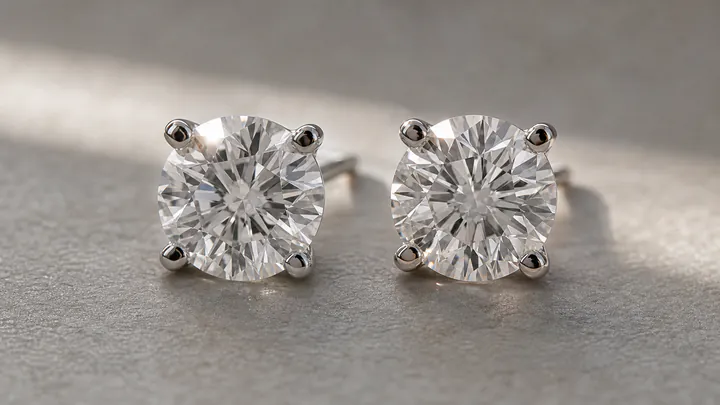
Short answer: buy the pair from a manufacturer, cutting house or dealer, and have both stones laid on one cloth before either is set.
- Matching only happens where the stones are. Two diamonds ticketed with the same letters can still sit visibly apart under one lamp, and that lamp is the whole test.
- Cheaper. A retail counter buys its stones at exactly that level and then roughly doubles the price, about three times in a branded showroom. Same two stones, one step earlier.
- Better odds of a real pair. The specification most buyers want is about five times more common at that level, 52 percent of trade-access stock against 9 percent of retail-held stock, and on earrings you have to draw it twice.
- They do the rest too. Setting, bespoke work, threaded backs, prong checks, re-tipping, insurance valuations, repairs and buy-back, usually on their own bench. A retail counter mostly sends that work out to a bench like theirs.
Go to a showroom instead only if the earrings are for a date that cannot move, if holding a dozen finished pairs against your own face is how you will decide, or if you want the brand and the box.
The best diamond earrings in South Africa are a matched pair, not a single stone
Walk in for the best diamond earrings in South Africa and you will reach for the same grade you would chase on an engagement ring, one stone, the highest letter you can afford. Earrings do not work that way: you are buying two diamonds, not one, and the whole job is getting them to match. I have stood at a bench and watched two stones both ticketed “0.25 ct, G, VS2” sit beside each other and look wrong, one a touch warmer, one with a faint table reflection the other did not have, the kind of difference you only catch with both stones in the same light. On a ring nobody compares one stone to a twin six centimetres away on the other ear. On earrings your buyer does it every time they look in the mirror. So the best diamond earrings in South Africa are not the cheapest pair or even the highest single grade. They are the best matched pair, and matching is a skill you are paying for whether the invoice names it or not. Matching is also something you have to judge with your own eyes, which makes the seller question on earrings narrower than on a ring. It is not only whether the stone is real and graded. It is whether both stones are in the building and can be laid side by side under one light, rather than approved from two catalogue photos of two diamonds that are each still somewhere else. My diamond buying checklist sets out how to establish that before you go anywhere.
Price earrings by total carat weight, then check each stone
The first habit to fix is reading earring prices the way the trade writes them, as total carat weight across both stones, shown as cttw. A “1 carat” pair of studs is two half-carat stones, 0.50 ct each, not two one-carat stones. This matters because two 0.50 ct stones cost far less than one 1.00 ct stone of the same grade, since a single larger crystal is rarer. So a 1.00 cttw pair and a 1.00 ct solitaire are not the same money, and a seller who blurs that line is either careless or hoping you do not notice.
Once you have the total weight, check that the two stones carry the same colour and clarity letter, not letters that are merely close. A G paired with an H reads as one slightly warmer ear under daylight. An eye-clean VS2 paired with an SI1 that has a visible inclusion means one stone twinkles and one sits flat. Ask the seller in writing whether the pair is a true match on colour, clarity and cut, or two separate stones that happen to land near each other. The answer separates a real pair from an assembled one.
What a matched pair actually costs in 2026
I will not give you a fake price grid down to the rand, because the honest truth is that two factors, who holds the stones and how tightly they are matched, move the number more than carat weight does. What I can give you is an anchor whose arithmetic you can repeat, which sits at one carat, and a straight account of how far it stretches towards a pair of studs.
Start with the anchor. The Rapaport round list of 20 March 2026 prices G/VS1 in the 1.00 to 1.49 carat bracket at $5,400 a carat. Take 20 percent off, convert at R16.50 to the dollar, add 15 percent VAT, and a single loose one carat lands at about R82,000 including VAT, with a defensible range of roughly R72,000 to R92,000 as the discount moves between 10 and 30 percent off list. That is a solitaire figure and an estimate rather than a measurement, and on this page it is a ceiling rather than an answer, because the rate per carat falls away sharply below one carat. Two 0.50 ct stones weigh the same as one 1.00 ct stone and cost considerably less than it, since a single larger crystal is much rarer than two smaller ones.
Then the honest stop. I did not price matched half-carat or quarter-carat pairs across this market, and I am not going to halve a solitaire band and present the output as research. What I can give you instead is what to put in the enquiry, which is more useful on earrings anyway:
- Ask for the per-carat rate at the stone size you actually want, 0.25 ct or 0.50 ct, not a rate borrowed from one carat. Small stones sit on a different rung of the ladder, and a seller who quotes one rate across all sizes is not quoting carefully.
- Ask for the two stones priced together as a matched pair, with the setting on a separate line. On studs the mount is a real fraction of the total and it disappears easily inside one bundled figure.
- Ask what the matching itself costs. A pair pulled and agreed at a bench is not the same product as two stones that happen to share a grade letter, and that difference is the thing this whole page is about.
The cheaper headlines deserve a warning, and on earrings the warning applies twice. Nine out of ten stones sitting in South African retail stock are already below a premium specification, so a cheap sticker is normally the ordinary stone rather than the same stone for less. On a pair you need that not to happen on either ear.
The wide online sellers read better on specification, and genuinely are, because a catalogue drawn from global trade supply is exactly where the 52 percent premium figure came from. On a pair that breadth is a real advantage: matching out of a deep catalogue beats matching from whatever happens to be in one drawer. Ordering in is not the flaw. The flaw is that the pair is then matched on paper, and a grade is a band rather than a colour. Two stones can both read G VS1 and still sit visibly apart in the light. Somebody has to hold them next to each other before they are set, and on that arrangement nobody does, including you, until after the money has gone.
Settings, screw-backs and the parts that fail
The diamond is half the earring. The other half holds it to your ear, and on earrings that part fails in ways a ring never does. For everyday studs and any stone of size, specify screw-backs or locking backs rather than friction push-backs. A push-back can ease loose through the day and a stud is the single easiest piece of fine jewellery to lose. When each stone is worth tens of thousands of rand, the few rand of a threaded back is not where you economise. Have the threads and prongs checked once a year, the same way you would a ring worn daily.
For huggies and small hoops the spec question shifts. These are many small stones across a curve, so you are not chasing one certificate, you are checking that the melee is consistent in colour and that the channel or pavé is set tight with no gappy or lifting stones. There is detail specific to that style in the diamond huggie earrings South Africa guide, and on plain studs in the best diamond stud earrings South Africa guide. If you are choosing the metal first, the gold diamond earrings South Africa page covers 9ct versus 18ct and white versus yellow for daily wear.
Where matching actually happens
Matching happens at a bench, with both stones out of their packets, on one cloth, under one light. Everything before that is a grade letter and a hope. So the seller question for earrings is narrower than the one you would ask for a ring: not only do you hold this stone, but can you put both of them in front of me at the same time.
Finding sellers who can answer that is where the usual advice fails people. Searching for a diamond dealer, or for diamond wholesalers in Johannesburg, turns up almost nothing you can act on, and hardly anyone runs those searches anyway. The searches that surface sellers working at trade level are the price ones, because anyone comfortable at that level publishes a per-carat number rather than a contact form. Start with something like diamond price per carat South Africa or 1 carat diamond price, then go to the ones who publish real figures and ask two things: what is your rate at 0.50 ct, and can you lay two of them side by side.
Then run the diamond buying checklist over the pair itself. Confirm both stones are physically held, verify each GIA report number yourself, get the stones and the setting priced as separate lines, confirm VAT and return terms in writing, and get at least two like-for-like quotes before paying.
Lab-grown studs undercut every number on this page, and for a season’s costume pair that is a perfectly fair call. You will not find a rand figure for a lab stone here. A matched pair takes weeks to source and set, the wholesale series those prices come off has been sliding for years with no sign of settling, and a number written into a page today would be out of date before the studs were finished, so get it quoted fresh instead. The shape is the part worth carrying around anyway: published tracking of that wholesale fall lands at about 70 percent on the kinder measures and as much as 96 percent on the longest-running index, the rate of the fall has eased without reversing, and resale is published at a fifth to two fifths of the purchase price, which is to say 10 to 40 percent.
Read against this page specifically, it is not the percentage that should decide you. It is the counter. Studs are the piece people most often trade up, half a carat each becoming three quarters and then a carat, and a trade-up is only worth anything if the counter wants the stones you are handing back. Major retail trade-in and upgrade programmes exclude lab-grown stones outright, and the secondhand market for them is thin, so the upgrade path most stud buyers assume they are keeping open is the exact thing lab-grown closes. For a pair you intend to keep, pass on, or grow into, natural is the version I would put my name to.
How to brief a seller in one message
When you enquire, send this and you will sort the serious sellers from the rest fast. State the total carat weight you want and that you want it matched, ask whether the two stones are from the same source and matched at the bench or sourced separately, ask for the colour and clarity letter on each stone and a GIA report per stone at 0.50 ct each and above, ask whether you can inspect the actual pair before paying, and confirm screw-backs in writing. A seller who answers all five plainly is selling you earrings. A seller who dodges the matching question is selling you two diamonds and hoping they look alike.