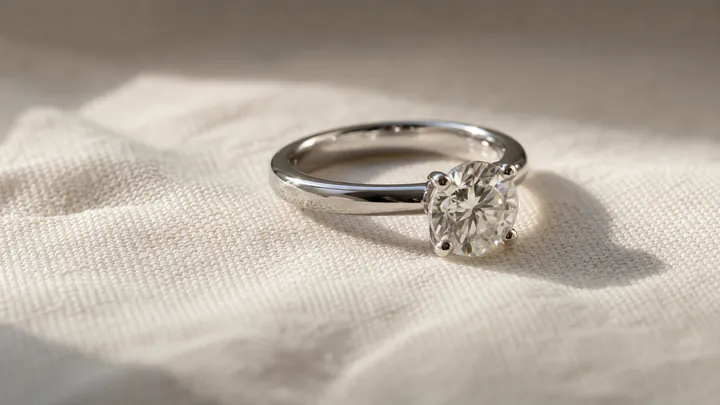
The answer, before the guide
Short answer: buy the centre stone from a manufacturer, cutting house or dealer, then have the ring made around it.
- Cheaper, on the trade’s own convention. A retail counter buys its stones at that level and then applies keystone, roughly doubling the price, with branded showrooms at about three times. Between trade levels the steps are thin, commonly 3 to 5 percent. Buying one step earlier removes the one big doubling.
- A better pool to choose from. What most people actually want, a properly cut stone in the F to H colour band with VS clarity, is about five times more common up the chain: premium specification ran 52 percent of trade-access stock against 9 percent of retail-held stock.
- The ring gets made and looked after there. Setting and bespoke commissions, then the resizing, re-tipping, repairs, insurance valuations and trade-in an engagement ring genuinely needs across decades of daily wear. Most dealers and manufacturers either run a bench or work with one, and that bench is exactly where a retail counter sends the same jobs.
Use a showroom if the proposal is next weekend and nothing can move, if putting a dozen finished rings on the actual hand is how the decision will really be made, or if the brand and the box are part of the gift.
The number to start from, with its working shown so you can redo it: the published Rapaport round list of 20 March 2026 puts a one carat G/VS1 at $5,400 a carat, which at 20 percent off list, R16.50 to the dollar and 15 percent VAT is about R82,000 including VAT for the loose stone, and roughly R72,000 to R92,000 across the usual spread of discounts. Change one grade at a time and the same arithmetic gives you R60,000 to R77,000 in H/VS1, R56,000 to R71,500 in H/VS2, and R41,000 to R53,000 in I/SI1, or R83,500 to R108,000 if you go up to F/VS1. Loose round brilliant, stone only: the setting, the making and the certification are extra. Use a current list and a current exchange rate rather than trusting mine, because the rate moves every figure proportionally.
Why two identical carat numbers cost different money
Two engagement rings can carry exactly the same carat number and sit hundreds of thousands of rand apart. In July 2026 I priced 73 listed rows, 71 of them carrying a figure, at 18 sellers of which 17 are South African, and at one carat, finished rings in premium showrooms ran from R105,000 to R428,000. That band comes off three listings of three different specifications, from a 1.0 ct I/VS2 oval to a 1.04 ct G/VVS2, each of them a ring with its setting included, so it is the range of what a showroom charges for a one carat ring rather than one stone priced three ways. The carat number explains none of the distance between the ends of it. That gap is the single most useful thing to understand before you spend on an engagement ring in South Africa, because almost every buyer fixates on carat size and underweights the things that actually move both price and beauty: the centre stone’s cut, colour and clarity, and the kind of seller standing on the other side of the counter. So if you want the best engagement rings South Africa has to offer rather than the biggest sticker, start with the stone spec, not the band.
Lead with the centre stone, because that is where the money goes
On a typical solitaire, the centre diamond is most of the spend and almost all of the visual result. Get it right and a modest setting looks superb. Get it wrong and no amount of metalwork rescues it. The order I work in with buyers is simple: cut first, then colour and clarity, then carat, then the setting.
Cut is the lever people skip. A diamond graded GIA Excellent for cut, polish and symmetry returns light evenly and looks alive in ordinary light. Drop below that and you start seeing dark patches, a sleepy centre, or a stone that only sparkles under a jeweller’s spotlight. For any ring at or above one carat, treat GIA Excellent as your floor, not your upgrade. A crisply cut 0.90 carat will outshine a dull 1.10 carat every time, and it costs less. The catch is that most natural-diamond sellers online never hold the stone; they ship it in once you have paid, so you commit before you have seen the cut perform. Cut is the one C that no listing can show you and no report fully captures, which makes it the one I would insist on judging in person. Put the actual diamond under a loupe, then under ordinary daylight, and watch it work before a cent changes hands. My diamond buying checklist covers how to arrange that and what to look at once the stone is in front of you.
Then insist on a real GIA report for the actual stone. Ask for the report number, type it into gia.edu/report-check yourself, and confirm the four Cs match the quote. EGL and in-house grading run softer and are not directly comparable, so a stone graded “G colour” by one lab can sit two grades apart from a GIA G. On a serious purchase, GIA is the only certificate I would pay against.
What a one-carat natural actually costs in South Africa
Here are the two anchors, and they are different kinds of number, which matters more than either figure on its own. The showroom side comes from the July 2026 pricing work across 73 listed rows, 71 of them priced, at 18 sellers of which 17 are South African, and is published as a band rather than as individual stones, because a band describes a market while one stone with one price describes one business.
| One carat, including VAT | Figure | What it actually is |
|---|---|---|
| Loose G/VS1 round, list less 20 percent | about R82,000, and R72,000 to R92,000 across a 10 to 30 percent discount | arithmetic on the published Rapaport round list of 20 March 2026 at $5,400 a carat, converted at R16.50 with 15 percent VAT. A bare stone, an estimate rather than a measurement |
| Finished ring, premium South African showroom, July 2026 | R105,000 to R428,000 | three listings of three different specifications, from a 1.0 ct I/VS2 oval to a 1.04 ct G/VVS2. Rings including their settings |
Hold the carat number still and change only the grade, and the same arithmetic prices the rest of the shortlist. Every cell below is a loose one carat round brilliant including VAT, taken at 10 to 30 percent off the 20 March 2026 list for that grade, converted at R16.50 to the dollar.
| One carat loose, incl VAT | D/VS1 | F/VS1 | G/VS1 | G/VS2 | H/VS1 | H/VS2 | I/SI1 |
|---|---|---|---|---|---|---|---|
| List less 30% to less 10% | R101,000 to R130,000 | R83,500 to R108,000 | R71,500 to R92,000 | R62,500 to R80,500 | R60,000 to R77,000 | R56,000 to R71,500 | R41,000 to R53,000 |
Read that row from right to left and the engagement ring argument is in one line. Going from I/SI1 to D/VS1 without touching the carat number multiplies the stone by about two and a half, and nothing about the ring looks any bigger for it. If the shortlist is F to H with VS clarity, which is where I would put most budgets, you are choosing inside a range of about R56,000 to R108,000 for the stone before anyone has quoted you a setting.
Two things about the first table are worth more than an hour of showroom conversation.
The first is the width of the showroom band. Four times the money at a nominal one carat tells you the carat figure on a price tag carries almost no information by itself. Colour, clarity, quality of make and the seller’s margin do all of the work.
The second is what the table does not entitle you to do. You cannot subtract the top row from the bottom row and call the difference your saving, because the bottom row includes a setting, a making charge and a shop floor and the top row is a bare stone. Nobody publishes a like-for-like measurement of the same stone at two levels, mine included. The trade-level argument does not need one: it rests on the keystone mechanism below, which the trade states about itself and which you can apply to any quote you are given.
For most engagement rings, an F to H colour band with VS clarity and a genuine Excellent cut is where the value sits. Money freed up by not chasing D colour or IF clarity is better spent on cut, or on a slightly larger stone inside the same colour band, than on flawless paperwork nobody will ever read.
For the full method behind these bands, see the diamond price index for South Africa, which is built from the same primary data.
The seller types behind the price, and the one thing most sellers will not tell you
Where you buy changes what you get for your money, though not in the way the adverts suggest, and my cleanest evidence is about inventory rather than price.
In June 2026 I went through 230 GIA-certified natural diamonds listed with full specification by six South African sellers, split by where the stone was physically held. Among sellers working with trade access, the premium specification rate was 52 percent, where premium means D to G colour together with VS2 clarity or better. Among stock held in South African retail it was 9 percent.
Read that carefully, because it is a statement about availability and not about price. It does not say retail is expensive. It says that if you walk into a South African display case and point at a stone, roughly nine times in ten it sits below that premium line, and a brightly lit shop is a very effective place not to notice. Often you are not being offered the same diamond for less. You are being offered a lesser diamond.
The wide online sellers sit at the other end of the same finding, because a catalogue drawn from global trade supply is exactly what produced the 52 percent figure. Their specification genuinely is better. What they mostly do not do is hold the stone. They list what they can order, so on an engagement ring you commit and pay before the actual centre stone is ever in the room, and cut, the one C that decides whether a ring looks alive on a hand, is the one thing a listing has never been able to show you.
Then there is the price mechanism, which is published, is not mine, and explains the shape of the bands above. The retail convention is keystone: the counter price is roughly double the trade cost, and a branded showroom runs to roughly three times. Within the trade the steps are small, commonly 3 to 5 percent from one level to the next. So the chain is not marked up evenly along its length. It is several small steps and then one large one, and the large one lands on the final hop, when the stone leaves the trade and reaches a retail counter. That is not a scandal. It pays rent, stock, staff, insurance and a brand, and a showroom does real things for you in return. It is simply worth knowing which side of that hop your quote came from before you decide it is a good price.
So the useful sorting question is not which category of seller is cheapest. It is whether this particular seller can put the actual stone in your hand, and whether they are willing to put a number on it in public. Both are answerable before you leave the house.
Setting and budget, once the stone is settled
Only after the centre stone is locked should you spend energy on the band. In South Africa, 18ct white gold remains the default for engagement rings because it keeps the diamond looking bright, costs less than platinum, and suits solitaire, halo and three-stone designs alike. Platinum runs roughly 30 percent dearer and feels heavier on the hand. Avoid 9ct white gold for a daily-wear engagement ring, as it discolours faster around the prongs where wear is highest.
A sensible budget split for a serious ring is to put the large majority into the centre stone and keep the setting proportionate. If a seller is showing you a finished ring at one all-in price, ask them to quote the loose diamond and the setting separately. That single request stops anyone hiding a weak stone behind an attractive mounting, and it lets you benchmark the diamond on its own merits against the figures above.
If your route is a custom build or you are weighing the big chains, the path differs by city and approach. For Johannesburg custom work where you brief the stone first, see custom engagement rings in Johannesburg. For Cape Town buyers, the local market and what to check is covered in engagement rings in Cape Town. And if your reference points are the national mall chains, treat them as familiarity benchmarks rather than as the natural home for a centre-stone budget: they are easy to visit and easy to compare against, and they sit at the retail-counter end of the pricing chain described above. Already have a ring you want to improve? The trade-in mechanics are in upgrading an engagement ring in Johannesburg.
The short version
Buy the cut before the carat. Demand a GIA report number for the specific stone and verify it yourself. Understand that the cheapest sticker usually means a downgraded diamond, that nine stones in ten sitting in a local display case fall below premium specification, and that most online sellers order the stone in rather than holding it, so you never see what you are buying. On any honest reading of the data, the best engagement rings South Africa offers come from inspecting a real, well-cut, GIA-certified natural stone in person before you pay for it.
One last practical note, because it is where people get stuck. Searching for a diamond dealer, or for diamond wholesalers in Johannesburg, will not find you a seller worth visiting. Those terms are close to empty in this country. Search the price question instead: a seller who publishes a per-carat number on a public page has already told you they are willing to be compared, which is most of what you needed to establish. Start at 1 carat diamond price, or diamond price per carat South Africa, and work from whoever answers with figures rather than a form.