Bottom line up front
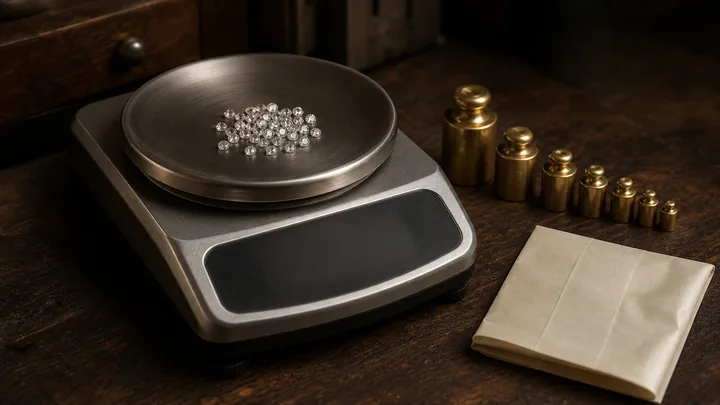
One gram of diamond is exactly five carats. One carat is 0.2 grams, so five of them make a gram.
Priced as five separate certified one carat round brilliants at G colour and VS1 clarity, a gram of diamond works out at roughly R360,000 to R460,000 in loose stones, including VAT.
That figure is built from the published list, not from any per gram rate, and you can rebuild it in a minute. The Rapaport round list of 20 March 2026 puts G/VS1 in the 1.00 to 1.49 carat band at $5,400 per carat. Nobody pays list, so take 10 to 30 percent off, convert at 16.50 rand to the dollar (the live rate on 4 August 2026) and add 15 percent VAT. One such stone comes to roughly R72,000 to R92,000, about R82,000 at 20 percent off list. Five of them make a gram. It is an estimate on published inputs and a stated assumption, and every input moves.
A gram of diamond is not one thing. It can be a single five carat stone, five one carat stones, or a hundred grains of melee. Those three grams weigh the same and are worth very different amounts, even at identical colour, clarity and cut. The concentrated one wins by a wide margin. So the figure above is real and nearly useless at once, and the rest of this page is why.
And if you are here to buy rather than to convert units, the short version:
- Buy at manufacturer, cutting house or dealer level. Diamonds are not bought the way gold is bought, by weight across a counter, and that is the level worth buying at.
- It costs less there. A retailer buys its stones at that same level and then applies keystone, roughly doubling the price, with branded showrooms at about three times, against 3 to 5 percent a hop inside the trade. That single step is the largest anywhere in the chain.
- Better stock, and they do the work as well. Premium specification ran 52 percent of trade-access stock against 9 percent of retail-held. Setting, bespoke work, resizing, repairs, insurance valuations and buy-back are bench jobs, and most dealers and manufacturers either run a bench or work with one. A retail counter mostly sends that work out to a bench like theirs.
A showroom earns its money if the piece is needed by a fixed date, if seeing a tray of finished designs on a hand and leaving with one is how you want to buy, or if the brand and the box are part of what is wanted.
I work in the diamond trade, so weigh what follows accordingly. The conversions are defined standards and the structural claims can be checked against the sources at the bottom.
Carat to grams: the conversion table
The metric carat is a defined unit, not a trade convention. It is exactly 200 milligrams, fixed by international agreement in the early twentieth century, and it is the same everywhere a diamond is weighed. A stone weighs the same in Johannesburg, Antwerp and Mumbai.
| Carat weight | Grams | Milligrams | What the trade calls it |
|---|---|---|---|
| 0.25 ct | 0.05 g | 50 mg | a 25 pointer |
| 0.50 ct | 0.10 g | 100 mg | a 50 pointer, or a half carat |
| 0.75 ct | 0.15 g | 150 mg | a 75 pointer |
| 1.00 ct | 0.20 g | 200 mg | a one carat |
| 1.50 ct | 0.30 g | 300 mg | a one and a half |
| 2.00 ct | 0.40 g | 400 mg | a two carat |
| 5.00 ct | 1.00 g | 1,000 mg | a five carat, and exactly one gram |
In the other direction: one gram is 5 carats, one kilogram is 5,000 carats, and a troy ounce, the unit gold trades in, is about 155.5 carats.
Points, because that is what you will actually hear
Under a carat, the trade talks in points. A point is one hundredth of a carat, which is 2 milligrams. A 0.25 ct is a 25 pointer, a 0.50 ct a 50 pointer, a 0.90 ct a 90 pointer. You will hear it across a counter and see it on a stock list.
It matters for a second reason. Prices step at round point numbers rather than climbing smoothly, which is why 0.50, 0.70, 0.90, 1.00, 1.50 and 2.00 carat are called magic sizes, and why a 0.90 costs meaningfully less than a 1.00 while measuring about 0.3 mm less across the top. The diamond size guide has the millimetre figures.
Karat and carat: why this confusion is completely reasonable
Nobody searches for a diamond price per gram out of carelessness. Two separate measurement systems collided in one syllable, and one of them genuinely is quoted per gram.
- Karat measures the purity of gold. 24 karat is pure gold with nothing alloyed into it. 18 karat is 75 percent gold, 14 karat is 58.5 percent, 9 karat is 37.5 percent.
- Carat measures the weight of a gemstone. It is 0.2 grams, and it says nothing whatsoever about quality.
Then the spelling makes it worse. American usage separates the two words: karat with a k for gold purity, carat with a c for gem weight. South African, British and most Commonwealth usage spells both of them carat, and South African gold jewellery is stamped 9ct or 18ct. So in this country the same three letters mean purity on the band and weight on the stone set into it, on the same invoice, sometimes in the same sentence.
The mental model people carry across is the correct one for gold. Anyone who has sold a piece over a counter has watched it weighed in grams, tested for purity, and multiplied against the day’s price per gram. That is how gold buying works, and it is fair on a plain chain. It falls apart on diamonds for one reason: gold is fungible and diamonds are not. Every gram of fine gold is interchangeable with every other, so a per gram rate is a real market price. No two diamonds are interchangeable, and the gap between two stones of identical weight can run into hundreds of thousands of rand. The same trap catches people selling gold jewellery with stones still set in it. If you are on the selling side of the counter, get the diamonds priced and offered on separately rather than weighed away with the metal. Most dealers and manufacturers will price a stone as a stone and make an offer on it, frequently on better terms than a retail counter, because they are buying at the level they sell at rather than taking a diamond back into a retail margin.
What a “24 carat diamond” would actually be
There are two ways to read the question, and both deserve an answer.
Read as purity, it does not exist. There is no 24 carat grade for a diamond, no 18 carat grade, nothing on that axis at all. Carat on a diamond is weight and only weight. The idea behind 24 karat, that nothing has been mixed in, does have a diamond equivalent, but it is expressed in two other grades entirely: colour and clarity. D is the top of a colour scale running D to Z. Flawless and Internally Flawless sit at the top of a clarity scale running down to I3. A D Flawless stone is as close to pure as a diamond gets, and it carries the price to match. Both scales are laid out in the colour and clarity charts.
Read as weight, it exists and it is enormous. Twenty four carats is 4.8 grams, or 2,400 points, against the 0.2 grams of the one carat most people are picturing. For a South African reference point, the largest rough diamond ever recovered anywhere was found near Pretoria in 1905 at 3,106.75 carats, just over 621 grams. That is the Cullinan, and it puts 24 carats in perspective in both directions: extraordinary as a finished stone, and a rounding error against the biggest crystal ever found.
Polished stones at that weight are negotiated individually rather than priced from a sheet, and no figure for one appears here, because the list this site works from stops long before 24 carats and per-carat rates do not scale that far in a straight line.
What can be given is the top of the list and the direction of travel. At 3.00 carat, the largest bracket on file, a loose round brilliant comes to roughly R976,000 to R1,255,000 including VAT in G/VS1, R817,000 to R1,050,000 in H/VS1 and R1,395,000 to R1,793,000 in D/VS1: the same arithmetic used everywhere on this site, the published list less 10 to 30 percent, at R16.50 to the dollar, plus 15 percent VAT, for the loose stone only. Set that against the one carat of the same grade, at R71,500 to R92,000, and three times the weight has cost about thirteen and a half times the money. Extend that curve eight times further and you can see why 24 carats is negotiated rather than listed, and why nobody sensible quotes it from a sheet.
The interesting part: how the gram is divided decides the price
This is the consequence worth taking away.
Price per carat is not flat across weight. It rises as stones get larger, and that is visible in the structure of the trade’s own reference: the Rapaport price list is cut into separate sheets by carat weight band, breaking at roughly 0.90 to 0.99, 1.00 to 1.49, 1.50 to 1.99, 2.00 to 2.99 and upward. If the rate were constant across weight, one sheet would do. The cause is geological. Large gem quality rough is far rarer than small, and the rarity compounds with size.
Now hold one gram still and divide it three ways, keeping colour, clarity and cut identical:
| One gram, divided | What it is | Where it sits on price |
|---|---|---|
| 1 stone of 5.00 ct | A single large certified stone | Worth the most, by a wide margin |
| 5 stones of 1.00 ct | Five certified solitaires | Worth substantially less than the single five carat |
| 100 stones of 0.05 ct | A parcel of melee | Worth a small fraction of either |
Same weight on the scale in all three rows. Three quite different prices. Here is that gap in rands, worked at three carats rather than five, because three carats is the largest bracket on the list used throughout this site. Every figure is a loose round brilliant at G colour and VS1 clarity, including VAT: the published list for that bracket, less 10 to 30 percent, at R16.50 to the dollar, plus 15 percent VAT.
| Three carats of diamond, divided | What it costs, incl VAT |
|---|---|
| One stone of 3.00 ct | R976,000 to R1,255,000 |
| Three stones of 1.00 ct | R214,500 to R276,000 |
| Ten stones of 0.30 ct | R50,000 to R65,000 |
Read the column. The single three carat stone costs about four and a half times the three one carat stones, and roughly nineteen times the ten smaller ones, for exactly the same weight on the scale at exactly the same colour and clarity. Nothing in that table is a difference in quality. It is entirely a difference in concentration, and it is the clearest answer this page can give to why a per gram rate cannot exist.
Two limits on it. It is round brilliants only, and it is the loose stone only, with no setting, no making and no certification fee inside any figure. And the multiplier is not a constant: it moves with the colour and clarity cell, the shape and the market that week, which is why the table shows the arithmetic rather than a rule of thumb. Be sceptical of anyone quoting you a fixed multiplier without showing the current list.
It also explains the most common pricing trap in this market, which runs in the opposite direction. A ring advertised as “1 carat” is often a total carat weight across a cluster of small stones rather than one certified crystal. The scale agrees. The value does not, and it is not close. That is the melee row sold as though it were the row above it. How to take a quote apart properly: diamond price per carat South Africa.
Where you buy moves the number as well
Hold the weight and the specification still, and the same certified carat still carries very different prices depending on where in the chain you buy it.
On the arithmetic above, the loose one carat G/VS1 works out at roughly R72,000 to R92,000 including VAT. In July 2026 I priced listings and rings across South African sellers, and a one carat ring in a premium local showroom ran R105,000 to R428,000. Those two numbers are not the same object and must not be read as one: the showroom figure is a finished ring with its setting inside the price, and it rests on three listings of three different specifications rather than one specification priced three times, so it describes what showrooms charge for “a one carat ring” rather than what a stone costs. That study covered 73 rows, 71 of them priced, across 18 sellers, 17 of whom are South African and one an international online retailer. Everything from it is published as bands rather than single stones with single prices, because one listing describes one business and a band across many of them describes a market.
The mechanism is published trade convention rather than anything I measured. Margins between one level of the trade and the next are thin, commonly 3 to 5 percent a hop. The large step happens once, when a stone leaves the trade for a retail counter: the convention there is keystone, roughly double the cost, and a branded showroom runs to around three times. That is not a criticism. It pays rent, stock, staff, insurance and a brand.
There is a specification story underneath the price story too. In June 2026 I listed 230 GIA-certified natural diamonds held by six South African sellers and recorded what each one actually was. Against a fixed bar of D to G colour with VS2 clarity or better, 52 percent of the stock reachable through trade access cleared it, against 9 percent of the stock in South African retail cases. A cheap headline is usually not the same goods, whichever unit it is quoted in. Method for both studies: the South African diamond price index.
If you are buying, use this unit instead
Drop the gram. Ask for price per carat at a stated specification, then multiply by the exact weight on the grading report. That is how the trade quotes, how the price list is built, and the only form in which two numbers compare without fooling you.
Getting there is mostly about finding a seller who will state a number in public at all. Fewer do than you would expect, and that is the most useful filter available to you: anyone who puts a per-carat figure where you can read it has already accepted that you will hold it against somebody else’s. So search the price question rather than the type of seller. Typing diamond price per carat South Africa or 1 carat diamond price surfaces the ones who answer it, where searching for a wholesaler or a dealer mostly surfaces whoever bought those words. Start with what a one carat costs and what a diamond costs in South Africa, then verify any grading report at gia.edu/report-check. The GIA guide explains each line, the glossary defines the terms.
What I do not know
- There is no measured per gram price for diamonds, mine or anyone else’s. The R360,000 to R460,000 at the top of this page is five times an estimated one carat figure, arithmetic on a published list and nothing more.
- There is no price here for a 24 carat stone, in this market or any other. The list this page works from stops at 3.00 carat, stones that size are negotiated individually rather than read off a sheet, and extrapolating one from a one carat rate would be arithmetic pretending to be knowledge.
- The five carat comparison is worked at three carats instead, because three carats is the largest bracket on the list. One 3.00 ct G/VS1 runs about R976,000 to R1,255,000, three 1.00 ct stones of the same grade about R214,500 to R276,000, and ten 0.30 ct stones about R50,000 to R65,000. The gap is real and it is large, but it is derived from a published asking list and a stated discount rather than measured, and the exact multiplier moves with the grade cell and the market.
- The one carat figure is an estimate, not a measurement. It is the published Rapaport list price plus an assumed discount of 10 to 30 percent off it, and I have not measured what South African sellers actually discount to. It is a loose round brilliant only, with no setting, making or certification fee in it.
- The exchange rate is the input that moves it most. The same arithmetic at 18 rand to the dollar rather than 16.50 lifts every figure on this page by about nine percent, so check the rate on the day.
Sources and references
- The metric carat of exactly 200 milligrams is an international standard, listed among the non-SI units in the United States guidance on the SI: NIST Special Publication 811. Every carat to gram figure here follows from it.
- GIA (Gemological Institute of America) for the colour scale (D to Z), the clarity scale (Flawless to I3) and report verification: gia.edu and gia.edu/report-check.
- Rapaport, for the structure of the trade price list: published weekly, quoted per carat, organised by shape and by carat weight band. The weight bands are what show that the rate rises with size. See rapaport.com/prices.
- My July 2026 price study: 73 rows, 71 of them carrying a price, across 18 sellers, of whom 17 are South African and one is an international online retailer. Published as bands only. It is cited here for the showroom side alone: a one carat ring in a premium South African showroom ran R105,000 to R428,000, a finished ring including its setting, resting on three listings of three different specifications. The loose one carat figure on this page does not come from that study. It is arithmetic on the published Rapaport list of 20 March 2026, set out at the top of the page.
- My June 2026 inventory study: 230 GIA-certified natural diamonds at six South African sellers, scored against D to G colour with VS2 clarity or better. Trade-access stock 52 percent, retail-held stock 9 percent. Inventory quality only, never price.
- Keystone, and the 3 to 5 percent margin between trade levels, are published trade convention rather than rates I measured.
- The Cullinan figures are sourced on the Cullinan page.
No business is named on this page, and no individual stone and price pair from the July study is published. Prices move with the market and the exact grading, so price the stone in front of you rather than this page. Method and corrections: editorial policy.
See also
- Diamond price per carat South Africa. The unit the trade uses, and how to compare quotes
- One carat diamond price South Africa. The one carat figure this page multiplies by five
- South African diamond price index. The method behind both studies cited here
- Diamond size guide South Africa. Carat to millimetre, and why weight is not size
- Diamond colour and clarity charts. The scales that do what karat does for gold
- Diamond glossary. Carat, point, melee and total carat weight