Bottom line up front
Short answer: the Cullinan was one rough crystal of 3,106.75 carats, found near Pretoria in January 1905, cut in Amsterdam in 1908, and now in Britain.
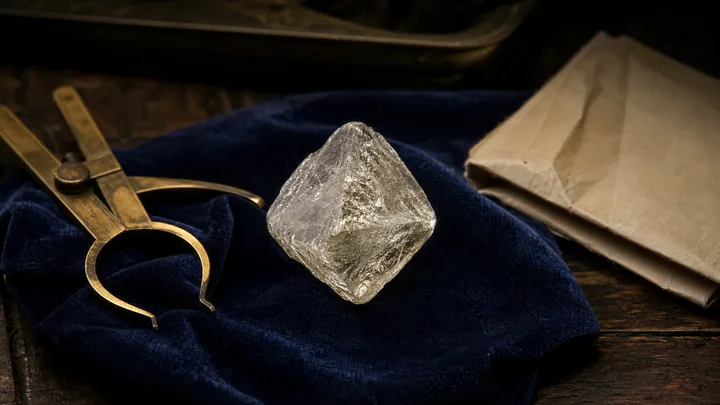
- The largest rough diamond ever found. 3,106.75 carats, roughly 621 grams, about the size of a man’s fist. In the 121 years since, nothing has come close.
- Nine principal stones came out of it, plus just under a hundred small ones. Cullinan I, the Great Star of Africa, is 530.2 carats and remains the largest cut colourless diamond in the world.
- It no longer holds the overall cut record. The largest cut diamond of any colour is the Black Falcon, a black carbonado of about 612 carats finished in 2025.
- Where they are. Cullinan I sits in the Sovereign’s Sceptre with Cross and Cullinan II in the Imperial State Crown, both on display at the Tower of London. Cullinan III to IX are personal jewellery of the reigning monarch.
- What they are worth: nobody knows. They have never been sold and never will be, so there is no market price to observe, and published estimates for Cullinan I alone span five times over.
The pattern is the point. South African ground, the value created at a foreign wheel, the stone worn somewhere else again. That is the shape of the diamond business and it has not changed.
What was actually found in 1905
Frederick Wells, the surface manager at the Premier Mine, is credited with the find. The usual telling has him inspecting the open pit about 5.5 metres below the surface when something caught the late sun in the pit wall a little above his head. He climbed up and prised out a crystal roughly 10.1 cm long, 6.35 cm wide and 5.9 cm deep.
It was so far outside anything anyone had seen that the first reaction at the mine was that somebody had planted a lump of glass as a prank. The previous record holder, the Excelsior, had been found at Jagersfontein in the Orange Free State in 1893 at about 995 metric carats. The Cullinan was more than three times that.
Four of the crystal’s eight surfaces were smooth cleavage faces, which is why the record has always carried an open question: the Cullinan may itself have been a fragment of something much larger, broken apart underground long before anyone dug for it. The other piece, if it exists, has never been found.
The stone was named after Thomas Cullinan, chairman of the company that owned the mine. Not after Wells, who received a cash reward most often reported as £3,500.
Where the record is genuinely disputed
This story has been retold so often that some of the retellings have hardened into facts they never were. Three points are actually contested, and it is worth saying so.
The date. You will see both 25 and 26 January 1905. The Heritage Portal, going back to the contemporary material, notes that a 1905 pamphlet and Wells’s own daughter’s 1946 account both give the 25th, while mining company archives and most later references give the 26th. Encyclopaedias and world-record listings mostly use the 26th. Neither date is provably wrong.
The finder. Wells is credited everywhere. But some accounts hold that an African mineworker saw the crystal first and pointed it out to him. There is no name attached to that person in any record. It is worth noting that the Excelsior, twelve years earlier, was found by a worker who deliberately went around his overseer and carried it straight to the mine manager, and was paid £500 and a horse with saddle and bridle for it. Whether the same thing happened at the Premier in 1905 is unknown and probably unknowable.
Whether it was ever whole. The cleavage faces are real. The larger parent crystal is a reasonable inference, not a finding.
There is also a fourth item, more famous and less serious. Almost every account of the cutting describes Joseph Asscher fainting after landing the blow that split the stone, with a doctor and nurse standing by. Ian Balfour, in Famous Diamonds, disputes it, and Asscher’s own nephew is quoted saying no Asscher would faint over an operation on a diamond. A bottle of champagne is the likelier ending. Treat the fainting as folklore.
From a bank window to a plain postal parcel
The mine’s owners could not sell it. It was first put on show at a bank in Johannesburg, where the company issued 3,000 passes and something like 8,000 to 9,000 people came anyway. Then it went to London to find a buyer, and for two years the largest diamond in the world sat unsold, because almost nobody on earth had the capital to buy it and nobody at all had proved they could cut it without destroying it.
In August 1907 the Transvaal Colony legislature voted, 42 to 19, to buy the stone for £150,000 and present it to King Edward VII as a gesture of loyalty five years after the South African War. Louis Botha, the Transvaal prime minister and a former Boer general, drove the purchase. The king hesitated. Winston Churchill, then Under-Secretary for the Colonies, talked him into accepting. The rough was handed over at Sandringham on 9 November 1907, the king’s 66th birthday.
The journey there is the best-told part of the whole story and appears to be true. A heavily guarded steamship carried a decoy box under detective escort. The actual diamond travelled to London in a plain box by registered post.
Amsterdam, 1908
The stone went to the Asscher brothers’ workshop in Amsterdam, then the only operation in the world with the nerve and the skill to take it on. Joseph Asscher had cleaved the Excelsior there five years earlier, so he already had the only relevant experience anyone had.
Work began on 23 January 1908. It took four days just to cut the groove for the cleaving blade. On the first attempt, on 10 February 1908, the blade broke and the diamond did not. The second attempt split it exactly as intended.
Then came the real work: three men, fourteen hours a day, for eight months. What came off the wheels was nine principal stones, a batch of small brilliants counted as 96 in most accounts and 97 by the Royal Collection Trust, and about 19.5 carats of unpolished fragments.
The nine principal stones weigh 1,055.89 carats between them. That is about 34 percent of the rough, with the small brilliants and fragments adding a little more. Losing that much of a crystal sounds like butchery and is not: cutting removes everything that stops light behaving properly, and weight left in the wrong place is worth less than weight taken away. The size guide covers the same trade-off at one carat, where it decides whether a stone reads big or small on a hand.
The nine principal Cullinan stones
| Stone | Weight | Cut | Where it is today |
|---|---|---|---|
| Cullinan I, the Great Star of Africa | 530.2 ct | Pear | Head of the Sovereign’s Sceptre with Cross. Crown Jewels, Tower of London, on public display |
| Cullinan II, the Second Star of Africa | 317.4 ct | Cushion | Front band of the Imperial State Crown. Crown Jewels, Tower of London, on public display |
| Cullinan III | 94.4 ct | Pear | Personal royal jewellery. Normally a brooch with Cullinan IV. Set in Queen Mary’s Crown for the 2023 coronation |
| Cullinan IV | 63.6 ct | Square cushion | Personal royal jewellery. Normally a brooch with Cullinan III. Set in Queen Mary’s Crown for the 2023 coronation |
| Cullinan V | 18.8 ct | Heart | Personal royal jewellery, a brooch. Set in Queen Mary’s Crown in 2023 in the position previously holding a Koh-i-Noor replica |
| Cullinan VI | 11.5 ct | Marquise | Personal royal jewellery, worn as a brooch with Cullinan VIII |
| Cullinan VII | 8.8 ct | Marquise | Personal royal jewellery, pendant on the Delhi Durbar necklace |
| Cullinan VIII | 6.8 ct | Oblong step cut | Personal royal jewellery, brooch with Cullinan VI |
| Cullinan IX | 4.39 ct | Pear | Personal royal jewellery, a platinum ring |
Weights as published by the Royal Collection Trust and Guinness World Records. Cullinan I is listed by some sources at 530.4 carats and by one South African heritage source at 520.2, which is almost certainly a transcription error. 530.2 is the figure the collection itself uses.
Cullinan I and II went into the regalia under George V after Edward VII’s death in 1910. The rest stayed in Amsterdam: the Asschers were paid in diamonds, not in money, keeping stones III to IX as their fee. Edward VII then bought VI and VIII back privately as a gift for Queen Alexandra, and the South African government bought the remainder and gave them to Queen Mary in 1910 to mark the inauguration of the Union. She left them to Elizabeth II in 1953, and they passed to Charles III. So South Africa paid for these stones twice, once as rough and once as finished gems, and kept none of them.
The pattern: found here, cut there, worn elsewhere
This is where the Cullinan stops being a curiosity and starts being useful.
South Africa in 1905 could find the largest diamond in human history. It could not cut it, could not insure it, could not finance it and could not sell it. The value did not exist in the ground. It existed in an eight-month process in a workshop 9,000 km away, performed by about the only people on earth willing to attempt it. Amsterdam held the scarce capability, so Amsterdam captured the margin, and it took its fee in the goods themselves.
The Excelsior went the same way for the same reason, to the same city and the same cutter. So did most of what came out of Kimberley and Jagersfontein and the Premier.
None of that is a scandal. It is a description of how value is distributed along a supply chain: the money accrues where the scarce capability sits, not where the raw material comes out of the ground. Digging is hard, capital-intensive and, in margin terms, the least rewarded step in the whole business.
What makes it worth writing about in 2026 is that the arrangement has proved remarkably stable.
The same shape, 121 years later
Put three verified numbers next to each other.
- South Africa’s entire rough diamond production in 2024, under Kimberley Process reporting, was 5,340,219 carats worth about USD 662 million, an average of USD 124 a carat.
- India’s exports of cut and polished diamonds in the 2024/25 financial year were USD 13.3 billion, and that was a nineteen-year low. India handles roughly nine of every ten diamonds polished anywhere in the world.
- South Africa had around 4,500 diamond cutters and polishers in the mid-2000s. By late 2015 the count reported in the local trade press was under 300.
The rough leaves. The value gets added in Surat and Antwerp and Mumbai. The finished stone comes back to a South African counter carrying every mark-up applied along the way, including the last one. There is a live illustration running right now: in January 2026 the Cullinan mine, still working, produced a 41.82 carat Type IIb blue, with reported estimates of around R655 million once polished. It will not be polished here.
The point is not that somebody should feel bad about this. Beneficiation policy has been South African government policy for two decades and the polisher numbers went in the wrong direction anyway, which suggests the constraint is real rather than a matter of will. The sightholder and beneficiation page covers how rough is actually allocated, and the page on South African diamond manufacturers covers what is genuinely still made here.
The point is what it tells you as a buyer. If you are standing in a South African shop looking at a diamond, almost every step that created its value happened somewhere else, and the single largest mark-up is the one being applied in front of you.
Is the Cullinan still the record holder?
Partly. Be precise about which record.
Largest rough ever found: still the Cullinan, at 3,106.75 carats. The two nearest challengers both came out of the Karowe mine in Botswana, more than a century later: the Motswedi at 2,492 carats in August 2024, the second largest rough ever recovered and the largest since 1905, and a 2,036 carat stone in July 2025. Before those, the Sewelô at 1,758 carats in 2019, which is coated in a thick carbon skin and described as near gem quality, and the Lesedi La Rona at 1,109 carats in 2015, a colourless Type IIa that sold for USD 53 million in 2017. Note what that last figure implies about the Cullinan: the Lesedi La Rona is about a third of the Cullinan’s weight, and it sold for a sum that dwarfs anything the 1907 transaction produced.
Largest cut colourless diamond: still Cullinan I, at 530.2 carats.
Largest cut diamond of any colour: no. That is now the Black Falcon, a carbonado of about 612 carats, cut over seven years from an 887 carat rough and completed in 2025. Before it, the Enigma at 555.55 carats, also a carbonado. And the Golden Jubilee, at 545.67 carats, is also larger than Cullinan I. It is a fancy yellow-brown, and it came out of the same Premier Mine in 1985.
That last detail deserves a line of its own. The same South African mine has produced both the largest rough diamond ever found and a faceted stone bigger than the one made from it. It has yielded more than 750 stones above 100 carats and roughly a quarter of every diamond ever recovered above 400 carats, and it remains the world’s main source of blue diamonds.
What South African diamonds are worth today, and where the margin sits
The history is only interesting if it tells you something about the invoice in front of you. It does.
The mechanism that moved the Cullinan’s value to Amsterdam is the same mechanism that moves it today, and it is published, not secret. Margins between one level of the trade and the next are thin, commonly 3 to 5 percent. Then a stone leaves the trade for a retail counter, and the convention is keystone: the counter price is roughly double the trade cost, and a branded showroom goes to roughly three times. That step pays rent, stock, staff, insurance and a brand. It is a legitimate cost of doing business. It is also, by a distance, the largest single mark-up in the chain.
You can see it in current South African numbers, provided you are careful about what is being compared. One carat finished rings in premium showrooms here ran from R105,000 to R428,000 in July 2026, a band drawn from three listings of three different specifications, each of them a ring including its setting. For a bare stone the reference is not a measurement but arithmetic anyone can repeat: the published Rapaport round list of 20 March 2026 prices G/VS1 in the 1.00 to 1.49 carat bracket at $5,400 a carat, which at 20 percent off list, R16.50 to the dollar and 15 percent VAT works out to about R82,000 including VAT, inside a range of roughly R72,000 to R92,000 as the discount moves. Do not treat the distance between those two figures as a saving, because one is a stone and the other is a finished ring. What the pair does show is that there is a great deal of room between the level a diamond is bought at and the level it is sold at.
So, for anyone buying rather than reading history: buy the stone from a manufacturer, cutting house or dealer, and let that same layer of the trade make the piece.
- Cheaper. A retailer buys at that level and then doubles it, three times at a branded showroom, while the steps between trade levels run at 3 to 5 percent. Buy before the one big hop and you pay less for the same stone.
- Better. The grades a careful buyer wants are far more common one step up: 52 percent of trade-access stock met a premium specification in June 2026 against 9 percent of retail-held stock.
- They make it, and they keep making it. Most dealers, manufacturers and cutting houses either run a bench or work with one, and that bench takes the commission, sets the stone, then resizes, re-tips, repairs and re-values the piece it built. A mount drawn around the particular stone you chose is a better object than a stone pressed into a mount that already existed. The Cullinan is that principle at an absurd scale: nine stones were designed out of one crystal by people who had the crystal in front of them, and the value was made at the wheel, not on a counter.
Take a counter instead when speed beats the making, when finished pieces on a hand are how you decide, or when the label is part of the gift. Commissioned work is made to order, so you choose from a stone and a drawing and then wait for it.
Specification moves with it. In a June 2026 look at 230 GIA-certified natural stones listed by six South African sellers, 52 percent of the stones held by sellers working with trade access met a premium specification of D to G colour and VS2 clarity or better. In retail-held South African stock the figure was 9 percent. That is a difference in what is on the shelf, not a claim about price, and it is the cleanest single fact on this site. The full method is on the price index, and the full cost breakdown works through where each rand goes.
Which leads to the practical thing to do about it. A seller worth buying from will put a per-carat number in writing before you walk in. The way to find the ones who do is to search the price question rather than the seller question: 1 carat diamond price, or diamond price per carat South Africa. Sellers who publish a number have already decided to compete on it. The ones who will not answer until you are standing in the showroom have decided something else. The one carat price page sets out what a real number should look like, and the GIA guide covers verifying the report yourself before any money moves.
What I do not know
- What the Cullinan stones are worth. There is no market price. Published estimates for Cullinan I range from about USD 400 million to over USD 2 billion. A five-times spread is not a valuation.
- Who first saw the crystal. Wells is credited. Whether an unnamed African mineworker saw it first is unresolved and the sources conflict.
- The exact discovery date. 25 or 26 January 1905, depending on which contemporary account you trust.
- Whether a larger parent crystal exists. The cleavage faces suggest one. Nothing has ever been found.
- The small stones. Counts of 96 and 97 both appear in reputable sources, including in the royal collection’s own material.
Sources and references
- Royal Collection Trust, “The Cullinan Diamond”: rct.uk. Rough weight, the cutting, the payment in stones, and the 1910 dispositions.
- Guinness World Records, on the largest rough diamond and the largest clear cut diamond: guinnessworldrecords.com. 3,106.75 carats and 530.2 carats.
- The Heritage Portal (South Africa), on the Premier and Cullinan Mine stones: theheritageportal.co.za. The date dispute, the finder dispute, and the larger-parent-crystal question.
- Cape Town Diamond Museum, “The World’s Largest Diamond”: capetowndiamondmuseum.org.
- Gemological Institute of America, on the Cullinan mine’s record for large stones: gia.edu.
- Roger Southall, Professor of Sociology, University of the Witwatersrand, on the repatriation question: The Conversation, 18 May 2023.
- Kimberley Process rough diamond statistics for 2024: kimberleyprocessstatistics.org. South Africa 5,340,219 carats, about USD 662 million, USD 124.03 per carat.
- India’s polished exports at a nineteen-year low of USD 13.3 billion in 2024/25: Mining Weekly, 14 April 2025.
- South African cutter and polisher numbers: SA Jewish Report, 11 November 2015, reporting a fall from about 4,500 to under 300.
- The January 2026 blue diamond at the Cullinan mine: Mining Weekly, 19 January 2026.
- The Black Falcon and the largest-cut-diamond record: Wikipedia. Reported at both 612.24 and 612.34 carats, hence “about 612” above.
- My own June and July 2026 South African studies: 230 GIA-certified listed stones across six sellers, and 73 listed rows of which 71 carried a price, across 18 sellers of which 17 are South African. Method in the price index.
- Rapaport round brilliant price list, 20 March 2026, used for the loose one carat arithmetic, converted at R16.50 to the dollar with 15 percent VAT added: rapaport.com.
Historical figures are quoted as the collections and the record give them, and I have flagged the points where sources disagree rather than picking the tidiest version. Current prices move with the market and the exact grading. For how these pages get researched and corrected, see the editorial policy.
See also
- South African diamond price index. The current numbers and the method behind them
- What a diamond costs in South Africa. Where each rand in the price actually goes
- Sightholders, beneficiation and OTC. How rough is allocated and why so little is cut here
- Natural versus lab-grown diamonds. What changes when the supply constraint disappears
- Ethical natural diamonds in South Africa. Provenance, the Kimberley Process and what it does and does not cover
- Diamond glossary. Cleaving, carbonado, Type IIa and the rest of the vocabulary above