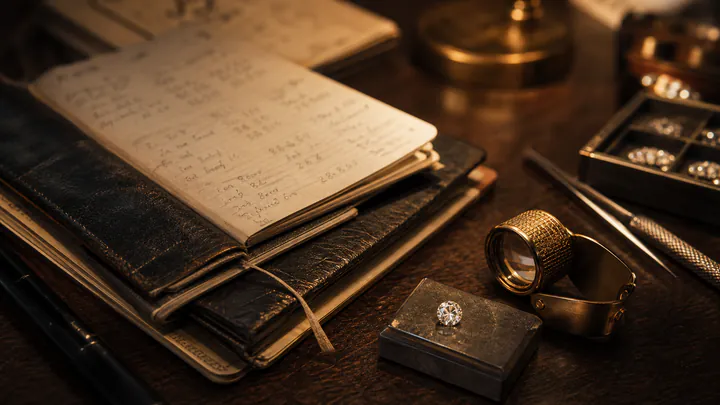
Short answer: if there are natural diamonds in the piece, take it to a dealer, manufacturer or cutting house, not a scrap counter.
- They pay for the stones. A scrap buyer pays for fine gold weight and hands the diamonds back in an envelope, because metal is the only part it can sell on. A dealer has somewhere to put a stone, so it prices one.
- Gold is the part everyone values the same. Spot is spot, and the three routes differ by a percentage on the metal. The diamond number moves by a multiple, which is the whole reason not to let a good stone near a scale.
- Buy one step earlier next time. What evaporated between the till and this offer is the making and the retail step, and the retail convention is keystone: roughly double the trade cost at a counter, about three times at a branded showroom.
- They do the rest too. Remaking, resetting, resizing, re-tipping, insurance valuations, repairs and buy-back, usually on their own bench, so selling is not the only option on the table.
Take the scrap route instead if the piece is plain, broken, unstamped or set with lab-grown stones, or if you need the money this week. On those the melt offer is the correct offer, and chasing a diamond quote will cost you a day for nothing. Take it knowingly rather than accidentally.
The fastest way to lose money is to sell gold jewellery by weight alone
When you sell gold jewellery in South Africa, almost every walk-in buyer pays you for one thing: the pure gold inside the piece, by weight, at that day’s spot price. Nothing else. The diamonds get tipped into a little envelope and handed back, or counted at close to zero. The making, the brand, the hours a setter spent, all of it falls away the moment the scale comes out. I have watched people accept a melt offer on a diamond cluster ring that was worth three times more once someone actually looked at the stones.
So the real question is not where to sell gold jewellery. It is whether your piece is plain metal or whether it is carrying value that a scrap scale cannot see.
Here is how the melt number is built, so you can sanity-check any offer before you accept it. Gold purity is sold in karats: 9ct is 37.5 percent pure gold, 14ct is 58.5 percent, 18ct is 75 percent. A buyer weighs the piece, applies the purity to get the fine gold weight, then pays a percentage of the daily spot price on that fine weight. A 9ct chain weighing 10 grams holds roughly 3.75 grams of fine gold. At, say, 90 percent of spot, you are paid on 3.75 grams, not 10. That is why melt offers feel brutally low against what you paid at the till, and it is entirely correct for plain scrap. It is entirely wrong for a piece with good diamonds in it.
Three routes, and they pay very differently
| Route | Best for | What it pays you for | The catch |
|---|---|---|---|
| Scrap or melt sale | Broken, plain, unbranded gold with no real stones | Fine gold weight only | Diamonds and workmanship are ignored |
| Diamond-side quote from a dealer, manufacturer or cutter | Pieces set with natural certified stones | The gold at spot plus a real price for the diamonds | Needs a GIA report, or a grading appointment first |
| Repurpose or remake | Inherited rings, old engagement rings, diamond earrings | Metal credited and stones reset into something wearable | Needs a real workshop and a proper design conversation |
If your piece is genuinely just a bent 9ct chain, the scrap route is fine and a good local gold buyer will treat you fairly. My gold buyers Johannesburg notes cover how to read those offers. But the moment a natural diamond is involved, the maths changes completely, and you want the stone valued on its own terms.
Why the diamonds are usually where the money is
A certified natural diamond of a carat or more is not a rounding error to be handed back in an envelope, and the quickest way to see that is what the same stone costs on the buying side. Work it off the published benchmark rather than anyone’s opinion: Rapaport’s round list of 20 March 2026 prices a one carat at G colour and VS1 clarity at $5,400 per carat, and after the 10 to 30 percent discount the trade transacts at, converted at R16.50 to the dollar with 15 percent VAT added, replacing that stone costs roughly R72,000 to R92,000. At the retail end, my July 2026 pricing of 73 one carat listings across 18 sellers, 17 of them South African, found finished one carat rings at premium showrooms running R105,000 to R428,000, settings included. Nobody is going to offer you either of those numbers for a stone you are selling, and I am not going to suggest they will. What they give you is the order of magnitude of the object a scrap counter is proposing to ignore.
Specification is what moves that number, far more than carat weight alone. The trade prices polished stones against a published list organised by colour and clarity, which means a buyer holding an ungraded stone has to price it as though the colour and clarity were weak, because that is the only assumption that cannot cost them money. This is the entire reason a GIA report changes an offer. It takes away the buyer’s need to guess low.
This is also why I am blunt about lab-grown stones. Lab-grown prices have collapsed on the wholesale side and are still drifting down, and the resale side barely exists: published estimates put it at somewhere around 10 to 40 percent of what was paid, and a great some jewellers will not buy a lab-grown stone back at any price. If your jewellery is set with lab-grown stones, expect an offer built on the gold and very little else, and treat it as a correct offer rather than an insult. Knowing which you have before you walk in saves a lot of disappointment. My sell diamond ring South Africa guide goes deeper on grading your stone before you sell it.
Get it in writing, and understand what you are being offered
Before you accept anything, get a written, GIA-based valuation for any significant diamonds and a clear breakdown that separates three numbers: the gold value, the diamond value, and a remake estimate. A verbal “I’ll give you X for the lot” is the easiest way to be underpaid, because you can never see which part of the piece is being shortchanged.
The same discipline works in reverse when you are the one being quoted. Every question on the diamond buying checklist was written for a buyer, and every one of them has a mirror on this side of the counter. Instead of asking whether the seller holds the stone, ask what this buyer will do with it once you leave. Instead of asking for the loose stone and the setting on separate lines, ask for the fine gold weight, the percentage of spot being paid on it, and the diamond value as three separate figures. Instead of checking a report number before you pay, check it before you hand anything over. A buyer who answers all of that plainly is worth more to you than a familiar name on the window, and you can run the whole test in five minutes without knowing anything about the business.
Where I would take a diamond-set piece first
Gold has one very useful property in this argument: it is the only part of a piece of jewellery that is worth roughly the same to everybody. Spot is spot. A scrap counter, a diamond dealer and a manufacturing jeweller are all working off the same daily price applied to the same fine weight, and they differ by a percentage, not a multiple. Nobody will pay you double for gold and nobody will pay you a tenth.
Diamonds behave nothing like that, and that is the whole reason this section exists. What a natural stone is worth depends entirely on who is buying it, because it depends on what they can do with it next. A metal buyer has no use for your diamond, so it becomes an envelope handed back across the counter. A cutting house, a manufacturer or a diamond dealer with a bench can put that stone into the next commission or hold it as certified stock, so it becomes a stone with a price. That is not generosity on their part. It is simply having somewhere for it to go.
So take a diamond-set piece to the diamond side of the trade first, and take plain scrap wherever is convenient. If the piece is mixed, get both quotes. You will find the gold number barely moves between them, while the diamond number moves enormously, and that gap is the entire reason not to let a good stone anywhere near a scale.
There is a lesson pointing the other way too, and gold is what makes it visible. When you compare what you are being offered against what you originally paid, notice that the metal is not where the shortfall came from. Gold has done what gold does. What evaporated was the making and the retail margin, and trade convention on that margin is keystone, meaning the counter price is roughly double the cost, with branded showrooms running to about three times, while the margins between one trade level and the next are only around 3 to 5 percent a hop. If you buy again, that is the step to buy before: the stone from a dealer, a manufacturer or a cutter that sells to the public, and the making paid for on its own line. Finding that layer is easier than it sounds, and it starts with the price rather than the seller. Search what a carat costs, in those words, and the sellers who publish a per-carat number in the open are the ones already working close to trade level. The chain is set out in what a diamond costs in South Africa.
Two checks before you hand anything over. Ask what the buyer intends to do with the stone after you leave, because the answer predicts the offer better than any haggling will. And ask for the fine gold weight they calculated, the percentage of spot they are paying on it, and the diamond value, as three separate figures. All three can be checked on a phone calculator while you sit there.
The message I would actually send
I have a gold and diamond piece I may sell or repurpose. Please give me a written quote that separates the gold value, the diamond value, and a remake estimate, and tell me whether any of the stones are natural and worth resetting.
Send clear photos of the front, the side, the hallmark, and a close-up of the main stone. That alone gets you a far more honest first number than walking in cold and putting it on a scale.
Sources and references
- naturaldiamond.co.za July 2026 price study: 73 one carat listings across 18 sellers, 17 of them South African and one an international online retailer, with 71 rows carrying a price. Published as bands only, with the business I am connected to excluded from the sample
- Rapaport round price list, 20 March 2026, used as the published benchmark behind the loose-stone arithmetic on this page, with the discount, exchange rate and VAT stated in the text
- GIA Report Check
- South African Diamonds and Precious Metals Regulator
- Jewellery Council of South Africa
- the Diamond Dealers Club of South Africa
See also
- Gold buyers Johannesburg
- Sell diamond ring South Africa
- Diamond jewellery buy-back South Africa. How a buy-back differs from a scrap or pawn offer
- South African diamond price index