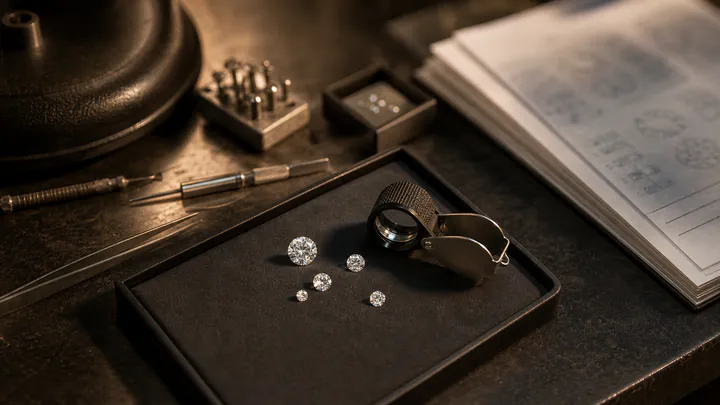
Short answer: shortlist on one question rather than on the tier. Does this house hold the stone today, and will somebody qualified open the parcel, check it against its report and let you look before you pay.
- Better goods, which is the whole reason the trade level is the level. 52 percent of stock held by sellers working with trade access came in at D to G colour with VS2 clarity or better, against 9 percent of retail-held stock. Roughly five times richer a pool to fill an order from.
- Cheaper for whoever buys the finished piece, and it is arithmetic. Retail convention is keystone: the counter price is roughly double the trade cost, about three times at a branded showroom, while one trade level to the next is commonly 3 to 5 percent. Buying here puts your client in front of that step, which is where your margin lives.
- They do the bench work too. Cutting, design, casting, setting and full-stack fabrication, which is what makes a manufacturer worth an account rather than a price list, and it is the work a retail counter sends out to a bench like theirs.
Go to a house quoting off an external catalogue instead when the brief is an unusual make in an unusual weight, or the order has to be filled this week. Ask for the stone on approval, and for import and VAT inside the quoted number rather than arriving after it, and most of the gap closes.
Diamond manufacturers South Africa jewellers should call: bottom line up front
The tier printed on a letterhead tells you almost nothing about your real price or your real risk. What trade level does predict is the goods. In June 2026 I listed 230 GIA-certified natural diamonds held by six South African sellers: 52 percent of the stock held by sellers working with trade access came in at D to G colour with VS2 clarity or better, against 9 percent of the retail-held stock. That is a roughly five-fold difference in what is on the shelf to be selected from, and for a jeweller filling an order it matters far more than any per-carat headline.
For a trade buyer who wants a loupe on a GIA-certified loose stone before it goes on the account, a house that carries its own stock is worth shortlisting. Not because sourcing to order is a sin, it is half of what a manufacturer does, but because the stone is there on the day you ask and somebody in the building will answer for it. Only a handful of South African cutters carry their own GIA-certified natural stock, and the way to find the ones worth an appointment is to see who publishes a per-carat figure in public, which is what searching the diamond price per carat question in South Africa turns up. Searching for a wholesaler mostly turns up businesses that will not quote you a number at all. Once you have a shortlist, run each of them through the diamond buying checklist.
SA is the most cost-competitive English-speaking diamond-cutting market because the strongest manufacturers cut in-house, removing two or three intermediary layers. Trade pricing requires a verified jeweller account (business registration plus tax ID plus a trade reference). The tier hierarchy runs Sightholder, then DBCM Beneficiation Customer, then OTC trade. But read the rest of this guide for the distinction the tier label hides, which is not stock versus source. It is who examines the stone, and when you get to see it.
Stock versus source: the question that sets your real price
Before tiers, before Rapaport discounts, before any of it, ask one thing of any SA manufacturer: do you own this stone right now, or will you source it after I commit?
It sounds obvious. It is the most expensive thing most jewellers never ask. Here is why it moves the number more than carat does.
A house that holds its own stock has already bought the rough, cut it, paid for the GIA report, and is carrying that stone on its books in a safe in Johannesburg or Cape Town. The price reflects a finished, inspectable, locally certified diamond that you can hold to the light before a cent changes hands. Do not assume that makes it the lowest number in front of you. A house carrying finished goods has capital tied up in them, and its per-carat figure can quite properly sit above a catalogue quote for what looks on paper like the same stone.
A house that sources on demand quotes you off an external catalogue many times larger than anything it physically holds, and brings the stone in once you commit. That reach is a real asset, and on an unusual brief it is the only way to fill the order. A catalogue quote will often look keener than a stone you can walk in and see, and that gap is genuine as far as it goes, but three things hide inside it: on the usual arrangement nobody there inspects the stone before it reaches you, the quoted price frequently excludes VAT and import landing, and the seller has no skin in the cut because they did not make it. Ask what changes if you insist on all three, because a house that will open the parcel, check the make and let you look before paying has removed most of the difference.
Budget local retail is the third pattern, and it is the trap. It carries the cheapest headlines a buyer will see and, as the shelf figures above show, the thinnest goods behind them. The cheap sticker is usually a downgraded stone: a lower colour or clarity grade dressed up as a like-for-like deal. Compare specs, not stickers, or you will buy an I-SI2 thinking you paid a fair price for an F-VS1.
The practical rule for a jeweller stocking engagement-ring inventory: if you can inspect the stone before paying and the certification is GIA, a higher per-carat from a genuine cutting house is often the cheaper diamond in the end, once you count what a downgraded or unexamined stone costs you on your own side of the counter. That is a judgement rather than a measurement. I have no data on how often an unseen stone comes back, because nobody in this trade publishes their returns. Which is why the first thing I check is neither the Sightholder cachet nor whether the house owns the stone today. It is who puts an eye on it, and whether I see it before I pay.
Tier structure (the part nobody explains correctly)
Diamond manufacturers in South Africa operate at three distinct supply-chain tiers, each with different rough-supply terms and downstream pricing flexibility. Most international jewellers don’t know the difference, so suppliers exploit the ambiguity. None of these tiers tell you whether the house holds its stock, which is why the previous section comes first.
De Beers Sightholder (highest tier). A Sightholder is one of about 45 globally approved companies, down from 69 after De Beers cut the list with effect from 1 July 2026 with a multi-year direct supply contract from De Beers Global Sightholder Sales (formerly DTC). They receive guaranteed rough allocations 10 times per year (“Sights”). A small number of Sightholders run cutting operations in South Africa, and the globally approved roster changes each contractual cycle, so confirm any current claim against the De Beers list rather than trusting the letterhead. Sightholder rough costs roughly 5 to 10 percent below open-market spot, and their downstream parcels carry the Sightholder cachet, worth a 3 to 5 percent premium when stated explicitly on invoices.
DBCM Beneficiation Customer (second tier). De Beers Consolidated Mines operates a separate South African supply arrangement under which a share of local rough production goes to approved beneficiation customers who cut and polish inside the country. The value of it to a jeweller is narrative rather than price: rough mined here, polished here, a chain of custody short enough to describe in one sentence to a customer. What I cannot give you is a reliable discount figure for this tier, because the terms are not published and I have not read a contract. If a supplier quotes you a precise beneficiation discount, treat it as sales language until they show you the paperwork behind it.
OTC trade (open-market trade). Cutting houses that source rough on the secondary market (from Sightholders, brokers, or auction houses) without direct miner contracts. Most working SA manufacturers are OTC. Rough costs roughly 5 to 15 percent above Sightholder spot, but the operational advantage is flexibility: OTC houses pick exactly the rough they want for each cut, rather than working through allocated parcels.
For a jeweller buying polished, the practical implication is that Sightholder, then DBCM Beneficiation Customer, then OTC is the order of supply-chain narrative defensibility. But for price, an OTC house with strong cutting talent can beat a Sightholder, because it is not paying the Sight allocation premium. And again, none of this answers the question that matters most: does the house actually hold the stone you are about to buy?
None of that is checkable from a letterhead either, which is why a trade account is worth opening on evidence rather than on tier vocabulary. Put identical questions to every house on your shortlist, in the same order, and set the answers side by side. The diamond buying checklist is the version I work from, and for a jeweller the lines that earn their keep are the ones about who physically holds the stone on the day you ask, who opens the parcel and checks the make against the report, and whether VAT and import landing sit inside the quoted number or arrive afterwards.
The active SA manufacturers serving jewellers in 2026
Rather than rank these, here is the honest map of what diamond manufacturers South Africa jewellers can actually work with, grouped by what they do. The main clusters are Johannesburg and Cape Town, with appointment-only offices, trade desks, and retail-facing workshops operating under different supplier models.
OTC trade and full-service manufacturers. Several OTC houses serve jewellers across Johannesburg and Cape Town, some offering full-stack fabrication (cutting plus design plus casting plus setting) for jewellers wanting end-to-end work, others positioning on broad inventory and direct-manufacturer pricing. The advantage here is flexibility and range. The thing to confirm with each is the stock-versus-source question above, because a house can be a genuine cutter on some lines and a source-on-demand reseller on others.
The Sightholders. The largest Sightholders work at the very top of the chain but do not meaningfully serve the small-to-mid jeweller buyer. They sell large parcel volumes to retail-tier houses. For per-stone or parcel-grade supply, the cutting-house and OTC options above are the realistic route, and the Sightholder name on an invoice is worth a small premium only when it is explicit and verifiable.
One filter I apply throughout: this site is natural-only. Where a supplier’s public positioning leans heavily on lab-grown inventory, I leave it off this shortlist. The reason is commercial rather than technical. Lab-grown wholesale prices have fallen very steeply and are still falling, with published trade indices putting the drop anywhere from roughly 70 percent to 96 percent since tracking began, depending on the base year and the size being measured. Behind that there is a thin secondhand market, and a great some jewellers will not take a lab-grown stone back at any price. For a jeweller stocking heirloom, resale-aware or upgrade-path inventory, that is a difficult position to defend to a customer two years after the sale, so I would sell a lab-grown stone for what it is on the day rather than as something that holds its worth. For the full picture on tiers, read Sightholder vs Beneficiation Customer vs OTC.
How to qualify for trade pricing (the actual process)
Trade pricing in SA requires a verified jeweller account. The verification standard is set jointly by the Diamond Dealers Club of South Africa (Diamond Dealers Club) and the Jewellery Council of South Africa, plus FATF-derived KYC under the SA Financial Intelligence Centre Act (FICA).
Minimum documentation:
- Business registration in your jurisdiction (proof of trading entity, for example Companies and Intellectual Property Commission registration in SA, or the jurisdictional equivalent)
- Tax ID (VAT number where applicable; US TIN for US jewellers; UK VAT for UK)
- Beneficial-ownership disclosure (FATF R.22 mandate, applies to all DPMS jewellery transactions over $10K)
- DDC member reference or Jewellery Council member reference or established trade history (3-plus years filing tax returns as a jewellery business)
- Resale certificate (where applicable in your jurisdiction)
- Insurance certificate of jeweller’s-block coverage (typical $50K to $2M coverage)
Onboarding timeline with a serious SA manufacturer:
- Trade-account application submitted: day 0
- KYC and documentation verification: 5 to 10 business days
- First reservation or order placed: day 14 to 20 (after documentation accepted)
- First insured international shipment: day 25 to 30
Costs to expect (independent of stone price):
- KP cert handling: $10 to $30 per shipment (usually built into supplier invoices)
- Insured international shipment (FedEx Priority plus Brink’s secure): $200 to $500 per shipment depending on declared value
- VAT 15 percent (recovered at airport for foreign buyers on purchases over R250; get an SA VAT-refund form at point of sale)
Pricing benchmarks for this market in 2026
The useful anchor for a jeweller is not a per-carat league table of supplier types. It is what the shelf actually holds, and what the far end of the chain charges for the same certified carat.
In June 2026 I listed 230 GIA-certified natural diamonds held by six South African sellers, recording the specification and price of each. Split by where the inventory sits, taking premium specification to mean D to G colour and VS2 clarity or better:
| Inventory type | Stones listed | Premium specification |
|---|---|---|
| Sellers working with trade access | 93 | 52 percent |
| Retail-held South African stock | 137 | 9 percent |
Read that as a jeweller. It deliberately says nothing about who is cheaper, and it cannot: the trade-access figures come off a global wholesale feed and are not landed South African prices, so setting the two per-carat columns against each other would be meaningless. What it does say is that the pool you select from is about five times richer in premium goods once you are buying at trade level. If your inventory has to survive a GIA report on a shop floor, that ratio is your problem long before the sticker is.
For price, anchor the loose stone to a published list rather than to anybody’s shop window, because a jeweller can redo that sum in front of a client. The Rapaport round list of 20 March 2026 puts G/VS1 at 1.00 to 1.49 carats at $5,400 per carat, so one loose carat, less a discount off list, converted at R16.50 to the dollar and grossed up by 15 percent VAT, works out at roughly R72,000 at Rap less 30 percent and about R92,000 at Rap less 10 percent, with R82,000 in the middle at Rap less 20 percent. Those are estimates on a published list, not transaction records, and they move whenever the list, the rand or VAT moves.
At the far end of the chain, across 73 listings from 18 sellers in July 2026, of which 17 are South African and 71 of the rows carry a price, a premium showroom sells a finished one-carat ring at between R105,000 and R428,000. Two warnings on that number before you use it with a client. It includes a setting, so it is not the same product as the loose figure above. And it rests on three listings of three different specifications, so it is the spread of what showrooms charge for something sold as a one carat ring rather than a like-for-like comparison. I publish it as a band rather than as individual stones and prices, because one listing is one business.
The mechanism behind the gap is published, not mine, and not controversial. Retail convention is keystone: the counter price is roughly double the trade cost, and a branded showroom runs to about three times. Between one trade level and the next, margins are thin, commonly 3 to 5 percent. The doubling happens at the single moment a stone leaves the trade for a retail counter, and it pays for rent, stock, staff, insurance and a brand. As a jeweller you are on the inside of that step, which is exactly why the specification question earns you more than shopping supplier tiers does.
Spec, not carat, is what moves a one-carat price. Two stones both sold as one carat can be entirely different products, and the distance between a low-colour SI stone and a colourless VVS one at the same weight is wide enough to swallow any saving you might chase on supplier choice. That is a large part of why the showroom band above is so broad. It is also why a cheap per-carat headline tells you nothing until the colour, clarity, cut grade and grading laboratory are pinned down. For the full method behind both studies, see the flagship Diamond Price Index South Africa, and for converting list-price quotes into real wholesale pricing read How Wholesale Diamond Pricing Works alongside the Rapaport jeweller-discount methodology.
How to choose between SA manufacturers
Work through it in this order, because the order is what protects your margin.
- Stock or source? Compare suppliers on the stone they can actually show, the GIA report number, VAT, return terms, and separated stone/setting pricing.
- Lock the spec, then compare. Never compare two per-carat numbers without fixing colour, clarity, and cut. A cheaper sticker on a lower grade is not a saving. Use the price-index anchors above.
- Confirm the certification. GIA as standard above 0.30 ct. Treat EGL and in-house reports with care for resale-aware inventory.
- Match the service to the job. Need full-stack fabrication (cutting plus design plus casting plus setting)? A Cape Town full-service house fits. Need the strongest origin and chain-of-custody narrative on large stones? That is the Sightholder conversation, accessible mainly at top-tier order sizes.
- Verify compliance. SADPMR registration, KP-defensible supply, and Diamond Dealers Club or Jewellery Council membership are checkable in minutes and worth checking.
Sources and references
This article cites the following authoritative sources. Each was verified at the publication date shown. Inventory findings are drawn from naturaldiamond.co.za’s own June 2026 listing of 230 GIA-certified natural diamonds held by six South African sellers, and the showroom price band from its July 2026 study of 73 listings across 18 sellers, 17 of them South African, with 71 of the rows carrying a price. Loose-stone figures are derived from the published Rapaport round list of 20 March 2026 rather than from that study. See the Diamond Price Index South Africa for the full methodology.
- GIA (Gemological Institute of America) for diamond grading standards and Report Check verification: gia.edu and gia.edu/report-check
- De Beers Group for the Sightholder programme and DBCM Beneficiation Customer transparency disclosures: debeersgroup.com
- the Diamond Dealers Club of South Africa for trade member directory and member-good-standing: diamonds.org.za
- Jewellery Council of South Africa for jeweller member directory: jewellery.org.za
- South African Diamonds and Precious Metals Regulator (SADPMR) for SA regulatory framework and supplier registration: sadpmr.co.za
- Kimberley Process Certification Scheme for international rough-diamond compliance: kimberleyprocess.com
- Responsible Jewellery Council (RJC) for chain-of-custody standards: responsiblejewellery.com
- Rapaport and Rapaport Store for industry pricing benchmarks: rapaport.com, store.rapaport.com
- South African Diamonds Act 56 of 1986, as amended by the Diamonds Amendment Act 29 of 2005 and the Diamonds Second Amendment Act 30 of 2005 (in force 1 July 2007) for SA cutting-industry regulatory framework: gov.za
- South African Advertising Regulatory Board (ARB) code of conduct: arb.org.za
Pricing benchmarks reflect naturaldiamond.co.za’s own 2026 studies plus published listings and trade-press references current as of the update date. Specific quotes for specific stones must come from the supplier directly. Editorial opinion in this article reflects research at the update date and may change as new information becomes available.
For our complete editorial methodology, conflict-of-interest disclosure, and corrections process, see the editorial policy.
See also
- Diamond Price Index South Africa. The method behind the inventory split and the price bands used on this page
- Sightholder vs Beneficiation Customer vs OTC. The tier distinctions explained for jewellers
- Diamond wholesalers in Johannesburg that sell to the public. What the word wholesaler hides, and the price question worth searching instead
- How Wholesale Diamond Pricing Works. Rapaport-based methodology for turning list-price quotes into real wholesale pricing
- Rapaport Price List 2026 jeweller-discount methodology. Subscription tiers, discount conventions, 2026 list movements
- Diamond glossary. Plain definitions for every trade term used above