The short answer
Short answer: a pendant is almost entirely its one centre stone, so buy that stone from a manufacturer, cutting house or dealer.
- Nowhere to hide. No melee, no matched pair, very little making. Nearly the whole invoice is one diamond, which is why the level you buy it at shows up so plainly in the number.
- Cheaper. The retailer bought that same stone at trade level and then roughly doubled it, about three times at a branded name. One step earlier is the same diamond without the doubling.
- Better. Roughly five times more of the stock reaches D to G colour with VS2 clarity or better there: 52 percent through trade access against 9 percent held in South African retail cases.
- They mount and mend it too. The bail gets sized to your stone, and a snapped chain, a worn bail, a re-tipped claw and an insurance valuation are all bench jobs. Most dealers, manufacturers and cutting houses run a bench or work with one, often the same bench a counter sends the job to.
Use a showroom instead if the pendant has to be in a box by a fixed date, if you want to see chain lengths and bail styles hanging against your own neckline this afternoon, or if the name on the box is part of the present.
What you are actually paying for
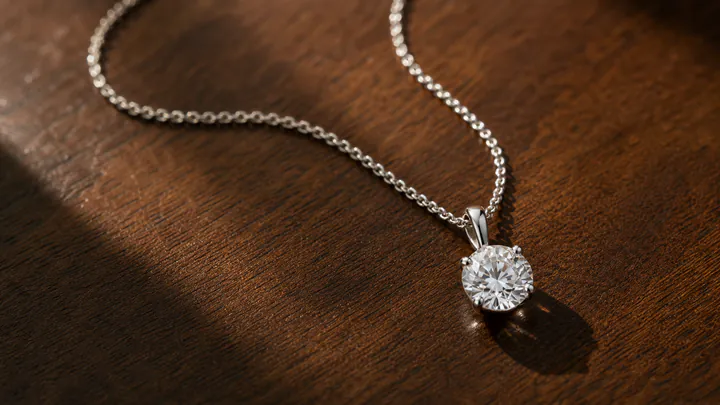
A gold diamond pendant is the most honest single-stone purchase in fine jewellery, because there is nowhere to hide. A ring has a head, a shank and shoulders to spread cost across. A pendant has one stone, one bail and a chain. That means the centre diamond is almost the entire price, and the gold is a supporting act. How much room sits inside a single carat weight is easy to underestimate. Hold the specification completely still at G colour, VS1 clarity and an excellent cut, and a loose one carat still estimates anywhere between about R72,000 and R92,000 including VAT, and the whole of that width is one unknown: how far below the published asking list the stone actually changes hands. Move the colour or the clarity and the number moves again on top of that. Same carat, same pendant mount, a completely different invoice. So when you search gold diamond pendant South Africa, the first thing to fix in your head is that you are buying a diamond first and a piece of gold jewellery second.
That single-stone honesty is exactly why a pendant is one of the cleanest ways to own a natural diamond. You can inspect one stone, hold one GIA report, and compare one price. There is no melee, no matched pair, no row of stones to argue about. Everything rides on getting that one diamond right.
The bail and the chain are where pendants fail
Here is the part most online listings skip. A pendant lives or dies on its bail, the small loop that connects the stone to the chain, and on the chain itself. I have seen beautiful natural stones lost down a drain because a thin bail wore through, or a fine cable chain snapped at the clasp after years of being slept in. When you price a gold diamond pendant, check three things on the mount that have nothing to do with the diamond grade.
First, the bail. It should be solid gold, properly soldered, and sized to the stone. A half carat solitaire can sit on a delicate bail. A two carat stone needs a substantial one, or it will eventually fatigue. Second, the chain gauge. A heavy pendant on a whisper-thin chain looks lovely and breaks within a year. As a rough rule, the bigger the stone, the heavier the chain has to be to carry it safely. Third, the clasp. A spring ring is cheap and fine for light pieces; a lobster clasp or a proper bolt ring is what I want under a meaningful stone. None of this shows up in a carat-colour-clarity line, and all of it decides whether your diamond is still around in ten years.
The price bands a pendant should be measured against
Because a pendant is single-stone, you can price it almost exactly off the diamond. Two reference points, and they are not the same kind of number. The first is arithmetic you can redo yourself. Rapaport’s round brilliant list dated 20 March 2026 puts G/VS1 in the 1.00 to 1.49 carat bracket at $5,400 per carat, and that list is an asking price, so a discount has to be assumed. At R16.50 to the dollar and 15 percent VAT:
| One carat G/VS1, excellent cut, loose | Rand incl VAT |
|---|---|
| Estimated at 10 percent off the published list | about R92,200 |
| Estimated at 20 percent off the published list | about R82,000 |
| Estimated at 30 percent off the published list | about R71,700 |
The second reference point is observed rather than estimated, and it answers a different question. In our July 2026 sample of 73 rows, 71 of them carrying a price, across 18 sellers, 17 South African and one an international online retailer, three premium showroom listings of a finished one carat ring ran R105,000 to R428,000. That number has a setting inside it, and those three listings were three different specifications, so it describes what a showroom charges for “a one carat ring” and cannot be laid directly against the loose estimates above. One includes making and metal, the others do not.
We publish bands across many sellers and never a single stone with a rand figure beside it, because one stone and one figure points at one identifiable business while a band points at a market. For a pendant the loose rows are the ones that matter, since a pendant mount is a fraction of a ring’s making.
Specification drives the price far more than carat does. For most people a stone around H VS2 to F VS1 gives you a white, lively, eye-clean natural diamond without paying the IF and D premium that only a loupe ever sees. Note which specification the band is built on, a G with VS1 clarity, so a warmer or slightly less clean stone should sit under it and a top-colour, near-flawless one well above it. Add the gold and chain, usually R3,000 to R12,000 depending on metal weight and length, and you have your real number. Our South African diamond price index sets out the wider findings and, just as importantly, what they cannot be used for.
Where the cheap pendant prices come from
When you see a much lower headline price for a “1 carat diamond pendant”, look closely at two things. One, is it natural or lab grown. A grown stone costs a small fraction of the bands above, and that fraction keeps shrinking. The wholesale index the trade watches for grown stones sits about 96 percent below its July 2018 starting point, and although the rate of fall eased through 2026 it has not turned around. Resale is the harder half. Published estimates of what a grown stone recovers are wide and disagree with each other, mostly landing between a fifth and two fifths of the purchase price, and plenty of jewellers will decline to buy one back at all. So lab is a legitimate choice for a pendant you want now and will never sell, and a poor one for a pendant you expect to be worth something later. Either way the listing should say plainly which it is. Two, is the price ex VAT, and does it include the mount, or is the chain extra.
There is a deeper thing worth understanding about how diamonds reach you here. On a single-stone pendant you are betting everything on one diamond, and much of the online market never actually holds that diamond: it is pulled from a much larger external catalogue only after you have paid, so the listing is a photo and a report number, not a stone anyone has held. Our June 2026 inventory count puts figures on the trade-off. Stones reachable through trade access met premium specification, meaning D to G in colour with VS2 clarity or better, 52 percent of the time. Stock actually held in South African retail met it 9 percent of the time. So the catalogue genuinely does hold the better goods and the case genuinely does hold fewer of them, which on a single-stone pendant makes this a real choice rather than an obvious one: reach, or the ability to look at the diamond first. That count measures stock rather than price. The price side rests on the trade’s published convention instead, which is that a counter roughly doubles what the stone cost it, so the same diamond costs less a step earlier. What the count adds is that a cheap headline on a pendant is far more often a lower grade dressed in nice gold than it is a bargain.
How to find the stone
No seller is named on this site, so the useful part here is the search. Do not go hunting for a diamond dealer or a wholesaler. Hardly anybody searches that way and the results will not help you. Search the price question instead: what a one carat diamond costs, or the diamond price per carat in South Africa. That works unusually well for a pendant, because a pendant is one stone and one number, so a seller who publishes per carat pricing is already talking in the units you need to compare.
On a pendant the comparison is unusually easy to run, because there is only one stone to hold anybody to. Take the diamond buying checklist and put the same four questions to everyone about that one diamond. Is this exact stone in the building today, or is it a row in somebody else’s catalogue that becomes real after I pay. What is the GIA report number, so I can check it myself before I come in rather than after. What does the loose stone cost with the bail, the mount and the chain priced underneath it instead of folded inside it. And what happens if I bring it back. Four answers from two or three sellers and the shop name stops carrying any weight, because you are no longer comparing shops. You are comparing one written specification against itself, and the only thing still moving is the price.
Repurposing an old diamond into a pendant
An inherited or old engagement diamond often makes more sense as a pendant than anything else. The stone keeps its meaning, a single solitaire on a chain reads as modern even when the diamond is decades old, and you skip the cost of a full ring rebuild. Ask a real cutting house to assess the diamond and quote three numbers separately: the scrap value of the old gold, the value of the natural diamond on its own, and the cost of the new pendant setting and chain. Seeing those three figures apart is what lets you decide honestly whether to reset it or sell it. A good cutter will also tell you if the old stone has chips or wear that need re-polishing before it sits in a new bail. All three of those are bench questions rather than counter questions, which is why the trade level answers them in one visit: the same people weighing the old gold and grading the stone are the ones who will build the new mount, and if you sell instead they are buying at the level they sell at.
If you want to go wider before deciding
A pendant sits in the same single-stone family as studs, where the maths is just doubled across a matched pair. If you are weighing pendants against earrings, our guides to the best diamond pendants in South Africa and gold diamond earrings in South Africa cover the trade-offs, and the diamond chain guide goes deep on gauge, length and clasp choices that decide whether your pendant survives daily wear. Whichever way you go, fix the diamond first, then build the gold around it.