Answer first
Short answer: price the stone before the chain, and buy the stone a step up the trade, from a manufacturer, cutting house or dealer.
- One step earlier costs less. A counter buys its centre stones and its melee parcels at that same level and then applies keystone, roughly doubling the figure, about three times at a branded name, while the hops inside the trade run 3 to 5 percent. The gold is the cheap part either way. The doubling lands on the diamond.
- The stone you want is likelier to be sitting there. On a pendant, where one stone carries the whole piece, premium specification ran 52 percent of trade-access stock against 9 percent of retail-held stock.
- The bench comes with it. Bails, bezels and the setting of a matched line, and afterwards the clasp repairs, re-rhodium, re-tipping and insurance valuations a chain needs over ten years of wear. Most manufacturers and dealers run a bench or work with one, and it is where a counter books the same work out to.
A counter is the right answer if there is a birthday on Saturday, if holding finished pendants and chain lengths against your own neckline and walking out with one is how the choice gets made, or if the name on the box is part of the present.
On a proper diamond chain, the gold is the cheap part. A fine 45cm 18ct white gold chain is a few thousand rand of metal and a bit of bench labour. The natural diamond hanging from it, or the parcel of stones set along it, is where almost all the money sits. That single fact changes how you should shop for a diamond chain in South Africa, because most retail quotes lead with the finished necklace and let the stone hide inside one number.
So before anything else, decide which kind of diamond chain you actually mean. The phrase covers three very different products, and each is priced on a different basis.
The three things “diamond chain” means
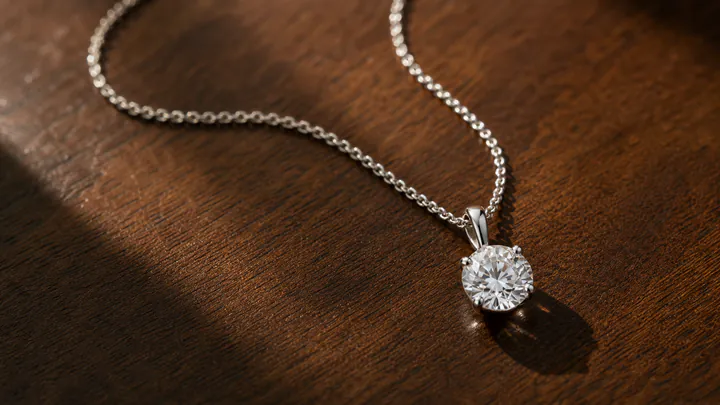
A single diamond pendant on a chain is priced on one stone. The chain is almost an afterthought. Get the centre diamond’s colour, clarity, carat and cut right and the gold around it is a small line item. This is the same single-stone logic that runs through our best diamond pendants South Africa guide.
A station or by-the-yard necklace spaces several small diamonds along the chain, usually in tiny bezels or claws. Here you are paying for matched small goods plus a lot of setting labour. The stones are rarely individually certified, so the colour and clarity band matters more than any single report.
A diamond tennis necklace is the chain, set end to end with matched stones. It is priced like its wrist cousin: on total carat weight across dozens of stones held to one consistent band. The matching discipline that makes or breaks a tennis line is exactly what I cover for the wrist version in best diamond tennis bracelets South Africa, and it applies in full to a necklace, only across more stones and a longer drop.
If you are still weighing pendant versus full necklace, our diamond necklaces South Africa page sits one step up and helps you place the chain decision.
Pricing a pendant chain by the stone
The honest way to buy a pendant chain is to make the seller quote the diamond and the chain separately. Once they are split, you can hold the diamond up against the open market instead of against the necklace it came attached to.
My July 2026 price work ran across 73 listings, 71 of them carrying a price, from 18 sellers, 17 South African and one an international online retailer. At the premium South African counter end, a finished one-carat piece ran R105,000 to R428,000. That band rests on three listings of three different specifications and every one of them includes a setting, so read it as the spread of what a showroom charges for a one carat piece rather than one stone priced three ways.
For the bare stone I would not lean on an observed band at all. The published list is better, because you can redo it. Rapaport’s round list of 20 March 2026 puts G/VS1 in the 1.00 to 1.49 carat bracket at $5,400 per carat, so one carat of it, converted at R16.50 to the dollar with 15 percent VAT added, comes to roughly R92,000 at 10 percent off list, about R82,000 at 20 percent off, and roughly R72,000 at 30 percent off. Estimates rather than quotes, and a loose stone rather than a finished pendant.
The lesson in the distance between those two things is not that one seller is honest and another is not, and it is not that a setting is worth nothing. It is that the same class of stone is sold at very different points along a chain of hands, and the convention that governs it is published: retail works on keystone, roughly double the trade cost, a branded showroom goes to roughly three times, and margins between one trade level and the next are commonly 3 to 5 percent.
Specification does the rest. Colour and clarity move a pendant’s price far more than size does, so a well-cut 0.70ct in a high colour and clarity band will outshine a tired 1.00ct of lower goods on the same chain, and cost less doing it. Decide your band before you shop, and make every quote answer to that same band.
Add a chain (a 42 to 45cm 18ct white or yellow gold cable or box chain is the usual choice) and the metal is a modest top-up. Pick the chain for daily-wear strength and clasp security, not as a place to spend the budget. A lobster or bolt-ring clasp that actually closes firmly matters more than chain branding, because a pendant that slides off is a total loss.
Pricing a tennis necklace by total carat weight
A tennis necklace is a different animal. You are buying, say, 5 carats spread across many small stones that must read as one continuous line. The number that matters is total carat weight at a stated colour and clarity band, not any single stone.
Small matched goods price on their own basis, not on the solitaire list, and the rate swings hard with the band, so a per-carat figure carried across from a one carat stone would mislead you rather than help. Make the seller state it instead: total carat weight, colour band, clarity band, stone count, matching tolerance, and a rand-per-carat figure with VAT included. Small stones held to a good white band, think G to H and VS, cost real money per carat once matched and set, and a long necklace needs a great many of them. Two warnings from the bench:
- Matching consistency is everything. If a few stones are visibly off in colour or have a cloudy patch, the whole line looks cheap regardless of total carat weight. Ask the maker what tolerance they match to.
- Clasp safety is non-negotiable on a necklace. A tennis line carries its full value in stones you cannot afford to drop. A box clasp with a figure-eight safety catch is the standard I would insist on.
Where the value really sits, and why
Here is the structural problem with shopping a diamond chain online in South Africa, and it is not the one usually named. Much of the online market lists stones it does not hold and brings them in once you commit. On its own that is ordinary trade, and on a matched line it is close to unavoidable, because nobody warehouses every combination of size and colour on the off chance. What goes wrong is what does not happen next. Nobody lays the stones out, nobody pulls the one that reads warm, and you pay before anyone has looked, often on a sticker that quietly leaves out VAT and import.
There are numbers behind that risk, and they are about stock rather than price. Listing 230 GIA-certified natural diamonds offered by six South African sellers in June 2026, 52 percent of the 93 stones reachable through trade access were D to G in colour and VS2 or better in clarity, against 9 percent of the 137 stones held in South African retail. On a chain that cuts two ways. For a pendant it means the odds of the exact centre stone you specified actually existing on the shortlist are far better at trade level. For a station or tennis line it means the parcel a seller can put together without ordering in is more often than not a compromise on colour or clarity, and on a necklace a compromise does not stay hidden: it reads as an uneven line right across your collarbone. The full breakdown lives in our diamond price index South Africa.
On a chain the diamond buying checklist gets run two quite different ways, and it is worth knowing which one you are doing before you start asking. On a pendant it is a single-stone exercise: report number before the money, verified by you rather than read to you, and the stone and the chain quoted as two figures so the diamond has to stand up on its own. On a station or tennis line there is no report to verify, so the same checklist turns into a question of what a seller will put in writing. Total carat weight. The colour and clarity band. The stone count. The matching tolerance. Who laid the parcel out and paired it, and when. Ask either version with VAT stated and return terms attached, then get a second quote at the identical band. Sellers sort themselves on that within a phone call, and none of the sorting requires you to know one shop from another.
Finding sellers who will engage on that level is largely a search problem, and most people search the wrong thing. Diamond dealer and diamond wholesalers Johannesburg are close to dead terms here and the results are not what you want. Search the price question instead, 1 carat diamond price or diamond price per carat South Africa, and watch for who publishes an actual per-carat number. On a chain that unit is exactly the one you need, because a pendant is priced on a single stone and a tennis line on total carat weight, and both conversations start at rand per carat.
That is not the cheapest route on the day, and I would not pretend it is, but it sits below a branded showroom counter for comparable goods, and the reason is structural rather than moral. The doubling happens when a stone leaves the trade for a retail counter, and it pays for rent, stock, staff, insurance and a brand. What the extra effort buys you is a real stone you can hold, certified, chosen by somebody who actually looked at it, rather than one that reached you unexamined or a downgraded one dressed up by a low sticker. A showroom counter is a perfectly fair choice if you want to try chains on and walk out with one today, as long as you know the mark-up is what you are paying for. For a piece you intend to keep, that is the trade I make every time.
The short version
Split the diamond from the gold and price the stone first. For a pendant, get the GIA report number and verify it. For a station or tennis necklace, get the total carat weight, the colour and clarity band, the stone count and the matching tolerance in writing, and check the clasp has a real safety catch. Buy natural over lab-grown for anything you want to last. And buy from someone who actually holds the stones, so the diamond you pay for is the diamond you wear.