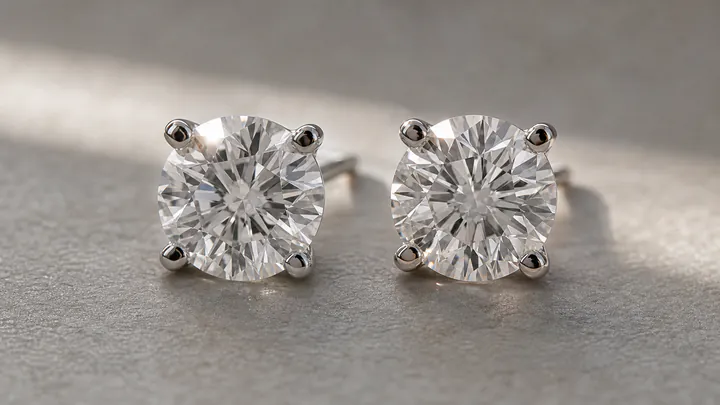
Short answer: let warm gold carry a lower colour grade, and buy the two stones from a manufacturer, cutting house or dealer.
- Yellow and rose gold hide warmth. They lend their own colour to the piece, so an I or a J reads as bright and deliberate on the ear where the same stone would look tinted in white gold.
- Cheaper. A retail counter buys those same certified stones at trade level and then roughly doubles the price, about three times at a branded name. Same pair, one step earlier.
- Better. The specification most buyers want is about five times more common at that level: 52 percent of trade-access stock against 9 percent of retail-held stock. On earrings a dropped grade costs you twice, once per stone.
- Somebody has to match the pair. Two stones under one light, held to one tolerance, in your hand before you pay. No certificate ever checks a pair, and a shop holding no stock cannot do it at all.
- They do the rest too. Setting, bespoke work, re-tipping a claw, tightening backs, insurance valuations, repairs and buy-back, usually on their own bench.
Go to a showroom instead if you need the pair for a date that cannot move, want to hold several settings against your own ear and skin tone first, or want the brand and the box. Earrings are worn more carelessly than rings, so a counter nearby that checks the backs each year has real value.
Gold diamond earrings: the metal decides what colour grade you should pay for
Start with the part almost nobody is told. Most shoppers assume yellow gold demands a bright, high-colour diamond to keep it from looking tinted, when the metal actually does the opposite favour. White gold and platinum sit hard against the stone and expose any warmth in it, so they reward a near-colourless diamond and punish a tinted one. Yellow and rose gold lend warmth to the whole piece, which means a slightly warmer diamond, an I, a J, sometimes even a K, reads as bright and deliberate on the ear rather than off-colour. In a white gold stud, dropping from G to J shows. In a yellow gold stud it often does not. So the honest move on yellow or rose gold is to spend the saved colour budget on cut and on pair-matching, which are what you actually see across a room.
Read the price per total carat weight, not per stone
Earrings are two stones, and the trade quotes them on total carat weight (you will see it written cttw). A “1 carat” pair of studs is usually two half-carat stones. This matters because diamond price per carat climbs steeply with size, so two 0.50ct stones cost far less than one 1.00ct stone, even though the carat total is the same. That is genuinely good news for earrings: you get visible presence on the ear at a much gentler price than a solitaire of the same total weight.
Our July 2026 pricing sample held 73 rows, 71 of them carrying a price, across 18 sellers, 17 South African and one an international online retailer. It covered one carat stones and finished one carat rings. It did not cover stud pairs. We are not going to convert a one carat figure into a pair price and hand you the result as a finding, so here is the honest version of the earring maths.
The reference points at one carat are these, and they are two different kinds of number. For a loose stone, work it out from the published list rather than borrowing somebody’s band: the Rapaport round list dated 20 March 2026 puts G/VS1 in the 1.00 to 1.49 carat bracket at $5,400 per carat, and at 10 to 30 percent off list, R16.50 to the dollar and 15 percent VAT, that estimates to roughly R72,000 to R92,000 including VAT, with about R82,000 at 20 percent off. Separately, three showroom listings of a finished one carat ring ran R105,000 to R428,000, and that figure includes the setting. Those three listings were three different specifications, so it is a range of what showrooms charge for “a one carat ring” rather than a like-for-like comparison, and it cannot be set against the loose estimate directly because one has a setting in it and the other does not. For earrings, read both as ceilings rather than targets:
- A 1.00ct total weight pair is two half carat stones, and half carats price lower per carat than full carats, so the pair should land meaningfully under that single stone band.
- A 0.50ct total weight pair drops further again for the same reason, and on that size the setting and the labour start to matter as a share of the total.
- A 2.00ct total weight pair is different in kind. Each stone is now a real one carat and each one prices inside that band on its own. That is not a stud upgrade, it is two solitaires bought at once.
Note where the width of that loose estimate comes from. The specification is fixed and the list price is published, so the entire spread is one unknown: how far off list the stone is actually being sold. That is the reason a pair quote has to be broken open before you can judge it, and it is why the same question decides everything: ask for both loose stones separately, on the same VAT basis, with the gold and the making as their own lines. If a seller will only give you one figure for a finished pair, you cannot tell which part of it is diamond. On earrings you do have some room to work with, because a slightly lower colour grade hides well on the ear, especially in yellow gold.
The two stones have to match, and a certificate will not tell you that
This is the part of earring buying that has no shortcut. Each diamond can be perfect on its own GIA report and the pair can still look wrong on the ear. Two stones graded a colour apart, or one cut Excellent against one Very Good, will show a difference in brightness and warmth when they sit either side of a face. Certificates grade each stone in isolation. They never check the pair.
So you check it deliberately: ask for both GIA report numbers, confirm the stones are close on colour, clarity and cut, and verify each at gia.edu/report-check. This is also where sourcing quietly matters. A seller that holds nothing orders each stone in after the sale, so your two earring diamonds can arrive from different parcels, “matched” on paper and never once compared in the same light before you pay. A house with no stone in the safe cannot match a pair at the bench, and for earrings that is exactly the weak point.
Which makes the useful question about a seller not who they are but whether those two particular stones exist today and who put them next to each other. Stones in one safe can be laid under a single light, held to one tolerance at the bench, and handed to you as a pair before any money moves. The diamond buying checklist turns that into things you can say out loud at a counter. Can I see both stones together, loose, before they are set. Can I have both GIA report numbers in advance so I can check them myself. Who compared them, and against what tolerance. And is the matched-pair work quoted as its own line rather than folded into one price for a finished pair. Sellers who can answer all four are a small group, and the shop sign is no guide at all to which ones they are.
For honest market context, our June 2026 inventory count found that 9 percent of the stock actually held in South African retail met premium specification, meaning D to G in colour with VS2 clarity or better, against 52 percent of what those sellers could reach through trade access. That is precisely how a “cheap” stud pair ends up as two quietly downgraded stones that never quite agree with each other. On a solitaire a dropped grade is one compromise. On earrings it is two, and they have to match.
Settings and backs: where studs actually fail
Once the stones are right, the failure point is mechanical. For daily-wear diamond studs I specify screw-back posts (threaded, so they cannot work loose) over push-backs, which are the single most common way people lose a stud. A locking butterfly is a fair compromise if screw-backs feel fiddly. Ask for the post in the same karat as the setting so the metals wear evenly, and have the prongs checked once a year, because a lifted prong on an earring is silent until the stone is gone. For larger stones I move from a four-prong basket to six prongs for security; for drop and dangle pieces, also check the bail and the hook or clasp, not just the stone setting.
A last word on gold karat. In South Africa you will mostly see 9ct, 14ct and 18ct. 18ct holds a richer colour and wears beautifully but is softer and dearer; 9ct is harder and cheaper but paler in tone. On a stud the gold is a small fraction of the total cost, so I would let the diamond and the look decide, not the metal saving.
Two levers, and this page has only shown you one
Everything above turns on a single lever: warm metal lets you buy a lower colour grade without it showing on the ear, so you keep the money that would otherwise have gone into a letter nobody can see. That is real, and on earrings it works twice, once per stone.
There is a second lever and it is the bigger of the two. A retail jeweller’s supplier is a diamond dealer. The jeweller buys the certified stones at trade level and then adds a margin, and trade convention is keystone, meaning the counter price is roughly double the cost, with branded showrooms running to about three times. Margins between one trade level and the next are only about 3 to 5 percent a hop, so the chain stays thin the whole way along and then doubles once, at the very end. Dropping from G to J in yellow gold saves you a slice of the stone price. Buying the same two stones one step earlier in that chain works on the entire number, whichever colour grade you settled on. The levers stack, and most buyers only ever get told about the first one.
There is a practical reason this bites harder on earrings than on a ring. You can only tell whether the colour saving actually reached you if the quote separates the loose stones from the gold and the making. One sticker for a finished pair lets a keen stone price be quietly neutralised by a dear setting, and you will never see it happen. Trade level quotes that way by habit, because that is how the trade buys and sells. It is also the level that can match two stones to a single tolerance and put both in your hand before you pay, which is the one thing no certificate will ever do for you.
The showroom keeps its honest advantages here, and they are not small. Earrings should be seen on a face, in ordinary light, against your own skin tone, and a counter that checks the backs and re-tips a claw each year is genuinely worth having on a piece worn daily. On a 0.50 carat total pair the margin at stake is a few thousand rand and that service may be worth exactly that much. On a 2.00 carat total pair, where each stone is a real one carat, it is a different amount of money and deserves a different answer.
Three checks, whoever you buy from. Ask for the loose stones, the gold and the setting labour as three separate lines on the same VAT basis. Ask for both GIA report numbers before you pay, verify them yourself, and confirm the two stones sit within a colour grade and a cut grade of each other. Then take those same two report numbers, or the identical written specification, and get a second price on them. Finding somewhere to do that is easier than it looks, though not by searching for a diamond dealer or a wholesaler: hardly anyone searches that way and the results do not repay the effort. Search what a diamond costs per carat in South Africa instead. Sellers who publish a per carat number are the ones set up to price a written specification, which is exactly what you are handing them. When the report numbers match, the diamonds are a constant, and whatever is left in the gap is margin.