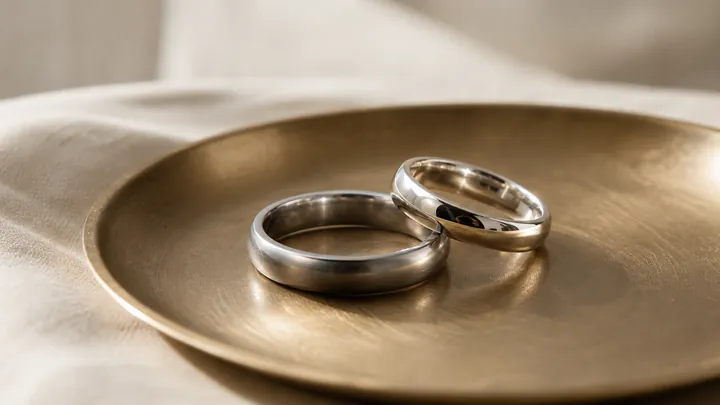
Short answer: buy half eternity unless the finger size is settled, and have the band made where the melee parcel is chosen and laid up. That means a manufacturing jeweller, a cutting house or a dealer with a workshop.
- There is no certificate on a row of thirty melee stones. What you are buying is somebody’s judgement, so buy where that judgement is exercised and can be shown to you before the row is soldered.
- Cheaper. A counter buys at exactly that trade level and then roughly doubles the price, about three times in a branded showroom, and on a band the doubling lands on the melee, the metal and the making together.
- Better. The specification most buyers want is about five times more common at that level: 52 percent of trade-access stock against 9 percent of retail-held stock. That count was of certified single stones rather than melee, and it still points at the colours and clarities that wreck a row.
- They do the rest too. Matching the parcel, setting the row, resizing a half eternity, re-plating, tightening beads, insurance valuations, repairs and buy-back, usually on their own bench. A retail counter mostly sends that work out to a bench like theirs.
Go to a showroom instead only if there is an anniversary next week, if you want to try several finished bands against your own engagement ring, or if you want the brand and the box.
A diamond eternity ring lives or dies on one thing: whether the small stones match
A solitaire stands on a single diamond. An eternity ring stands on twenty or thirty of them sitting shoulder to shoulder, and the human eye is brutal at spotting the one that is off. If two stones in the row are a shade warmer, or one is cut slightly shallow and goes glassy in the same light where its neighbours sparkle, you will see it every single day. So the real question for diamond eternity rings South Africa is not which retailer has the prettiest display band. It is who matched the melee, and how honestly they will tell you where those small diamonds came from.
Melee is the trade word for the little diamonds, usually under about 0.20ct each, that fill an eternity band, a halo or pave shoulders. They are rarely certified individually because grading one costs more than the stone is worth. That is normal and not a red flag. What it means is that all the trust sits with whoever assembled the parcel. A consistent band comes from one matched parcel cut to one standard. An uneven band comes from a grab-bag of leftover stones that happened to be the right size, and no certificate will save you from that, because there is no certificate. Because a matched band or a full eternity row has to read as one continuous standard, the safest way to buy one is from whoever will put the finished row in front of you before you pay, and who matched that parcel by eye rather than assembling it from scattered lots nobody ever compared side by side. Both of those are questions you can ask outright, and you will usually have your answer inside the first minute.
Full, three-quarter or half eternity
This is the first decision and it is more practical than romantic.
| Band type | Diamond coverage | Resizing | Best for |
|---|---|---|---|
| Half eternity | Top arc only, roughly the front half | Yes, the plain underside can be cut and rejoined | Most buyers, daily wear, finger size that may change |
| Three-quarter eternity | About 75 percent of the circumference | Limited and fiddly | A fuller look while keeping a small plain section |
| Full eternity | The entire circumference, no gaps | No, the band has to be rebuilt | A fixed, confirmed finger size and a wish for sparkle from every angle |
I steer most South African buyers to half eternity. It looks identical from above, where you actually see the ring, it survives a resize after a pregnancy or a few years, and it sits flatter and more comfortably against an engagement ring. Full eternity is beautiful and I do not talk anyone out of it, but go in knowing it is effectively a permanent size. The diamonds on the underside also take a beating against desks and steering wheels, and there is no plain metal to absorb the wear.
A word on the setting too. Channel-set bands, where the stones sit in a metal track, protect the girdles and snag less, which suits an everyday ring. Shared-prong or claw-set bands let in more light and look brighter, but the tiny prongs wear thinner over years and need a stone-check. Ask which you are getting, because the picture rarely makes it obvious.
What an eternity band actually costs
Eternity rings are priced on total carat weight, not on one headline stone, so the number that matters is the combined carat of all the melee plus the metal and labour. Tie it to real data rather than a showroom mood.
Start from the ceiling and work down, and set the ceiling with arithmetic rather than with somebody’s advertised band. Rapaport’s round list of 20 March 2026 puts G/VS1 at 1.00 to 1.49 carats at $5,400 per carat, so a single loose one carat comes to roughly R72,000 to R92,000 including VAT, converting at R16.50 to the dollar and depending on the discount off list. A premium South African showroom finishes a certified carat into a ring at somewhere between R105,000 and R428,000, a band drawn from three listings of three different specifications among the 73 rows and 18 sellers I recorded in July 2026, and that one has a setting inside it while the list-derived figure is a bare stone. Those are the numbers for one large graded stone. Melee sits at the opposite end of the scale, trading well below the per-carat rate of a certified solitaire, so use the solitaire figures as a ceiling and never as a rate to multiply by your total carat weight. A half-eternity band carrying about 1ct of total natural melee at a good colour and clarity lands in the low tens of thousands of rand for the diamonds at most, before you add the platinum or gold and the making, and often less. That is a transparent estimate, not a quoted price, and your figure will move with the carat total, the grade and the metal you choose. For where the showroom band and the list arithmetic come from, see what a certified carat costs here.
Two honest warnings on cheaper numbers. First, a low headline per carat is usually a lower grade rather than a better buy. Grade for grade, the retail case is the weaker pool. In a June 2026 listing of 230 GIA-certified naturals across six South African sellers, stock held at trade level ran 52 percent at D to G colour with VS2 clarity or better, while retail-held stock ran 9 percent. That count was of certified single stones and not of melee, so read it as a signal about the grade a case tends to carry rather than a measurement of small goods. It still points at exactly the lower colours and clarities that wreck a row’s consistency. Second, many online sellers quoting keen prices do not hold the diamonds at all: the melee is shipped in only after you commit, so you never see the actual row before you pay and you are trusting that a remote parcel was matched well. For a single solitaire that is a manageable risk. For an eternity band, where matching is the whole game, it is the risk.
Who actually holds the melee
This matters more for eternity rings than for almost any other style, because you cannot judge a matched row from a render. A seller who assembles the row from a catalogue and never lays it out has nothing to show you before it is built, so by the time the parcel arrives you have paid for a match nobody checked, including you.
So the diamond buying checklist has to be adjusted for a piece that arrives with no paperwork at all. Its verification step assumes a report number you can hold against a public record, and on a row of thirty melee stones there is simply nothing to hold. What stands in for it is how much a seller will write down and how much they will show you. Get the total carat weight, the colour and clarity range and the words natural diamond onto the invoice. Ask to see the row before it is soldered, or the loose parcel laid out on a tray. Take the stones and the making as two figures with VAT already inside them, and get the return terms in writing for the case where the row reads unevenly in daylight once it is on a hand. Then put the same requests to a second seller at the same total weight. What you are really comparing is how much of their own judgement each is willing to commit to on paper, which is the only comparison left when there is no certificate to compare.
If you do shop elsewhere, the defence is simple. Ask to see the melee in person or under magnification. Get the total carat weight, a natural-diamond confirmation, and a colour and clarity range in writing. And ask, directly, whether the seller holds the stones or sources them in. The answer tells you most of what you need to know.
How this fits the rest of the ring
An eternity band is usually a second ring, worn next to the engagement ring, so it has to match a stone you already own. If your centre is a brilliant, browse our round brilliant guide for how that cut reads in the same light as the melee, and our solitaire guide for the engagement ring it will sit against. For the wider decision, the best wedding rings in South Africa overview and our diamond rings for women page set the context.
Get the band matched right and it disappears into a clean line of light. Get the matching wrong and it is the one thing your eye finds every morning. With diamond eternity rings, that is the whole decision.
With no certificates, you are buying somebody’s judgement
Everything above comes back to one uncomfortable fact: on an eternity band there is no document. A solitaire arrives with a GIA report that settles most arguments before they start. A row of twenty or thirty melee stones arrives with a total carat figure and somebody’s word. So you are not really buying a graded product here. You are buying the judgement of whoever chose the parcel and laid up the row.
That points you closer to the bench than most buyers ever go. A manufacturing jeweller, a cutting house or a dealer with a workshop is the level at which the parcel is actually selected and the row is actually built. You can ask who matched it, see the stones loose before they go into metal, and look at the assembled row before it is soldered and set. A retail counter is selling a finished band that arrived already matched or already not matched, and the person behind the counter is usually in no position to tell you which, because they were not there when it was decided.
The price argument runs the same direction and deserves to be said once, plainly. A retailer’s supplier is the dealer. Trade convention is keystone, meaning the counter price is roughly double the cost, with branded showrooms at around three times, while the margins between one trade level and the next are only about 3 to 5 percent a hop. On an eternity band that doubling is applied to the melee, the metal and the making together, including the stones nobody graded. The mechanics are set out in what a diamond costs in South Africa.
Retail still earns its place on this particular piece, and for one reason rather than several. Trying finished bands against your own engagement ring, on your own hand, is genuinely how the half versus full decision gets made, and a case full of made-up bands is the only place you can do it this afternoon. What retail does not have to itself is the aftercare. Resizing, re-plating and tightening a loose bead are bench jobs, and a counter usually sends them to a bench like the one that would have made the band in the first place. A half eternity band is also not a large purchase by diamond standards, so the rand value of the margin is smaller here than it is on a centre stone.
Whoever you buy from, at any level, ask three things and watch how comfortably they are answered. Who matched this parcel, and were the stones cut to one standard or gathered from several. May I see the row under magnification, or the stones loose, before they are set. And will you write the total carat weight, the colour and clarity range and the words natural diamond onto the invoice. Nobody at any level of this trade should hesitate over those.