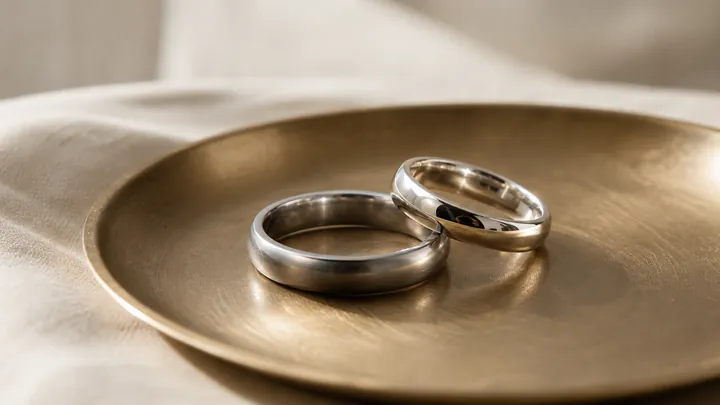
Short answer: match the band to the engagement ring in metal and carat from one workshop, and if it carries diamonds buy it at manufacturer, cutting-house or dealer level.
- Match the metal and the maker. Two rings pressed together for decades file each other if their hardness differs, so order the band in the same carat and alloy, ideally from the same bench.
- Cheaper. A retail counter buys the same row at trade level and then roughly doubles the price, about three times at a branded name. On a made-up band that doubling covers the metal and the setting labour as well as the stones.
- Better. The specification most buyers want is about five times more common at that level: 52 percent of trade-access stock against 9 percent of retail-held stock, and a row of melee carries no report per stone to catch a downgrade.
- They do the rest too. Matching the row and setting it, resizing, re-tipping, re-plating, insurance valuations, repairs and buy-back, on their own bench.
Go to a showroom instead if the wedding is a few weeks out, you want to try a dozen widths and profiles against the actual engagement ring on the actual hand, or you want the brand and the box. For a plain band with no stones, buy wherever is convenient: it is priced on metal weight and there is nothing hidden in it.
The numbers. Plain 18ct gold runs about R6,000 to R18,000 and plain platinum R14,000 to R35,000, both mostly metal weight. A half-eternity diamond band runs about R18,000 to R55,000 and a full eternity band from about R32,000 upward. To sanity-check the diamond half of any of those, use the bottom of the published list: a loose 0.30 carat G/VS1 round comes to roughly R5,000 to R6,500 including VAT, about R17,000 to R22,000 a carat, against R71,500 to R92,000 a carat for the same grade at a full carat. Your melee is smaller and cheaper per carat again, so that is the ceiling on the stones in your row, not their price.
A woman’s wedding band spends more hours on the hand than any other ring she owns, and most of those hours are spent pressed flush against her engagement ring, so durability and a matched fit decide far more than the band’s looks on day one. That daily contact is exactly why shopping for a woman’s wedding ring in South Africa starts with metal hardness and how the two rings sit together, not with the carat count or the price tag. A woman’s wedding band is the piece of jewellery she wears most, on the same finger, against the same neighbour, every single day. It has to be chosen for how it ages, not just how it photographs in the shop.
So let me give you the things that actually matter for a ring that lives on your hand, in the order a jeweller would tell you over the counter if they were being honest. And if that band carries diamonds, especially an eternity or half-eternity row, the matching is everything: a row of small stones only reads evenly when one house grades the entire set to a single standard, not when twenty stones are gathered from a catalogue nobody inspected. What you want is a row graded as a set, by one person, against one benchmark, before any of it is set, so the line stays even instead of catching the light unevenly a year in.
Match the metal and the maker, not just the look
Your wedding band sits hard against your engagement ring for decades. If one is 18ct gold and the other is 9ct, or one is platinum and the other white gold, the harder metal slowly files the softer one. The fix is simple and it is the first thing I tell every bride: order the band in the same carat and metal as the engagement ring, ideally from the same workshop, so the alloy and, for white gold, the rhodium plating match. A pair that wears at the same rate keeps looking like a set.
If you are still choosing the engagement ring too, this is the moment to think about both together. Our companion guide to gold and diamond wedding rings in South Africa walks through how 9ct, 18ct and platinum behave differently on a thin shank.
Comfort fit is not marketing, it is engineering
Comfort fit means the inside surface of the band is gently domed rather than flat. It does two real things. It slides over the knuckle more easily, and it sits more kindly through a Highveld or coastal summer when your fingers swell in the heat. A flat-inside band has two sharp inner edges that you feel by the end of a long day. The trade-off is a little more metal, so a comfort-fit band costs slightly more. For a ring you never take off, it is money well spent. Always ask whether the band is comfort fit before you sign.
Choose the setting for your real life
There is no single best band style. There is a best band for your hand and your engagement ring.
- Plain band. The most durable choice, the easiest to resize, and the simplest to re-polish when it scuffs. If you work with your hands or simply want something you never have to think about, plain wins.
- Channel-set diamonds. The small stones sit in a recessed channel below the metal rim, so the metal protects them. This is my pick for active hands, gym goers, gardeners, anyone whose ring takes knocks.
- Pave. The most brilliant looking, because tiny diamonds cover the surface held by little metal beads. The honest catch is that those beads wear down over years and need re-tipping, and a stone can be lost if you ignore it. Pave is beautiful, but budget for maintenance and ask whether it is cast or hand-set, because hand-set holds tighter.
- Eternity and half-eternity. Diamonds all the way around, or across the top half only. A full eternity band is stunning and symbolic, but it cannot be resized without breaking the pattern, so get the finger sized properly first. Half-eternity is the sensible compromise: the diamonds you see, a plain comfortable underside, and resizable.
Matching a band to your engagement ring shape
A solitaire with a high-set stone usually pairs cleanly with a plain, channel or half-eternity band that sits flat against it. Halo rings and low-set or east-west designs often leave a gap, and that is where a shaped or contoured band earns its cost. It is cut to nest around the engagement ring so the two sit flush with no daylight between them. Bring the engagement ring to the appointment. A good workshop will mock the pairing up before they quote. Our broader roundup of the best wedding rings in South Africa covers how to brief a jeweller for a custom shaped band.
What a woman’s wedding band actually costs in 2026
These are manufacturer-direct estimate ranges for 2026, not fixed quotes. A diamond band’s price moves with total carat weight, metal, how well the small stones are matched for colour and clarity, and the quality of the setting work.
| Women’s wedding ring type | Manufacturer-direct estimate |
|---|---|
| Plain 18ct gold band | R6,000 to R18,000 |
| Plain platinum band | R14,000 to R35,000 |
| Half-eternity diamond band | R18,000 to R55,000 |
| Full eternity diamond band | R32,000 upward |
| Custom shaped band | Quoted per design |
The figure that trips people up is the eternity band. A band full of well-matched natural diamonds is essentially a row of small loose stones, and small stones are not cheap per carat once they have been matched, calibrated and set one at a time. The published list gives you two rungs to bracket that with, and both are worth writing down before you take a quote.
The upper rung is the solitaire. Rapaport’s round list of 20 March 2026 prices a single certified one carat at G colour and VS1 clarity at $5,400 per carat, so at the 10 to 30 percent under list the trade transacts at, converted at R16.50 to the dollar with 15 percent VAT added, that one stone costs roughly R72,000 to R92,000, which is also its per-carat rate.
The lower rung, and by far the more useful one for a band, is the bottom of the same list. At 0.30 carat, its smallest bracket, one loose round brilliant works out to about R5,000 to R6,500 including VAT in G/VS1, R5,000 to R6,000 in H/VS1 and R4,000 to R5,000 in I/SI1, on identical arithmetic. Read as a rate that is roughly R17,000 to R22,000 a carat, about a quarter of the one carat rate for the same grade. The melee in an eternity band is smaller than 0.30 carat, so it sits below that rung again. Use R17,000 to R22,000 a carat as the ceiling on the diamond line in your quote, never as its price, and note that both figures buy a bare stone with no metal and no setting labour attached.
Getting from the ceiling to the actual number is a matter of method rather than of a rate I could hand you. Ask for the row costed in three lines, the stones at a stated colour and clarity band, the metal by weight and the setting labour per stone, then divide the stone line by the total carat weight. That gives you the seller’s real melee rate, and it should land some way under the 0.30 carat ceiling. If it does not, either the stones are larger than described or something that is not diamond has been costed inside the diamond line. And note that in a diamond band the labour is not a rounding error either, because somebody sets every stone in the row by hand.
What decides the quality of a band, though, is not the rate. It is the matching. Twenty small stones assembled from a catalogue that nobody laid out on a tray is exactly where quality quietly slips, and unlike a solitaire there is no report per stone to catch it. So get the colour and clarity band of the entire row in writing, ask who matched it, and ask to see the finished row in daylight before you pay. The South African diamond price index sets out the pricing work behind the anchor above.
The natural versus lab question for bands
For a wedding band you intend to keep, choose natural. Lab-grown prices have fallen very steeply at wholesale and were still falling through 2026, the secondhand market for them is thin, with published estimates putting resale at roughly a fifth to two fifths of what was paid, and some jewellers will not take lab-grown stones back on trade-in at all. Fill an eternity band with lab stones and you should plan to keep it rather than trade it later, and it will never quite match an heirloom natural-diamond engagement ring when you stand the two side by side. Natural diamonds in a band hold trade value and keep the set coherent. If you want the same logic from the groom’s side, the men’s wedding rings guide covers it.
Where this gets bought well
With most online sellers, the diamond is listed rather than held, and ordered in from a much larger catalogue once you pay. The ordering is fine; on a matched row it is close to unavoidable. What follows is not. You commit before anyone has seen the stones, and on an eternity band that is a whole row nobody has laid out and checked for matching, including you.
Ask, then, where the stones are right now. Not who the seller is, where the stones are. A row already in the country can be laid out on a tray in front of you before the band is built. A row that is still a set of catalogue lines cannot be, and no amount of reassurance changes that. If the answer is that they will be ordered in, ask to approve the matched row before it is set rather than after, get the return position in writing for the case where the line does not read evenly, and make sure the quote separates the stones from the metal and the setting labour so you can see which part you are actually arguing about. Those questions, and the rest of the set, are on the diamond buying checklist.
If you only want a plain band and no diamonds, a chain retailer is perfectly fine, because a plain band is priced on metal weight and there is no stone quality to be quiet about. Our wedding ring comparison is the place to start. For the difference between a wedding band and a wedding ring as terms, see our guide to wedding bands in South Africa.
Sources and references
- Natural Diamond July 2026 price study: 73 one carat listings across 18 sellers, 17 of them South African and one an international online retailer, with 71 rows carrying a price, published as bands only and with the business I am connected to excluded from the sample. The loose one carat figure on this page is not from that study; it is arithmetic on the published Rapaport round list of 20 March 2026, with the discount, exchange rate and VAT stated in the text. See diamond price index South Africa.
- This site’s diamond buying checklist, for the supplier questions referred to above.
- GIA Report Check for verifying a diamond’s certificate.