Short answer: buy a tennis bracelet from a manufacturer, a cutting house or a dealer, on the matched parcel rather than on total carat weight.
- Somebody has to match forty stones. Melee under about 0.30ct is almost never certified individually, so the only real guarantee is the person who sorted the parcel and rejected the stones that did not agree.
- Cheaper. A retail counter buys that same row at trade level and then roughly doubles the price, about three times at a branded name. On a bracelet that doubling lands on the setting labour as much as on the stones.
- Better. The specification most buyers want is about five times more common at that level: 52 percent of trade-access stock against 9 percent of retail-held stock, and on an uncertified row there is no report to catch a downgrade for you.
- They do the rest too. Setting every stone in the line, lengthening, clasp replacement, re-tipping, insurance valuations, repairs and buy-back, on their own bench.
Go to a showroom instead if there is a hard deadline, you want to try several widths and lengths on the actual wrist, or you want the brand and the box. A bracelet needs its clasp checked more than any other piece, so a shopfront you can walk back into is a genuinely strong argument here.
The ceiling to hold a quote against. The published round list stops at 0.30 carat, right about where melee begins, and there one loose round brilliant comes to roughly R5,000 to R6,500 including VAT in G/VS1 and R4,000 to R5,000 in I/SI1: the list for that bracket less 10 to 30 percent, at R16.50 to the dollar, plus 15 percent VAT. As a rate that is about R17,000 to R22,000 a carat, against R71,500 to R92,000 a carat for the same grade at a full carat. The stones in your row are smaller and cheaper per carat again, so that is a ceiling on the diamond line, not its price. Divide the stone line in your quote by the total carat weight and see where it lands against it.
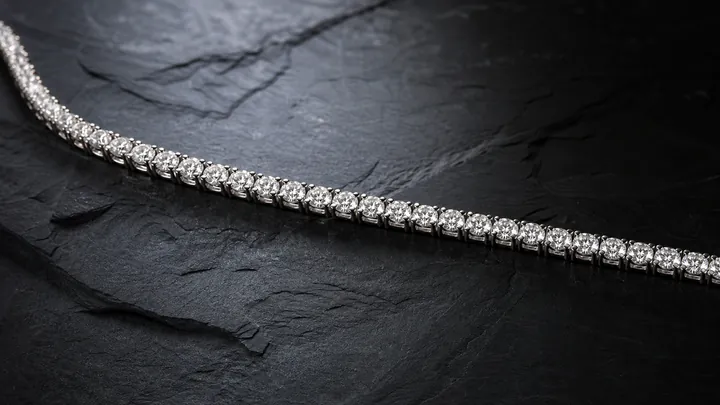
A tennis bracelet is the one diamond piece where the hardest part is not the diamond, it is the agreement between forty of them. A 7-inch line holds roughly 40 to 55 small stones, and a buyer’s eye does not read them one by one. It reads the row as a single ribbon of light, which means one stone that is a shade darker, or a touch cloudier, or cut a fraction shallower, breaks the whole effect. That is why two bracelets at the same total carat weight can sit a long way apart on price, and why the tennis bracelet South Africa search is really a question about matching, not carats.
Price the total carat weight, not the bracelet
Tennis bracelets are sold on total carat weight, written as cttw or “ct total”. Nobody lists the 45 individual stones, so the only honest way to compare two bracelets is per carat of the whole row, then check that the colour and clarity band is the same.
Here is what the published list can and cannot do for you. It prices single round brilliants, so it gives you two ceilings and the shape of the curve between them. It does not price melee, because the list stops before melee starts, and a bracelet budget built on a rate nobody derived would be worse than no rate at all.
The high ceiling first, and you can build it yourself. Rapaport’s round list of 20 March 2026 prices a single one carat at G colour and VS1 clarity at $5,400 per carat. Take the 10 to 30 percent off list that the trade transacts at, convert at R16.50 to the dollar, add 15 percent VAT, and that single stone lands at roughly R72,000 to R92,000, which at exactly one carat is also its per-carat rate.
The low ceiling is the useful one, and it sits much closer to your row. The same list bottoms out at the 0.30 carat bracket, which is roughly where individual certification stops making economic sense and melee begins. There, one loose round brilliant comes to about R5,000 to R6,500 including VAT in G/VS1, R5,000 to R6,000 in H/VS1 and R4,000 to R5,000 in I/SI1, on identical arithmetic. Read as a rate, that is roughly R17,000 to R22,000 a carat, about a quarter of the one carat rate for the same grade. Rarity climbs steeply with size in a single crystal, so the stones in a 40-stone row, being smaller again, sit under that rate again.
Two things follow, and both are usable this afternoon. If a row is quoted anywhere near a solitaire rate per carat of total weight, something is badly wrong with the quote. And if the implied melee rate lands at or above R17,000 to R22,000 a carat, either the stones are much larger than you were told or something that is not diamond has been costed inside the diamond line. Both figures are loose stones only, with no metal, no clasp and no bench time in them.
Then the shape of the market. In July 2026 I priced 73 one carat listings across 18 sellers, 17 of them South African, and premium showrooms billed R105,000 to R428,000 for a finished one carat ring, setting included. Set that against the loose-stone arithmetic above and remember the second figure has a mount and a counter inside it, so the distance is not all margin. Trade convention explains the part that is: keystone, meaning the counter price is roughly double the cost, with branded showrooms running to about three times, while the margins between one trade level and the next are only around 3 to 5 percent a hop. That applies to a row exactly as it applies to a solitaire, and on a bracelet it applies to the labour as much as to the stones.
So ask for the row costed in three lines rather than one: the stones at a stated colour and clarity band, the metal by weight, and the setting labour for the number of stones in the line. A maker who will not split those three is asking you to trust a single figure that hides the thing that varies most. If a sticker sits well under a comparable quote at the same total carat weight, something gave way, and with melee that is almost always colour, clarity, or whether the stones were ever properly graded at all.
Why the cheap row is usually the downgraded row
This is the trap specific to bracelets. With a single solitaire you can demand a GIA report and read the grade yourself. With a tennis bracelet, stones under about 0.30 carat are rarely certified individually, because the cost of a report would be more than the stone. So the grade of the row rests entirely on who set it and how honest they are about the parcel.
There is a measurement worth borrowing here, with a caveat attached. In June 2026 I specced 230 individually listed GIA-certified natural diamonds at six South African sellers. Of the stock sitting in South African retail cases, 9 percent reached D to G colour with VS2 clarity or better, against 52 percent of the stock reached through trade access. The caveat is that I measured certified single stones, not melee, so read it as what a retail case tends to stock rather than as a melee statistic. But the direction is the point. On a single certified stone the report catches a downgrade for you. On a 45-stone row with no individual certificates, nothing does, until you see it in daylight next to a better bracelet and the cheaper line looks faintly grey or restless instead of white and even. That is the downgrade you paid for without being told.
The third archetype matters here too. Many online “SA dealers” do not hold the row; it is assembled from a catalogue and shipped in once you commit. Ordering a row to order is not the problem, and on melee it is close to unavoidable, because almost nobody warehouses forty matched stones on the off chance that you will want them. The problem is that nobody lays them side by side first. For one certified diamond that is a manageable risk. For forty stones that have to agree with each other, none of them individually graded, paying before anyone has seen them together is the riskiest version of this purchase.
What to settle before anyone matches a row
Forty stones is forty chances for a quote to be vaguer than it looks, so the questions worth asking here are not the ones you would ask about a single diamond. Ask who physically matches the row and where. Ask whether the parcel is selected in one place against one standard, or gathered from several. Ask for the colour and clarity band of the whole line in writing, since no individual report is coming to do it for you. Ask whether you can see the finished bracelet in daylight before the balance is paid rather than after. And ask what happens if two stones read differently once the row is built. None of that depends on recognising a shop name, because every one of those answers has to come from the person quoting you. The long form of the same questions is the diamond buying checklist.
The clasp is not a detail
A tennis bracelet has no anchor stone. A pendant has a bail, a ring has a finger, but a bracelet hangs on its clasp alone, so if the clasp fails the entire row is gone in one motion. It is one of the most common ways to lose diamond jewellery, and it is fully avoidable.
Insist on a box clasp with a figure-eight safety catch, or a double safety latch on heavier lines. Open and close it ten times yourself in the shop, feel for a clean positive click each time, and have the fit checked so it sits snug rather than loose, since a loose bracelet swings and stresses the catch. A beautifully matched row on a weak single clasp is a bad buy, however good the diamonds are.
How it compares to the rest of the box
If the budget for a full row is tight, the same matched-stone logic applies more gently to a diamond bracelet with fewer or larger stones, where there is less matching to get wrong. A graduated diamond necklace is the closest sibling in difficulty, because it too lives or dies on stone-to-stone consistency across a long line. And if you want the curated shortlist of where these rows are actually being made well in South Africa right now, read the best diamond tennis bracelets in South Africa. For the pricing work behind the anchors on this page, the South African diamond price index sets out the July 2026 harvest in detail.
Buy the matching, insure the clasp, and price the whole row honestly per carat. Do that and a tennis bracelet stays the easiest diamond piece to love and the hardest to fake.