The short answer
Short answer: buy a bracelet on total carat weight and a written colour and clarity band, from a manufacturer, cutting house or dealer.
- The retail step lands on every stone at once. Trade convention is keystone, roughly double the trade cost at a counter and about three times at a branded name, while the hops inside the trade run 3 to 5 percent. On a forty stone line that doubling is applied to the whole parcel, not to one diamond.
- The goods are better up the chain. Premium specification ran 52 percent of trade-access stock against 9 percent of retail-held stock, and on a line a weak parcel does not read as one poor stone. It reads as an uneven run of light all the way round your wrist.
- The bench that builds it also keeps it. The line is matched and set at that level, and so are the clasp checks, re-tipping, repairs, insurance valuations and buy-back a bracelet needs across the decades it actually gets worn. Most manufacturers and dealers run a bench or work with one, and that is where a counter sends the same jobs.
Buy from a showroom if the piece has to be in a box by a fixed date, if trying several finished lines on your own wrist and walking out with one is how you want to choose, or if the name on the box is part of the gift.
On rands, the unit to insist on is price per carat at a stated band. The published list prices single round brilliants, and melee trades on a different per-carat basis, so a bracelet total derived from a solitaire rate would be worthless to you. Ask instead for the total carat weight, the colour and clarity band the stones fall in, and the price per carat for that parcel with VAT included, then hold that per-carat figure against two or three quotes at the same band.
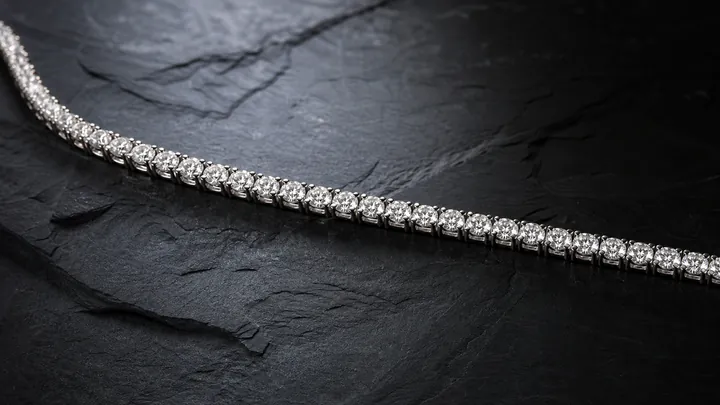
A diamond bracelet lives or dies on a problem most buyers never think to ask about: matching. A tennis line can carry forty or fifty natural diamonds, and the piece only looks right if every one of them steps evenly in colour, clarity and cut across your wrist. I have seen bracelets with an honest three-carat total that look cheap, because one bright stone sits next to a dull one and your eye goes straight to the gap. Carat weight is the number on the ticket. Matching is the thing you actually see.
Price the total carat weight, not the design
The single most useful habit when comparing diamond bracelets in South Africa is to ignore the styling and ask what total carat weight of natural diamond you are paying for, in what spec. Every other variable hangs off that.
On the price side, be precise about which unit applies. The published list prices single round brilliants by carat bracket, and melee trades on a quite different per-carat basis from a solitaire, so a bracelet total worked back from a one carat rate would be a guess dressed up as research. The unit that does work on a line puts the pressure where it belongs anyway: ask for the total carat weight, the colour and clarity band the stones fall in, and the price per carat for that parcel with VAT included, then compare that per-carat number across two or three quotes at the same band.
The trap is the headline total. A seller reaches an impressive carat figure cheaply by dropping the colour and clarity of every stone in the line, and a bracelet is where that hides best, because nobody loupes forty melee stones in a showroom. This is where stock quality bites. Listing 230 GIA-certified natural diamonds offered by six South African sellers in June 2026, only 9 percent of the 137 stones held in South African retail were D to G in colour and VS2 or better in clarity, against 52 percent of the 93 stones reachable through trade access. That is five times the odds of a good stone before anyone has quoted a price, and it compares what is in stock rather than what it costs. On a bracelet the difference compounds link by link: a friendly number on the ticket and a wrist full of slightly grey, slightly included stones. It looks like a win right up until the line is lying next to a properly matched one.
The matching problem, in plain terms
Ask any cutter and they will tell you a bracelet is harder to get right than a solitaire, because you are not matching a stone to a setting, you are matching dozens of stones to each other. Three things decide whether it works.
Colour consistency comes first. Every stone should sit in the same colour band. A bracelet that mixes G with J reads uneven in daylight even if the average looks fine on paper. Clarity consistency is next, and it matters most on the larger stones in the centre of a graduated design, where an eye-visible inclusion has nowhere to hide. Cut is the quiet one. If the stones are cut to slightly different proportions they will not return light at the same angle, so the bracelet flickers unevenly instead of running as one continuous line of fire.
This is exactly why it matters who handles the stones. Pulling melee from a catalogue is normal and unavoidable at these sizes, since nobody is cutting a bracelet’s worth of matched stones to order. The risk sits one step later: a line assembled from whatever parcel hit the price, with nobody laying the stones out and pairing them by eye, and you committing before anyone has seen them together. On a solitaire you can at least inspect the one stone when it lands. On a matched line, by the time it reaches you the matching decisions have already been made, set and polished, and undoing them means unsetting forty stones.
What to settle before you pay for a line
Every question on the diamond buying checklist has to be re-asked in the plural here, and that is the part buyers miss. Not is the stone held, but is the whole parcel held, matched, and laid out where you can see it running as a line. Not what does the report say, but what does it say about the certified centre stone if there is one, and what written colour and clarity band covers the forty that will never carry a report at all. Not one price, but the diamonds and the making as two figures with VAT already inside them. Then two quotes at the same total weight and the same band, because at matched weight alone a bracelet comparison tells you almost nothing. What those answers rank is how much a seller will commit to in writing about stones you cannot check one by one, and no shop name is needed to work out who commits to more.
It also helps to know where the money goes before you negotiate. Retail runs on keystone, meaning the counter price is roughly double what the goods cost at trade level, and a branded showroom goes to roughly three times, while the steps between one trade level and the next are commonly 3 to 5 percent. On a forty-stone line that multiplier lands on the whole parcel at once, which is why two quotes for the same carat weight can sit so far apart. The distance is usually a question of how many counters the stones crossed and how carefully they were paired, not of one shop being greedier than the next. Finding sellers who will quote in those terms is mostly a search problem, and searching for a diamond dealer or a diamond wholesaler will not do it, because those terms return almost nothing here. Search 1 carat diamond price or diamond price per carat South Africa instead. The sellers who publish a per-carat figure are already working in the unit a bracelet has to be priced in.
On a matched line, the cheap options are usually the ones hiding the cost: a low sticker on a downgraded parcel, or a keen number on a parcel nobody has inspected, ordered in only once you buy, and quoted before VAT. My own preference on a bracelet is fewer, better-matched stones rather than more of them, because the pairing is the part you actually look at.
Bracelet types, and where each one fits
A tennis line is the classic and the most demanding. It is a continuous run of matched stones, so it carries the most diamonds and asks the most of the matching and the clasp. A diamond bangle gives you a structured, rigid shape and usually fewer stones, so fit and comfort on the wrist matter more than the diamond count. A station bracelet spaces a handful of diamonds along a chain, which is the lightest on budget and the easiest to wear daily, though there is far less diamond presence. If you are spending seriously, compare the tennis bracelet first, then decide whether you actually want that much continuous sparkle or would rather put the budget into a few better stones.
If it is specifically a tennis line you are after, our dedicated guides go deeper on the line itself: see best diamond tennis bracelets in South Africa and the focused tennis bracelet South Africa page for clasp engineering and stone-count detail. For the wider category and how bracelets sit against rings and earrings, the best diamond jewellery in South Africa overview puts it in context, and you can sanity-check any per-carat quote against our South African diamond price index.
The clasp is not a detail
More diamond bracelets are lost to a clasp than to anything else, and the clasp is where a maker economises when the price has to hit a number.
What you want on a line of stones is a box clasp with a figure-of-eight safety catch, or a double tongue mechanism, rather than a plain lobster on a jump ring. On anything above roughly R150,000 the safety catch stops being optional. Ask what the clasp is, ask to open and close it yourself half a dozen times, and feel whether it seats with a definite click or a vague one.
This is also a useful tell about the rest of the piece. A maker who has specified a proper clasp has generally not cut corners on the settings holding forty small stones, because both decisions come from the same bench and the same brief. A bracelet with a beautiful front and a cheap fastening tells you where the budget went.