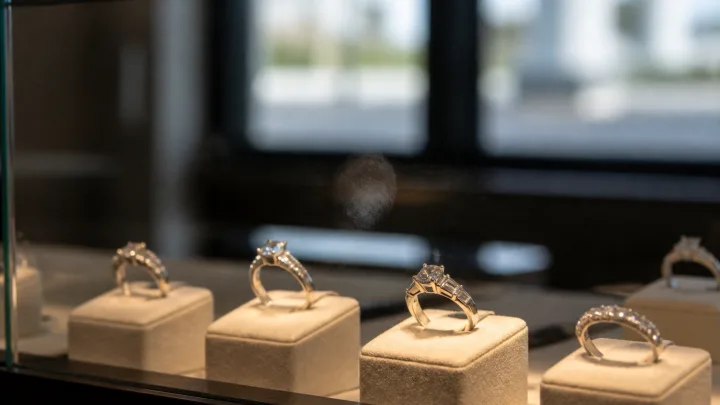
The short answer on diamond retailers
Short answer: no honest list of the best diamond retailers in South Africa exists, so judge the tier and the number instead of the name.
- What a retailer is. The last hop in the chain. It buys finished pieces and loose stones from the trade, displays them, and sells to the public. That is a real business doing a real job, but it is not where the stone was cut, and usually not where it was graded either.
- What that last hop costs. Retail convention is keystone: the counter price is roughly double what the goods cost at trade level, and roughly three times at a branded showroom. Inside the trade, one level to the next moves commonly 3 to 5 percent. The mark-up is not spread along the chain, it arrives in one step.
- What sits in the case. Across 230 GIA-certified natural diamonds listed by six South African sellers in June 2026, 52 percent of trade-access stock was D to G in colour with VS2 clarity or better, against 9 percent of retail-held stock. That is a difference in what gets stocked, roughly five to one, and it is a statement about specification and not about price.
- Know the number before you hear one. A loose one carat G/VS1 round brilliant works out to roughly R71,500 to R92,000 including VAT on the published Rapaport round list of 20 March 2026, taken at 10 to 30 percent off list, at R16.50 to the dollar. Walk in carrying that figure rather than waiting to be told one.
Use a retailer when the piece has to exist today, when sliding twenty finished rings onto an actual hand is how you want to choose, or when the name on the box is part of what you are buying. Those are good reasons and nothing below sneers at them.
Why nobody can hand you a list of the best diamond retailers
Ask an assistant, a forum or a friend who the best diamond retailers in South Africa are, and something list-shaped will come back. Treat every one of those lists as unreliable, for three reasons that have nothing to do with the businesses on them.
A retail list goes stale fast. Stock turns over, staff leave, ownership changes and buying policies change with them. The shop that priced a stone well in March is not necessarily the shop pricing well in November, and nothing about a name is durable enough to carry a recommendation for a year.
Roundups are frequently paid placement. A slot in a “best of” article, a directory tier or an awards page is often bought, and the buyer is rarely required to say so. A ranking you did not commission was usually commissioned by somebody.
Even an accurate list answers the wrong question. What decides whether you were treated fairly is what you paid against what the stone is worth, and a shop name cannot tell you that. Two people can buy on the same afternoon from the same counter, on the same budget, and end up with very different diamonds.
This site names no business anywhere, in any context, and that is a standing rule rather than a shortage of opinions. I work in the South African diamond trade, which is exactly why a ranking from me would be worth nothing to you. What follows is the thing the list was meant to be a shortcut to.
What a diamond retailer actually is
A diamond retailer is a business whose job is selling finished jewellery and loose stones to the public, from a shopfront or a website. It buys in, marks up, displays and sells. It generally does not mine, does not cut, and did not grade the stone. That is the whole definition, and precision here matters because the words further up the chain are not interchangeable. A cutting house or manufacturer turns rough or sawn goods into polished stones and finished pieces, and usually runs a bench. A dealer or wholesaler buys and sells polished stones, mostly to the trade and sometimes to the public. A retailer is the layer that faces you. Many South African businesses stand on more than one rung at once, so the sign above the door is a claim to check rather than a description to trust.
The four levels, and what each one is for
| Level | What it does | What it is genuinely for |
|---|---|---|
| Mining and rough trading | Recovers and sells uncut goods | Not a route open to a private buyer, whatever a website implies |
| Cutting house or manufacturer | Cuts and polishes, casts, sets, runs or shares a bench | Bespoke work built around a chosen stone, and the richest specification pool |
| Dealer or wholesaler | Buys and sells polished stones, holds or sources stock | Getting an exact specification at trade level, with the report before payment |
| Retailer | Buys finished goods in, displays and sells to the public | Immediacy, finished stock to try on, convenience, and the brand |
The practical question is never which level sounds most impressive. It is which level the business in front of you is actually operating at today, and whether it holds the diamond it is showing you. Ask both in plain words and the tier sorts itself out.
How diamond retailers price a diamond
Retail pricing in this trade runs on a published convention called keystone: the counter price is set at roughly double what the goods cost the retailer. A branded showroom typically runs to about three times. That is not a scandal and it is not an accusation. It pays a high street lease, insurance on stock that sits in a case for months, security, staff, marketing, and the brand you walked in for.
What is worth understanding is where in the chain the mark-up happens. Between one trade level and the next, margins are thin, commonly 3 to 5 percent a hop. A stone can pass through several trade hands and barely move. Then it crosses from the trade to a retail counter and roughly doubles in a single step. Buying one step earlier means buying before that step, which is arithmetic rather than opinion.
What the stone should cost before you hear a price
There is no need to guess, and no need to take anybody’s word for it. The published benchmark for round brilliants is the Rapaport list, which the trade treats as an asking price and then transacts below. So the calculation is:
list price per carat, USD
  less 10 to 30 percent      (the discount assumption, stated not measured)
  x carat weight
  x 16.50                    (rand to the dollar, 4 August 2026)
  x 1.15                     (15 percent VAT)
  = rand, including VAT, loose round brilliant, stone only
Worked through on one cell so the method is checkable. The round list of 20 March 2026 prices a G/VS1 in the 1.00 to 1.49 carat bracket at $5,400 per carat. Less 20 percent is $4,320. At R16.50 that is R71,280, and with 15 percent VAT it is about R82,000. Take only 10 percent off and it is about R92,200. Take 30 percent and it is about R71,700. Every cell below is that same calculation run on its own bracket’s list price.
Loose round brilliant, stone only, including VAT.
| Carat | D/VS1 | F/VS1 | G/VS1 | G/VS2 | H/VS1 | H/VS2 | I/SI1 |
|---|---|---|---|---|---|---|---|
| 0.50 | R16,500 to R21,500 | R14,000 to R18,000 | R12,500 to R16,000 | R12,000 to R15,500 | R11,500 to R14,500 | R10,500 to R13,500 | R8,500 to R11,000 |
| 0.70 | R32,500 to R42,000 | R28,000 to R36,000 | R25,000 to R32,500 | R22,500 to R28,500 | R21,500 to R27,500 | R19,500 to R25,000 | R15,000 to R19,000 |
| 1.00 | R101,000 to R130,000 | R83,500 to R108,000 | R71,500 to R92,000 | R62,500 to R80,500 | R60,000 to R77,000 | R56,000 to R71,500 | R41,000 to R53,000 |
| 1.50 | R253,000 to R325,000 | R215,000 to R277,000 | R187,000 to R241,000 | R169,000 to R218,000 | R153,000 to R197,000 | R139,000 to R179,000 | R106,000 to R136,000 |
Inputs: Rapaport round brilliant list dated 20 March 2026, discount of 10 to 30 percent off list, R16.50 to the dollar at 4 August 2026, 15 percent VAT. Change any input and every figure moves proportionally, so redo it rather than quoting this table in six months.
Four limits, and they are real. These are round brilliants only, because fancy shapes price off separate lists. They are the bare stone, with no setting, making or certification fee inside them. They include VAT, so never set them beside an ex-VAT quote without saying so. And they are arithmetic on a published asking price plus one stated discount assumption, not a measurement of what South African sellers charge, because nobody publishes that. Substitute your own discount if you disagree with mine. The point of showing the working is that you can.
When a diamond retailer is the right choice
Genuinely often, and for three reasons that are not consolation prizes.
Immediacy. A showroom has completed pieces on a shelf. You can try twenty finished rings on an actual hand this afternoon and leave wearing one. Work at trade level is generally made to order, which means you are choosing from a stone and a drawing and then waiting.
Convenience. Mall hours, no appointment, parking, a fixed address you already know how to find, and somebody behind the counter whose job is to talk you through it.
The brand. If the name and the box are part of what you want to give, that is a real thing to want, and paying for it is not a mistake. It is a purchase of something other than carats.
If any of those three is what the occasion actually needs, a retailer is the right answer and the rest of this page is background rather than a warning.
What a retailer is not better at
The claim that most often appears in favour of the shop counter is aftercare, and it is largely wrong. Setting, resizing, re-tipping, re-shanking, re-plating, repairs and insurance valuations are usually taken in over the counter and passed to an outside workshop, in many cases a manufacturer’s. Most manufacturers, cutting houses and dealers either run that workshop or work alongside one, and will accept the same job from you directly, often on a piece they made themselves. Buy-back runs the same way: a trade-level seller is buying at the level it sells at rather than taking a stone back into a retail margin.
The other two are already covered above. A counter is not better on specification, since retail-held stock met a premium grade in 9 percent of cases against 52 percent of stock at sellers with trade access. And it is not better on the number, because the keystone step is applied at exactly that counter and nowhere else in the chain.
Are diamond retailers in South Africa expensive?
Relative to buying one step earlier, yes, and the reason is structural rather than personal. Keystone sets the counter at roughly double trade cost and a branded showroom at around three times, while the hops inside the trade run 3 to 5 percent. That mechanism carries the whole argument on its own and needs no dataset behind it.
For scale, and with care: in a July 2026 listing exercise of 73 rows across 18 sellers, of which 17 are South African, finished one carat rings in premium showrooms were advertised between R105,000 and R428,000. That band rests on three listings of three different specifications, one of which has colour, clarity and cut unrecorded, so it describes what showrooms charge for “a one carat ring” rather than one stone priced three ways. Every figure in it includes a setting. Do not subtract a loose stone figure from it and call the difference a saving, because the two are not the same object.
What buyers say about retailers, and what that does not prove
A separate piece of work on this site read 6,482 Google reviews across 179 South African businesses, split by Google’s own category labels. The trade-labelled group averaged 4.77 against 4.53 for the retail-labelled group, and the largest retail category by a wide margin, jewellery store at 123 businesses, was the lowest rated of the lot at 4.47. Worth saying plainly, because it cuts against the easy reading: the trade labels do not come top overall. Jewellery designers, firmly on the retail side, average 4.87. The honest conclusion is that high-volume retail underperforms, not that the trade beats everybody.
The limits on that study are not optional footnotes. It measures satisfaction and sentiment, not rand prices, and does not by itself prove trade is cheaper. There is a selection effect, since trade sellers serve fewer, better-informed, self-selected buyers while retail absorbs walk-in and gift-buying traffic that is harder to satisfy. The wholesale jeweller label covered only three businesses, far too few to lean on. Google categories are frequently self-assigned by the business. No business is named and no review is reproduced. The full version, with the method and every caveat, is in diamond dealers versus retailers in South Africa.
How to judge any retailer standing in front of you
Seven questions, none of which need a shop name or a ranking.
- Which level are you operating at today, and do you hold this exact stone? Ask it in those words. Holding the diamond, sourcing it in after payment and having it cut are three different businesses.
- Price the diamond separately from the mount, VAT inside both, in writing. A single total hides which half of your money bought the stone.
- Compare that per-carat figure to the table above before you compare it to another shop. If it sits well above the band, ask what the difference buys, and accept a good answer if you get one.
- Ask for the GIA report number while you are still deciding, not at the till, and run it through gia.edu/report-check yourself. Then ask to have the girdle inscription read back under a loupe and match it to the report.
- Ask who does the bench work and where. If the answer is an outside workshop, you now know that the setting, sizing and repairs are being resold to you.
- Ask for the buy-back terms in writing, before the sale rather than after it. What a seller will pay to take a piece back is the most honest thing it will tell you about the price it is charging.
- Compare replies, not premises. A polished floor is a fixed cost the business carries. It is not evidence about a diamond.
The longer appointment version of this is the diamond buying checklist, and what a GIA report actually says covers the report line by line.
A note on finding sellers at all
Most people start by searching the tier, and in South Africa that fails. Terms like diamond dealer and diamond wholesaler pull in the region of thirty searches a month between them, the results are thin, and much of what surfaces is not the kind of seller this page is describing. Search the price question instead. Putting a real per-carat figure on a public page is something a seller only does if it is comfortable being held to it, which makes the price question a filter as well as a search, and the demand happens to sit there too, roughly 28,410 searches a month across the price cluster against 30 for the tier words. Look for what a carat costs, what a diamond costs per carat in South Africa, and what diamonds cost here generally, then put the seven questions to whoever replies with figures rather than a contact form. Our own working is in the diamond price per carat guide and the one carat page, and the list itself is explained in how the Rapaport list and jeweller discounts work.
What I do not know
- What South African retailers actually charge the public. Nobody publishes it. The bands above are arithmetic on a published asking price plus one stated discount assumption, which is why the assumption is printed rather than hidden.
- Whether any individual retailer is honest. The inventory and review findings are about groups. They say nothing about the specific business you are about to visit, and they should not be used to accuse anyone.
- How representative the stock finding is. It is 230 listed stones at six sellers, captured in June 2026. It is a real snapshot and it is still a snapshot.
- Whether keystone holds everywhere. It is a convention, not a rule. Individual businesses price above it and below it, and some retail operations buy far better than others.
- What the rand will do. It is the most volatile input in the table and it moves every figure proportionally.
Corrections go to [email protected], and how this site researches and fixes things is set out in the editorial policy.
See also
- Diamond dealers vs retailers in South Africa. The 6,482-review study in full, with its limits
- Best jewellery stores in South Africa for diamonds. The retail layer read fairly, and how to buy well from one
- Best place to buy diamonds in South Africa. Every route compared, including online
- Diamond price per carat in South Africa. The full grid and the working behind it
- One carat diamond price in South Africa. The single most useful benchmark to memorise
- Rapaport price list and jeweller discounts. What the list is and why nobody pays it
- Diamond manufacturers in South Africa. The tier that cuts and runs the bench
- Diamond wholesalers in Johannesburg that sell to the public. What the word wholesale hides
- Diamond jewellery buy-back in South Africa. What a seller will pay to take it back