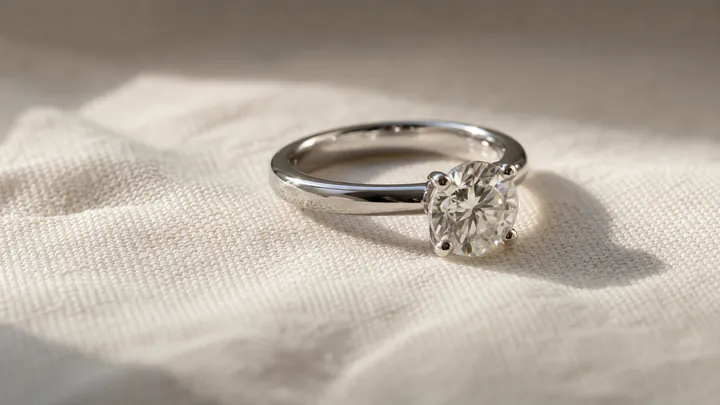
Short answer: buy the diamond first, at manufacturer, cutting house or dealer level, and treat the setting as trim.
- A finished one carat ring is roughly 80 percent stone. The diamond is the decision. Worked off the published trade list, a loose one carat at G colour and VS1 clarity comes to roughly R72,000 to R92,000 including VAT, and a setting for it runs somewhere around R8,000 to R30,000.
- Cheaper. A retail counter buys its stones at exactly that level and then roughly doubles the price, about three times in a branded showroom, while one trade level to the next is commonly 3 to 5 percent. Same stone, one step earlier.
- Better. The colour and clarity worth wearing for thirty years are about five times more common at that level: 52 percent of trade-access stock against 9 percent of retail-held stock.
- They do the rest too. Setting, bespoke commissions, resizing, re-plating, re-tipping, insurance valuations, repairs and buy-back, usually on their own bench. A retail counter mostly sends that work out to a bench like theirs.
Go to a showroom instead only if the ring is needed by a fixed date, if you want fifteen finished settings tried on the actual hand first, or if you want the brand and the box.
The setting, the metal, the brand name on the box, all of that is the minority of what you pay. So when you search diamond rings for women South Africa, the first thing to get right is not the style. It is the stone, and whether you ever actually see it.
The setting is the cheap part, the diamond is the ring
Which is why the useful way to compare two rings is to make each seller take them apart. Ask for the diamond as one number and the setting as another, with the GIA report number attached to the first, and a ring you were told costs R95,000 turns into two facts you can hold against anybody else’s. Work through the diamond buying checklist in the same order with every seller you approach, and what you end up comparing is how each of them handles a stone rather than how much confidence the shop front projects.
This applies whatever the occasion. Diamond rings for women cover engagement rings, anniversary rings, eternity rings, right-hand and dress rings, and milestone gifts. If there is a meaningful centre stone, treat it like an engagement purchase regardless of the label.
Diamond rings for women: real 2026 price anchors
The loose one carat row below is arithmetic on the published Rapaport round list of 20 March 2026, which puts G/VS1 in the 1.00 to 1.49 carat band at $5,400 per carat: take 10 to 30 percent off list, convert at 16.50 rand to the dollar and add 15 percent VAT. The showroom row comes from a July 2026 study of 73 rows, 71 of them priced, across 18 sellers, 17 of whom are South African. Read that row carefully, because it is a finished ring with the setting inside the price and it rests on three listings of three different specifications rather than one specification priced three times. The smaller pieces and the setting costs are my own working estimates, marked as such rather than dressed up as measurements.
| Ring | How it is built | Estimated price |
|---|---|---|
| Small accent-stone dress ring | Several melee stones, no certified centre | R12,000 to R35,000, estimated |
| 0.50 ct natural GIA diamond ring | Certified centre stone plus setting | R38,000 to R70,000, estimated |
| 1.00 ct natural GIA stone, loose | Trade list less 10 to 30 percent, G/VS1, incl VAT | R72,000 to R92,000 |
| 1.00 ct ring, stone bought at trade level | That loose stone plus R8,000 to R30,000 of setting | about R80,000 to R122,000 |
| 1.00 ct ring from a premium showroom | Finished ring including setting, counter price, three listings of three specifications | R105,000 to R428,000 |
Confirm whether VAT sits inside or outside any figure you are quoted, because sellers differ on that and it is 15 percent of the decision. Every rand figure in that table includes VAT. And if a one-carat “diamond ring” is being advertised well below the R72,000 floor for a loose stone of that weight and grade, ask hard questions. It is usually a downgraded stone, lower in colour and clarity than the headline implies, or a lab-grown centre, or a price with the VAT quietly left out.
The seller question nobody answers for you
Here is the part the trade does not volunteer. When a ring is sold online, the centre stone is often pulled in from a much larger external catalogue only after you commit, so the listing is a photo and a report, not inventory anyone in the shop has touched. That is ordinary trade and it is not the part that should worry you. What should is that nobody on this side opens the parcel, so the first person to examine your diamond is you, after payment. The cheap end of the high street has a different problem, and this one is measurable. Premium specification means D to G colour with VS2 clarity or better. Across 230 GIA-certified naturals I listed with six South African sellers in June 2026, that description fitted roughly one retail-held stone in eleven, and better than one in two of the stones held by sellers working with trade access. A low sticker is usually a downgraded stone wearing a good price.
The money, though, moves at one step in the chain rather than across the whole of it. Retail convention is keystone: the counter price is roughly double the trade cost, and a branded showroom runs to about three times, while margins between one trade level and the next are thin, commonly 3 to 5 percent. You can see that single step if you set the numbers side by side, provided you say out loud what each one contains. The premium showroom band for a finished one-carat ring runs R105,000 to R428,000, setting included, while a loose one-carat G/VS1 works out at roughly R72,000 to R92,000 on the trade list. One of those has a mount in it and the other does not, so the distance between them is not all margin. What it is mostly is that single doubling, and that is not a swindle: it pays rent, stock, staff, insurance, a brand, and the ability to walk out with the ring that afternoon. It does mean the obvious thing, though, and there is no reason to be coy about it. Buy before that step and the same stone costs less, because you have not paid for the step. That is the trade’s own published convention rather than a finding of mine, and it holds without any dataset behind it. Buying there also makes the price legible, since the diamond and the setting arrive as two numbers instead of one, and on a ring worn for decades reading the number and shaving it turn out to be the same skill.
Metal: choose it for the diamond, not the other way around
The band matters less than the stone, but it still changes how the diamond reads. White gold and platinum keep near-colourless diamonds looking crisp and icy, which flatters G to D stones. Yellow gold faces warm colour up into the stone, so a slightly warmer diamond looks intentional and vintage rather than tinted, which can save you money by letting an I or J colour work in your favour. Rose gold is style-led and romantic but does the same warming. Platinum is denser and develops a soft patina over time that many people love, while white gold needs occasional rhodium re-plating to stay bright white. None of this should outrank the centre-stone decision. If you want to go deeper on the band itself, our platinum engagement rings South Africa page lays out the metal trade-offs in full.
How I would actually buy one
Start with the diamond, not the design, and start by finding out what your weight and grade costs today. Searching the price question, along the lines of the diamond price per carat in South Africa, turns up the sellers who publish a real number in public, and those are the only ones whose quote you can actually check. Then ask the seller to quote the natural diamond separately from the setting, to include the GIA report number, and to confirm in writing that the stone is natural. Verify that report yourself on GIA Report Check and check the laser inscription matches under the loupe. Then choose the setting, whether that is a classic solitaire, a sparkle-maximising halo, or a round brilliant for maximum light return.
For the wider market context behind every number on this page, read our diamond price index for South Africa, where the bands used here are set out with their method.
Sources and references
- Natural Diamond South Africa inventory study, 230 GIA-certified natural diamonds listed by six South African sellers, June 2026.
- Natural Diamond South Africa retail price study, July 2026: 73 rows, 71 of them carrying a price, across 18 sellers, of whom 17 are South African and one is an international online retailer. Published as bands. The showroom figure is a finished ring including its setting.
- Rapaport round brilliant price list, 20 March 2026, G/VS1, 1.00 to 1.49 carat band, $5,400 per carat, for the loose stone arithmetic. Converted at 16.50 rand to the dollar on 4 August 2026 with 15 percent VAT added. The 10 to 30 percent discount off list is an assumption, not a measurement.
- GIA Report Check
- GIA diamond education
- diamond buying checklist