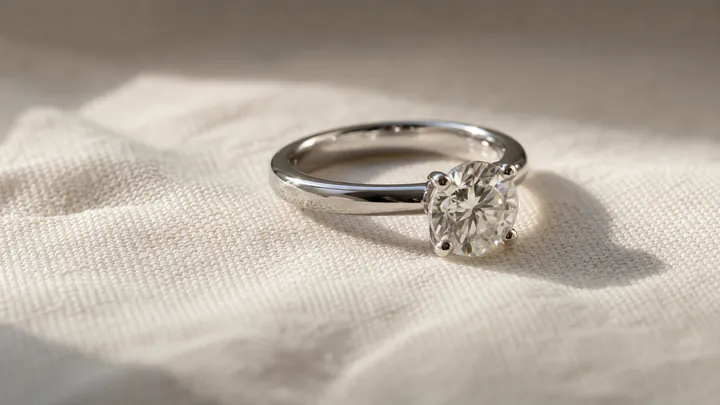
Bottom line up front
Short answer: pick the natural GIA centre stone first and buy it at a manufacturer, cutting house or dealer, then let yellow gold change which stone you are shopping for. Warm metal reflects up into the diamond and masks a faint body colour, so yellow gold engagement rings South Africa are the one case where you can drop a colour grade or two on purpose and spend the difference on cut.
- Cheaper, twice over. A retail counter buys its stones at that same level and then applies keystone, roughly doubling the price, about three times at a branded showroom. On top of that, every colour grade you step down is a real quoted step down the published list, and warm metal is what makes that step safe.
- Better. 52 percent of trade-access stock made D to G colour with VS2 clarity or better, against 9 percent of retail-held stock. On this metal the half that matters is clarity and cut, because warm gold flatters colour and flatters nothing else.
- They make the ring too. Most dealers, manufacturers and cutting houses either run a bench or work with one, so the mount is built around your stone in the metal you chose, claw metal included, and it is their bench that resizes and re-tips it later. Yellow gold never needs the re-plating white gold does.
Go to a showroom instead if you need the ring today, want to try a dozen finished yellow gold rings on a hand, or want the brand and the box.
What the colour step is worth, in rands. Holding clarity at VS1 and weight at one carat, a loose round brilliant comes to roughly R101,000 to R130,000 in D, R83,500 to R108,000 in F, R71,500 to R92,000 in G and R60,000 to R77,000 in H, all including VAT, on the published list less 10 to 30 percent at R16.50 to the dollar. So the single step from G to H is about R11,500 to R15,000, and D down to H is roughly R41,000 to R53,000. Loose stone only, no setting in any of it. Yellow gold is what makes spending that difference elsewhere a deliberate choice rather than a compromise.
The tier matters twice over on this metal. Dropping a colour grade deliberately only works if you can put that actual stone under a light in that actual metal before you pay, so whichever route you take, insist on seeing it in yellow gold rather than under a white display lamp.
Why the metal colour faces up into the stone
This is the part the showroom rarely explains. A diamond is a lens. Light enters through the table, bounces around the pavilion, and comes back at your eye, and on the way it picks up the colour of whatever sits underneath and around the stone. Set a near-colourless diamond in cold platinum and any faint body tint reads against a white background, so it shows. Set the same stone in yellow gold and the warm metal reflects up through the pavilion, so a touch of warmth in the diamond now looks like it belongs with the ring rather than a flaw in the stone.
The practical result: in platinum or white gold I would push for a G or H colour to keep a stone looking icy. In yellow gold I would happily look at I, J, even K, because the warm setting makes those grades look intentional. GIA grades colour against a white background with the stone face down precisely to remove this effect, which is why a lab certificate and a ring on a finger can look like two different diamonds. Trust the GIA grade for what you are buying, but judge the look in the actual metal.
What that is worth in real money
Here is where the warm metal earns its place, and it is worth putting rand figures on rather than leaving it as a principle.
The trade prices polished stones against a published benchmark organised by colour and clarity, which is why every colour grade you step down is a real, quoted step in the price rather than a matter of taste. So hold the clarity at VS1, hold the weight at one carat, and read the colour column. Every figure below is a loose one carat round brilliant including VAT, built the same way: the published round list of 20 March 2026 for that grade, less 10 to 30 percent, converted at R16.50 to the dollar, plus 15 percent VAT.
| One carat loose, VS1 clarity, incl VAT | D | F | G | H |
|---|---|---|---|---|
| List less 30% to less 10% | R101,000 to R130,000 | R83,500 to R108,000 | R71,500 to R92,000 | R60,000 to R77,000 |
Read that from left to right and the yellow gold argument prices itself. Going from D to H, four colour grades on identical clarity and identical weight, takes roughly R41,000 to R53,000 off the stone. The single step from G to H alone is about R11,500 to R15,000, and in a warm setting it is the step almost nobody can see. Move the clarity down alongside the colour, to an eye-clean I colour with SI1 clarity, and the same one carat comes to R41,000 to R53,000, a little over half of the G/VS1 figure.
Three things those numbers are not. They are not a measurement of what a South African seller charges, because nobody publishes that; they are arithmetic on a published asking list plus one stated assumption about discount. They are the loose round brilliant only, with no setting, no making charge and no certification fee. And the steps below H are not on that table, because the list continues down through I, J and K in colour and the cells at VS1 for those grades are not published here, so ask your seller for the same stone quoted at two named colour grades, in writing, on identical clarity and cut. That gap is specific to the stone in front of you rather than to an average, and yellow gold is the one setting that lets you spend it somewhere the eye will actually notice. The pricing work behind these figures is in the diamond price index South Africa.
So the move is deliberate: choose yellow gold, drop from a G to a J on colour, and redirect that gap into a better cut grade or a slightly larger stone. The diamond will look just as white in the warm setting, and a better cut returns far more sparkle to the eye than two colour grades you cannot see once the ring is on. That is a smarter trade than spending up on a paper grade the metal is already hiding.
How the same carat gets sold three ways
The same stone reaches you through very different doors, and a yellow gold buyer needs to know which one they are standing at, because this metal changes what you should be checking.
In June 2026 I specced 230 individually listed GIA-certified natural diamonds held at six South African sellers, using one bar throughout: D to G colour with VS2 clarity or better, both at once. Of the stock held in South African retail cases, 9 percent cleared it. Of the stock reachable through trade access, 52 percent did.
Now read that with a yellow gold eye, because it does not mean what it means on the white metals. You are deliberately shopping below D to G on colour, so the colour half of that bar is not your standard and you should not treat it as one. The clarity half is, and it is precisely the half a warm setting will not rescue for you. Yellow gold forgives a low colour grade. It does not forgive a busy inclusion or a dead cut, and a cheap retail ring can quietly carry both behind a metal that is flattering the colour on its behalf. So in a display case, ask about clarity and cut grade specifically, and let the colour argument go.
The catch on the trade-access side is a different one, and it lands hardest on exactly this metal. Those sellers mostly list the stone rather than hold it, so you pay before you ever see how that particular diamond behaves in yellow gold. For a metal whose entire advantage is the way it interacts with one specific stone, buying one you cannot put into the setting and look at defeats the point of choosing it. Ask to see the stone, in the metal, in daylight, before any money moves. On this page that is not general advice. It is the whole method.
Yellow gold setting styles that actually work
A few real choices, not a catalogue:
- Yellow gold solitaire. The classic, and the one where the warm-colour advantage is strongest because the metal sits right against the stone.
- Yellow gold band with white gold or platinum claws. White claws keep the very top of the diamond reading cool while the shank stays warm, a fair compromise if you want a whiter face-up but still love yellow gold on the hand.
- Yellow gold three-stone or hidden halo. More metal near the stone means more warmth reflected up, which leans the design further toward the warm, vintage look.
Ask for the version with yellow claws and the version with white claws on the same stone before you decide, because they genuinely look different from the top.
That comparison is easier to get before the mount exists. Most dealers, manufacturers and cutting houses either run a bench or work with one and take commissions, so the ring can be built around the stone you picked, with the claw metal, the shank and how much warm metal sits next to the pavilion all settled while that stone is on the bench in front of you. That is a different job from choosing a finished ring and dropping your stone into it, and on this metal it is the job that matters, because the entire argument for yellow gold is what one particular stone does in one particular amount of warm metal. What it costs you is time, since nothing built that way is ready this afternoon. If you are still weighing metals, our white gold engagement rings South Africa and platinum engagement rings South Africa pages cover the rhodium cycle and the patina question that yellow gold sidesteps entirely.
How I would actually buy it
Ask any jeweller for the loose natural GIA diamond priced separately from the yellow gold setting. Never accept a single ring number, because that is exactly where a low colour grade and a flattering metal hide a weak stone. Then put the stone in the metal before you pay, in daylight, and judge it with the GIA report in your hand.
If you want to compare designs at the same budget, our best engagement rings South Africa page runs the same loose-stone-first logic across solitaire, halo and three-stone.
Where I would buy the stone
Start with the price question rather than the seller question. Search what a carat costs, in those words, and the sellers who publish a per-carat number in public are the ones already prepared to be measured on the stone. That matters more than usual here, because a yellow gold buyer is asking for a slightly unusual thing, a deliberately lower colour grade at a strong clarity and cut, and a seller who quotes openly is a seller you can hold to that combination.
After that, the test is whether a seller will commit the unusual part to writing. Buying a deliberately lower colour grade only works if the clarity and the cut are genuinely strong and the stone is genuinely the one described, so get the colour, the clarity, the cut grade and the report number onto the quote itself. Ask whether that exact stone is here or arriving. Ask whether you can see it in yellow gold, in daylight, before the balance is due. And ask what the position is if it reads warmer in the metal than you expected, because that is the one risk this metal actually carries. The diamond buying checklist has the full set, and on yellow gold the viewing question is the one to be stubborn about.