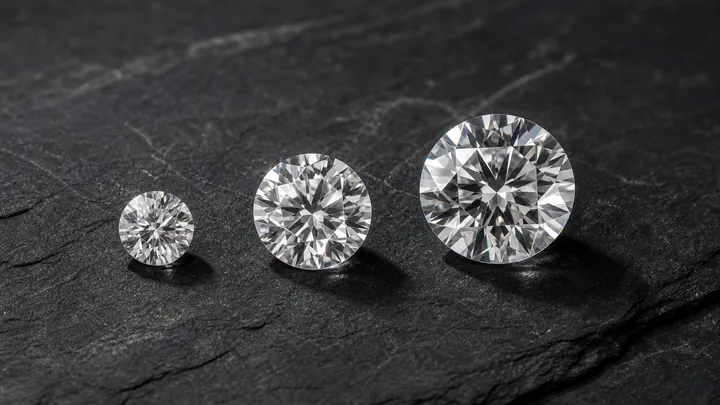
Straight answer at three carats
Short answer: buy the stone at manufacturer, cutting house or dealer level and commission the setting separately.
- It costs less, by published convention. Retail runs on keystone: a counter buys its three carat stones at that level and roughly doubles the price, a branded showroom runs to about three times, and margins between one trade level and the next are thin at 3 to 5 percent a hop. On a six figure stone that single doubling is the largest number in the deal.
- Better odds on the grade. Premium specification, meaning D to G colour with VS2 clarity or better, ran 52 percent of trade-access stock against 9 percent of retail-held stock, so the combination worth spending three carat money on is about five times more common a step up the chain.
- They do the rest of the work too. Setting a three carat centre, bespoke commissions, resizing, re-shanking, repairs, insurance valuations and trade-in, usually on their own bench. A retail counter mostly sends that work out to a bench like theirs.
Go to a showroom instead if the date is fixed and close, if trying a dozen finished mounts on a hand and walking out with one is how you will really decide, or if the name on the box matters to whoever will wear it.
The number, for the stone on its own: roughly R976,000 to R1,255,000 including VAT for a loose 3.00 carat round brilliant in G/VS1. Step across to H/VS1 and it is R817,000 to R1,050,000, to H/VS2 R737,000 to R948,000, and to I/SI1 R558,000 to R717,000. Chase D/VS1 and it is R1,395,000 to R1,793,000. That is the Rapaport round list of 20 March 2026 at the three carat bracket, taken at 10 to 30 percent off list, converted at R16.50 to the dollar with 15 percent VAT added, which is arithmetic you can redo at today’s rate. Loose round brilliant, stone only, so the setting is still to come. Note how far above three times the one carat that sits: the same G/VS1 arithmetic at one carat gives R71,500 to R92,000, because rarity rather than weight sets the rate per carat.
The number that surprises 3 carat buyers
Two rings can both say three carats on the certificate and sit several hundred thousand rand apart. The letters beside the carat number, not the carat number itself, decide the invoice, and at this weight each of those letters costs more than most people spend on an entire ring. That is why a 3 carat diamond ring price in South Africa is a band attached to a grade rather than one figure, and why a page that hands you a tidy number without naming the colour and clarity it applies to is guessing.
You can watch the effect at a weight where sellers actually publish. My July 2026 pricing pass covered 73 listed rows, 71 of them carrying a price, drawn from 18 sellers of which 17 are South African. At one carat, finished rings in premium showrooms ran from R105,000 to R428,000. That band sits on three listings of three different specifications and each figure includes the setting, so it describes what a showroom charges for a one carat ring rather than one stone priced four ways. Now apply that kind of variation across three carats, with a steeper per-carat rate underneath it.
Most buyers searching this phrase expect a single answer. What I have instead is two pieces of measured work at the sizes where this market actually publishes numbers, done in June and July 2026, and an honest way to build up from them towards the stone you want. I will also say clearly where the build stops being measurement and turns into arithmetic, because that line matters more at 3 carat than anywhere else on this site.
3 carat diamond ring price South Africa, built from real anchors
The loose-stone side is published arithmetic and it is set out at the top of this page. What no list can tell you is what a finished three carat ring sells for across a South African counter, so here are both anchors in the open, with the point marked where measurement stops.
The showroom figures are published as a band rather than as individual stones, deliberately. A band describes a market. A single stone with a single price describes one business, and that is not a thing this site publishes. The loose figures are not a survey at all, they are arithmetic on a published list, and they are labelled that way everywhere they appear.
| Including VAT | Figure | What it actually is |
|---|---|---|
| Loose G/VS1 round, 3.00 ct, list less 10 to 30 percent | R976,000 to R1,255,000 | arithmetic on the published Rapaport round list of 20 March 2026 at the three carat bracket, converted at R16.50 and VAT added. A bare stone, no setting |
| Loose G/VS1 round, 1.00 ct, list less 10 to 30 percent | R71,500 to R92,000 | the same arithmetic at the one carat bracket, shown so you can see how steeply the rate per carat climbs |
| Finished ring, one carat, premium South African showroom | R105,000 to R428,000 | three listings of three different specifications, from a 1.0 ct I/VS2 oval to a 1.04 ct G/VVS2. Rings including their settings |
They are not comparable line to line, and it would be dishonest to present them as though they were: one is a stone on its own, the other is a stone plus a mount plus a making charge plus a shop floor. What they show side by side is how much room there is between the level a diamond is bought at and the level it is sold at.
At 3 carat, two things happen at once. First, you are buying three times the weight. Second, large clean rough is far rarer, so the price per carat itself rises, often steeply above 2 carat. A 3 carat stone is not three 1 carat stones priced in a line, and multiplying the one carat figure by three would understate it badly.
The list prices that step for you rather than leaving it to a multiplier somebody invented. At G/VS1 the one carat arithmetic gives R71,500 to R92,000 and the three carat gives R976,000 to R1,255,000, which is nowhere near three times anything, and it is why the bands at the top of this page come from the three carat bracket itself. With the stone priced, the work left at this size is the decision underneath it: whether you buy the loose stone at trade level or the finished ring across a retail counter, because that single choice moves the total more than any grade discussed on this page.
Whatever the stone comes to, add the setting after it. The mounting on a 3 carat ring is usually a small fraction of the total, which is exactly the point: nearly all your money is in the diamond, so nearly all your attention belongs there too. If you want the method in full, our diamond price index for South Africa sets out how the showroom band was collected and where the list arithmetic comes from.
Why spec beats carat, especially at 3 carat
People shop carat because it is one number. The trade prices the four Cs together, and colour and clarity swing the figure harder than buyers expect.
My strongest evidence for that is not a price list, it is stock. In June 2026 I worked through 230 GIA-certified natural diamonds listed with full specification by six South African sellers, and counted how many met a premium specification, which I defined as D to G colour together with VS2 clarity or better. Among sellers working with trade access, 52 percent cleared that bar. Among stock physically held in South African retail, the figure was 9 percent. Same country, same laboratory, roughly a five-fold difference in the odds that the stone in the tray in front of you is a high-grade one.
That gap is the whole reason a cheap 3 carat quote is almost never a bargain. Nine stones in ten sitting in local retail are already below the premium line, so the default stone at any weight is a lower colour or a lower clarity, and the price follows it down. Multiply that across three carats and a higher per-carat rate, and a quiet step from E to H, or from IF to SI, moves a 3 carat invoice by several hundred thousand rand. The seller has not necessarily done anything underhanded. They have sold you the stone that fits the price you named. The same trap shows up smaller at 1 carat and 2 carat, but at 3 carat the rand cost of a downgrade you did not notice is brutal.
So when you compare two 3 carat quotes, do not compare the price. Compare the GIA report, line for line: colour, clarity, cut, polish, symmetry, fluorescence. If you cannot put two reports side by side, you are not comparing prices, you are comparing marketing.
The pricing trap nobody tells you about: the stone is somebody else’s
Here is the part of the South African market that catches serious buyers, and it matters more at 3 carat than anywhere.
Many of the sellers quoting you a 3 carat stone do not have one in the building. The stone lives in a global catalogue and only moves once your deposit does, so at 3 carat you are wiring six or seven figures against a certificate for a diamond nobody local has held, least of all you.
The specification on those listings usually reads well, and that is not an illusion. It reads well precisely because it was picked off a global feed rather than chosen from a tray somebody can open in Johannesburg, and it is the same reason trade-access inventory in the June sample reached 52 percent premium specification against 9 percent for stock held in local retail. Sourcing wide genuinely does find better stones. It just does not put one in your hand.
Which leaves two separate questions at 3 carat, and they get confused constantly. Where the stone is, and where the price is set.
On price, the mechanism is not mine and it is not a secret. The trade calls its own convention keystone: the counter price is roughly double the trade cost, and a branded showroom runs to roughly three times. Between one trade level and the next, margins are slim, usually 3 to 5 percent on each hand-off. So the mark-up is not spread evenly along the chain. It is several small steps and then one large one, and the large one happens on the final hop, when the stone leaves the trade and reaches a retail counter. That is the mechanism that puts about R82,000 of list arithmetic for a loose one carat G/VS1 at one end and R105,000 to R428,000 of showroom ring at the other. Neither figure is dishonest and neither is the other one’s like-for-like: the first is a bare stone derived from a published list, the second is a finished ring including its setting across three differently specified listings. They describe different points on the same chain.
At 3 carat, keystone is a percentage applied to a six-figure base, which makes it the single largest line on the invoice. It is worth knowing which side of that line your quote came from before you spend an evening arguing about a clarity grade.
Why a 3 carat stone belongs somewhere you can stand
This is the size where I stop recommending the convenient option and start recommending the verifiable one. At 1 carat you can absorb the risk of a stone you never inspected. At 3 carat you cannot, because a hidden colour or clarity downgrade here is a six-figure error. The single most useful move is to buy where the diamond is physically held, from someone who can put it in your hand under proper light before the money moves.
Finding those sellers is the part nobody explains, and the standard advice is wrong. Searching for a diamond dealer, or for diamond wholesalers in Johannesburg, returns almost nothing you can act on, and hardly anyone runs those searches in the first place. Search the price question instead. Anyone working at trade level and comfortable being compared publishes a per-carat number, so queries along the lines of diamond price per carat South Africa, or simply 1 carat diamond price, surface the sellers who are willing to put figures on a page. Someone who publishes a rate at one carat will generally quote you a rate at three. Someone who publishes nothing and wants your phone number first has also told you something.
The diamond buying checklist covers what to verify once you are actually standing in front of a stone this size.
Honest market context, not a ranking: there are fine traditional retail jewellers in Johannesburg and Cape Town who will happily sell you a beautiful 3 carat ring, and some are excellent. Their margins at this size are simply larger, and most are selling you a stone they sourced in rather than cut. That is the trade-off you are weighing.
The 3 carat spec I would actually ask for
If you want a starting point to quote against, this is the practical brief I would hand a seller:
Natural 3.00 ct round brilliant, G to H colour, VS2 to SI1 clarity if genuinely eye-clean, GIA Excellent cut, polish and symmetry, none or faint fluorescence, GIA report number supplied before the appointment.
Hold the cut quality first. If the budget is tight, step down a grade of colour, from G to H, before you accept a weaker cut, because cut is what makes a 3 carat stone come alive in real light. A perfectly graded stone with a mediocre cut looks dead on the hand, and at 3 carat that flatness is impossible to hide.
On lab-grown at 3 carat
Three carats is where lab-grown looks most tempting, because the size for the money is dramatic. What that money does afterwards is the part to think about. Lab-grown prices have fallen very steeply since the trade began tracking them and are still falling, with published estimates of the fall running from about 70 percent to 96 percent depending on the base year and the size measured. The secondhand market behind that is thin: where a buyer can be found at all, published estimates of resale sit at somewhere between 10 and 40 percent, on estimates that disagree sharply with each other, of purchase price, and plenty of jewellers will not take one back. So at 3 carat you are buying presence on the hand today, with the replacement cost sliding underneath you. If everyone involved understands that, it is a defensible choice. If the ring is meant to hold worth, a smaller natural GIA stone stands a better chance of it than a larger lab-grown one.
Setting two 3 carat quotes against each other
At six figures a bundled number is not a price, it is a summary, and it hides the three things you are separately paying for: the diamond, the setting, and the margin on both. So make every seller itemise. The loose stone on its own line with its GIA report number attached, the mount on a second line, VAT already inside the total, and any sourcing or import cost named rather than absorbed. Then take the diamond buying checklist to the replies and read the process instead of the letterhead. Has anyone at that business physically had this stone in their hands. On what date can I look at it in ordinary daylight rather than under a display lamp. If it does not match its report when it lands, who pays to send it back. A 3 carat diamond shows every fault it has and a 3 carat invoice hides every fault it has, which is why the seller worth your deposit is the one whose answers get more specific as the number gets bigger, not vaguer.
Before you pay for a 3 carat ring
- Get the GIA report number first, and verify it yourself at gia.edu/report-check.
- Compare quotes on the report, line for line, not on the price.
- Ask directly: do you own this stone, or are you sourcing it in? Can I inspect it in person before I pay?
- Confirm whether the price includes VAT and any import cost.
- Ask what the large-stone premium looks like at this weight. The rate per carat climbs above 2 carat, and anyone genuinely working at this size can tell you roughly how much of your quote is that premium rather than three times a one carat rate.
At 3 carat, “how much” is a band attached to a grade rather than one number floating free, and the bands are at the top of this page. Fix the spec, know who chose and checked the stone, and make sure you actually see it. Get those three right and the price becomes something you can check rather than something you have to accept.